
Mindmap
Psychology
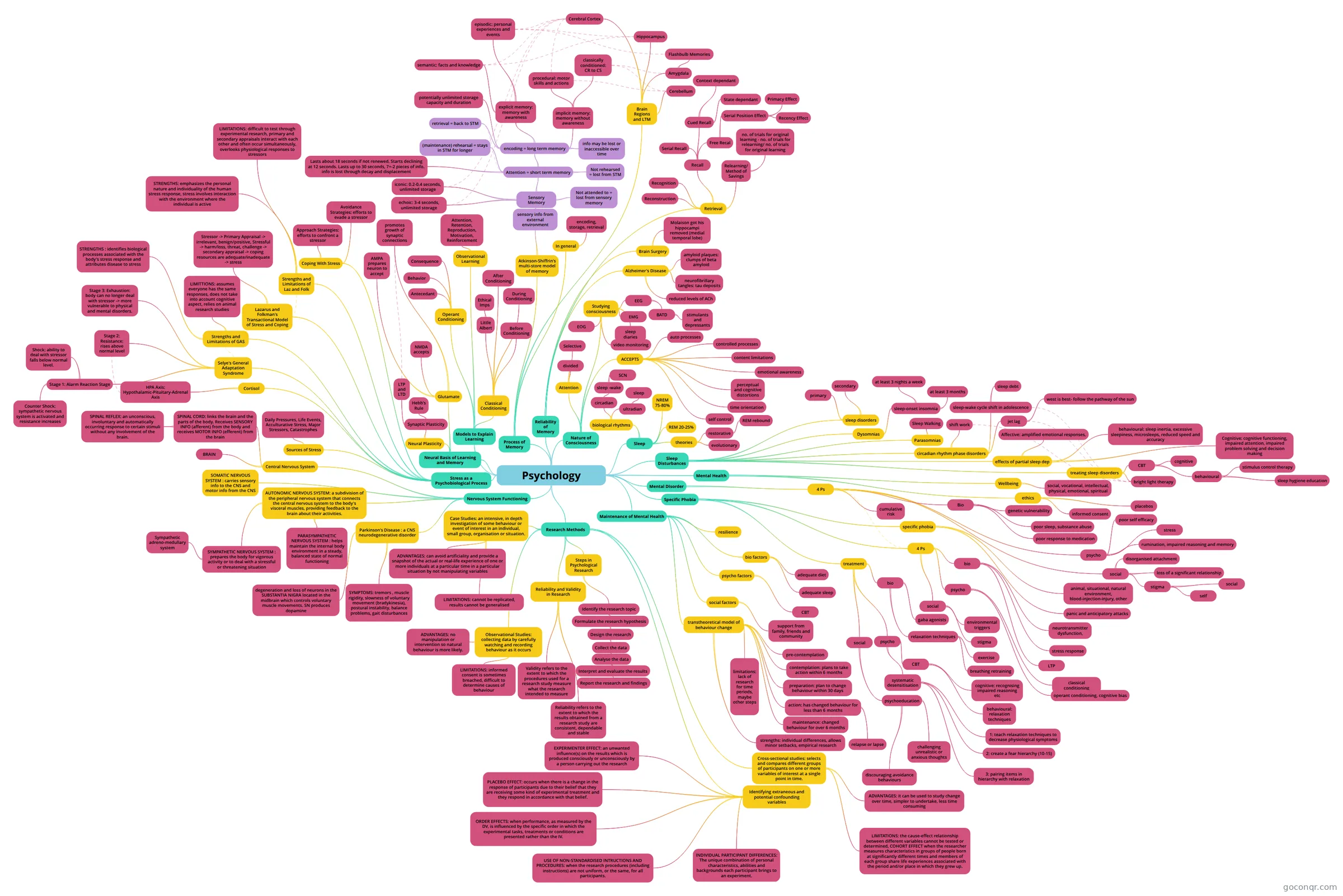
Mind map: Psychology
Inhalt der Mindmap
Psychology
Research Methods
- Steps in Psychological Research
- Identify the research topic
- Formulate the research hypothesis
- Design the research
- Collect the data
- Analyse the data
- Interpret and evaluate the results
- Report the research and findings
- Interpret and evaluate the results
- Analyse the data
- Collect the data
- Design the research
- Formulate the research hypothesis
- Identify the research topic
- Identifying extraneous and potential confounding variables
- INDIVIDUAL PARTICIPANT DIFFERENCES: The unique combination of personal characteristics, abilities and backgrounds each participant brings to an experiment.
- USE OF NON-STANDARDISED INTRUCTIONS AND PROCEDURES: when the research procedures (including instructions) are not uniform, or the same, for all participants.
- ORDER EFFECTS: when performance, as measured by the DV, is influenced by the specific order in which the experimental tasks, treatments or conditions are presented rather than the IV.
- EXPERIMENTER EFFECT: an unwanted influence(s) on the results which is produced consciously or unconsciously by a person carrying out the research
- PLACEBO EFFECT: occurs when there is a change in the response of participants due to their belief that they are receiving some kind of experimental treatment and they respond in accordance with that belief.
- Cross-sectional studies: selects and compares different groups of participants on one or more variables of interest at a single point in time.
- ADVANTAGES: it can be used to study change over time, simpler to undertake, less time consuming
- LIMITATIONS: the cause-effect relationship between different variables cannot be tested or determined, COHORT EFFECT when the researcher measures characteristics in groups of people born at significantly different times and members of each group share life experiences associated with the period and/or place in which they grew up.
- Case Studies: an intensive, in depth investigation of some behaviour or event of interest in an individual, small group, organisation or situation.
- ADVANTAGES: can avoid artificiality and provide a snapshot of the actual or real-life experience of one or more individuals at a particular time in a particular situation by not manipulating variables
- LIMITATIONS: cannot be replicated, results cannot be generalised
- Observational Studies: collecting data by carefully watching and recording behaviour as it occurs
- ADVANTAGES: no manipulation or intervention so natural behaviour is more likely.
- LIMITATIONS: informed consent is sometimes breached, difficult to determine causes of behaviour
- Reliability and Validity in Research
- Reliability refers to the extent to which the results obtained from a research study are consistent, dependable and stable
- Validity refers to the extent to which the procedures used for a research study measure what the research intended to measure
- Steps in Psychological Research
Nervous System Functioning
- Central Nervous System
- BRAIN
- SPINAL CORD: links the brain and the parts of the body. Receives SENSORY INFO (afferent) from the body and receives MOTOR INFO (efferent) from the brain
- SPINAL REFLEX: an unconscious, involuntary and automatically occurring response to certain stimuli without any involvement of the brain.
- AUTONOMIC NERVOUS SYSTEM: a subdivision of the peripheral nervous system that connects the central nervous system to the body's visceral muscles, providing feedback to the brain about their activities.
- SYMPATHETIC NERVOUS SYSTEM : prepares the body for vigorous activity or to deal with a stressful or threatening situation
- Sympathetic adreno-medullary system
- PARASYMPATHETIC NERVOUS SYSTEM : helps maintain the internal body environment in a steady, balanced state of normal functioning
- SYMPATHETIC NERVOUS SYSTEM : prepares the body for vigorous activity or to deal with a stressful or threatening situation
- Parkinson's Disease : a CNS neurodegenerative disorder
- degeneration and loss of neurons in the SUBSTANTIA NIGRA located in the midbrain which controls voluntary muscle movements. SN produces dopamine
- SYMPTOMS: tremors , muscle rigidity, slowness of voluntary movement (bradykinesia), postural instability, balance problems, gait disturbances
- SOMATIC NERVOUS SYSTEM : carries sensory info to the CNS and motor info from the CNS
- Central Nervous System
Stress as a Psychobiological Process
- Sources of Stress
- Daily Pressures, Life Events, Acculturative Stress, Major Stressors, Catastrophes
- Cortisol
- HPA Axis: Hypothalamic-Pituitary-Adrenal Axis
- Selye's General Adaptation Syndrome
- Stage 1: Alarm Reaction Stage
- Shock: ability to deal with stressor falls below normal level.
- Counter Shock: sympathetic nervous system is activated and resistance increases
- Stage 2: Resistance: rises above normal level
- Stage 3: Exhaustion: body can no longer deal with stressor -> more vulnerable to physical and mental disorders.
- Stage 1: Alarm Reaction Stage
- Strengths and Limitations of GAS
- STRENGTHS : identifies biological processes associated with the body's stress response and attributes disease to stress
- LIMITTIONS: assumes everyone has the same responses, does not take into account cognitive aspect, relies on animal research studies
- Lazarus and Folkman's Transactional Model of Stress and Coping
- Stressor -> Primary Appraisal -> irrelevant, benign/positive, Stressful -> harm/loss, threat, challenge -> secondary appraisal -> coping resources are adequate/inadequate -> stress
- Strengths and Limitations of Laz and Folk
- STRENGTHS: emphasizes the personal nature and individuality of the human stress response, stress involves interaction with the environment where the individual is active
- LIMITATIONS: difficult to test through experimental research, primary and secondary appraisals interact with each other and often occur simultaneously, overlooks physiological responses to stressors
- Coping With Stress
- Approach Strategies: efforts to confront a stressor
- Avoidance Strategies: efforts to evade a stressor
- Sources of Stress
Neural Basis of Learning and Memory
- Neural Plasticity
- Synaptic Plasticity
- Hebb's Rule
- LTP and LTD
- Synaptic Plasticity
- Glutamate
- promotes growth of synaptic connections
- AMPA prepares neuron to accept
- NMDA accepts
- Neural Plasticity
Models to Explain Learning
- Classical Conditioning
- Before Conditioning
- During Conditioning
- After Conditioning
- Little Albert
- Ethical Imps
- Operant Conditioning
- Antecedant
- Behavior
- Consequence
- Observational Learning
- Attention, Retention, Reproduction, Motivation, Reinforcement
- Classical Conditioning
Process of Memory
- In general
- encoding, storage, retrieval
- Atkinson-Shiffrin's multi-store model of memory
- sensory info from external environment
- Sensory Memory
- Not attended to = lost from sensory memory
- Attention = short term memory
- (maintenance) rehearsal = stays in STM for longer
- Not rehearsed = lost from STM
- encoding = long term memory
- info may be lost or inaccessible over time
- retrieval = back to STM
- potentially unlimited storage capacity and duration
- explicit memory: memory with awareness
- semantic: facts and knowledge
- episodic: personal experiences and events
- implicit memory: memory without awareness
- procedural: motor skills and actions
- classically conditioned: CR to CS
- Lasts about 18 seconds if not renewed. Starts declining at 12 seconds. Lasts up to 30 seconds, 7+-2 pieces of info. info is lost through decay and displacement
- iconic: 0.2-0.4 seconds, unlimited storage
- echoic: 3-4 seconds, unlimited storage
- Sensory Memory
- sensory info from external environment
- Brain Regions and LTM
- Cerebral Cortex
- Hippocampus
- Amygdala
- Flashbulb Memories
- Cerebellum
- In general
Reliability of Memory
- Retrieval
- Recall
- Free Recal
- Serial Position Effect
- Primacy Effect
- Recency Effect
- Serial Position Effect
- Serial Recall
- Cued Recall
- Context dependant
- State dependant
- Free Recal
- Recognition
- Relearning/ Method of Savings
- no. of trials for original learning - no. of trials for relearning/ no. of trials for original learning
- Reconstruction
- Recall
- Brain Surgery
- Molaison got his hippocampi removed (medial temporal lobe)
- Alzheimer's Disease
- amyloid plaques: clumps of beta amyloid
- neurofibrillary tangles: tau deposits
- reduced levels of ACh
- Retrieval
Nature of Consciousness
- Attention
- Selective
- divided
- Studying consciousness
- EEG
- BATD
- stimulants and depressants
- BATD
- EMG
- sleep diaries
- video monitoring
- EOG
- EEG
- ACCEPTS
- auto processes
- controlled processes
- content limitations
- emotional awareness
- perceptual and cognitive distortions
- time orientation
- self control
- Attention
Sleep
- biological rhythms
- circadian
- sleep -wake
- SCN
- sleep -wake
- ultradian
- sleep
- circadian
- NREM 75-80%
- REM 20-25%
- theories
- restorative
- REM rebound
- evolutionary
- restorative
- biological rhythms
Mental Health
- Wellbeing
- social, vocational, intellectual, physical, emotional, spiritual
- ethics
- informed consent
- placebos
- Wellbeing
Sleep Disturbances
- sleep disorders
- primary
- secondary
- Dysomnias
- sleep-onset insomnia
- at least 3 nights a week
- at least 3 months
- sleep-onset insomnia
- Parasomnias
- Sleep Walking
- circadian rhythm phase disorders
- sleep-wake cycle shift in adolescence
- sleep debt
- shift work
- jet lag
- west is best- follow the pathway of the sun
- sleep-wake cycle shift in adolescence
- effects of partial sleep dep
- Affective: amplified emotional responses,
- behavioural: sleep inertia, excessive sleepiness, microsleeps, reduced speed and accuracy
- Cognitive: cognitive functioning, impaired attention, impaired problem solving and decision making
- treating sleep disorders
- CBT
- cognitive
- behavioural
- stimulus control therapy
- sleep hygiene education
- bright light therapy
- CBT
- sleep disorders
Mental DIsorder
- 4 Ps
- Bio
- genetic vulnerability
- poor sleep, substance abuse
- poor response to medication
- psycho
- poor self efficacy
- stress
- rumination, impaired reasoning and memory
- social
- disorganised attachment
- loss of a significant relationship
- stigma
- social
- self
- cumulative risk
- Bio
- 4 Ps
Specific Phobia
- specific phobia
- animal, situational, natural environment, blood-injection-injury, other
- panic and anticipatory attacks
- 4 Ps
- bio
- neurotransmitter dysfunction,
- stress response
- LTP
- psycho
- classical conditioning
- operant conditioning, cognitive bias
- social
- environmental triggers
- stigma
- bio
- treatment
- bio
- gaba agonists
- relaxation techniques
- breathing retraining
- exercise
- psycho
- CBT
- cognitive: recognising impaired reasoning etc
- behavioural: relaxation techniques
- systematic desensitisation
- 1: teach relaxation techniques to decrease physiological symptoms
- 2: create a fear hierarchy (10-15)
- 3: pairing items in hierarchy with relaxation
- CBT
- social
- psychoeducation
- challenging unrealistic or anxious thoughts
- discouraging avoidance behaviours
- psychoeducation
- bio
- specific phobia
Maintenance of Mental Health
- resilience
- bio factors
- adequate diet
- adequate sleep
- psycho factors
- CBT
- social factors
- support from family, friends and community
- transtheoretical model of behaviour change
- pre-contemplation
- contemplation: plans to take action within 6 months
- preparation: plan to change behaviour within 30 days
- action: has changed behaviour for less than 6 months
- relapse or lapse
- maintenance: changed behaviour for over 6 months
- strengths: individual differences, allows minor setbacks, empirical research
- limitations: lack of research for time periods, maybe other steps
Informationen
- Beschreibung
- Mindmap am Psychology, erstellt von Serena Haiding am 16/10/2017.
- Erstellt von
- Serena Haiding
- Aufrufe
- 1
- Bewertung