
Mindmap
The post-Stalin thaw
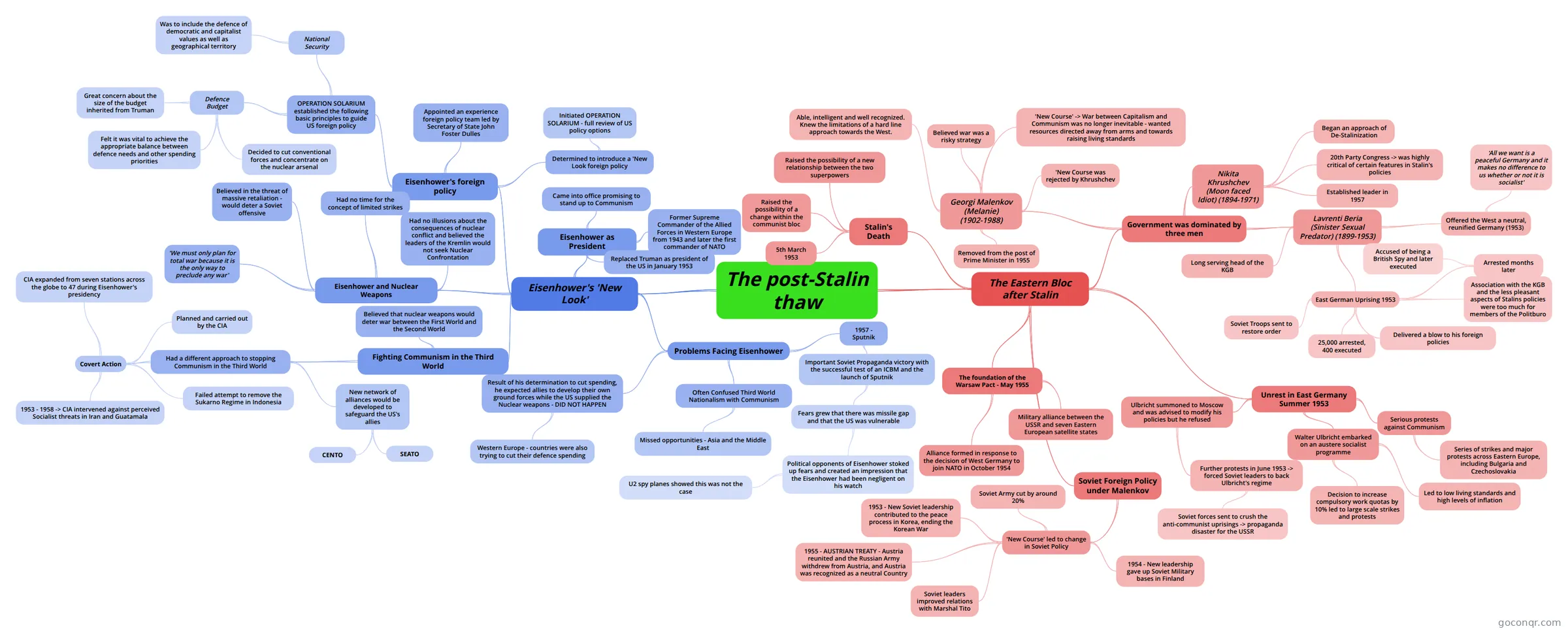
Mind map: The post-Stalin thaw
Inhalt der Mindmap
The post-Stalin thaw
The Eastern Bloc after Stalin
- Stalin's Death
- 5th March 1953
- Raised the possibility of a change within the communist bloc
- Raised the possibility of a new relationship between the two superpowers
- Government was dominated by three men
- Georgi Malenkov (Melanie) (1902-1988)
- Able, intelligent and well recognized. Knew the limitations of a hard line approach towards the West.
- 'New Course' -> War between Capitalism and Communism was no longer inevitable - wanted resources directed away from arms and towards raising living standards
- Believed war was a risky strategy
- 'New Course was rejected by Khrushchev
- Removed from the post of Prime Minister in 1955
- Lavrenti Beria (Sinister Sexual Predator) (1899-1953)
- Long serving head of the KGB
- Offered the West a neutral, reunified Germany (1953)
- 'All we want is a peaceful Germany and it makes no difference to us whether or not it is socialist'
- East German Uprising 1953
- Soviet Troops sent to restore order
- 25,000 arrested, 400 executed
- Delivered a blow to his foreign policies
- Association with the KGB and the less pleasant aspects of Stalins policies were too much for members of the Politburo
- Arrested months later
- Accused of being a British Spy and later executed
- Nikita Khrushchev (Moon faced Idiot) (1894-1971)
- Established leader in 1957
- 20th Party Congress -> was highly critical of certain features in Stalin's policies
- Began an approach of De-Stalinization
- Georgi Malenkov (Melanie) (1902-1988)
- Unrest in East Germany Summer 1953
- Serious protests against Communism
- Series of strikes and major protests across Eastern Europe, including Bulgaria and Czechoslovakia
- Walter Ulbricht embarked on an austere socialist programme
- Led to low living standards and high levels of inflation
- Decision to increase compulsory work quotas by 10% led to large scale strikes and protests
- Ulbricht summoned to Moscow and was advised to modify his policies but he refused
- Further protests in June 1953 -> forced Soviet leaders to back Ulbricht's regime
- Soviet forces sent to crush the anti-communist uprisings -> propaganda disaster for the USSR
- Further protests in June 1953 -> forced Soviet leaders to back Ulbricht's regime
- Serious protests against Communism
- The foundation of the Warsaw Pact - May 1955
- Military alliance between the USSR and seven Eastern European satellite states
- Alliance formed in response to the decision of West Germany to join NATO in October 1954
- Soviet Foreign Policy under Malenkov
- 'New Course' led to change in Soviet Policy
- 1953 - New Soviet leadership contributed to the peace process in Korea, ending the Korean War
- 1954 - New leadership gave up Soviet Military bases in Finland
- Soviet leaders improved relations with Marshal Tito
- 1955 - AUSTRIAN TREATY - Austria reunited and the Russian Army withdrew from Austria, and Austria was recognized as a neutral Country
- Soviet Army cut by around 20%
- 'New Course' led to change in Soviet Policy
- Stalin's Death
Eisenhower's 'New Look'
- Eisenhower as President
- Replaced Truman as president of the US in January 1953
- Former Supreme Commander of the Allied Forces in Western Europe from 1943 and later the first commander of NATO
- Came into office promising to stand up to Communism
- Eisenhower's foreign policy
- Determined to introduce a 'New Look foreign policy
- Initiated OPERATION SOLARIUM - full review of US policy options
- Appointed an experience foreign policy team led by Secretary of State John Foster Dulles
- OPERATION SOLARIUM established the following basic principles to guide US foreign policy
- National Security
- Was to include the defence of democratic and capitalist values as well as geographical territory
- Defence Budget
- Great concern about the size of the budget inherited from Truman
- Felt it was vital to achieve the appropriate balance between defence needs and other spending priorities
- Decided to cut conventional forces and concentrate on the nuclear arsenal
- National Security
- Determined to introduce a 'New Look foreign policy
- Eisenhower and Nuclear Weapons
- Had no illusions about the consequences of nuclear conflict and believed the leaders of the Kremlin would not seek Nuclear Confrontation
- Had no time for the concept of limited strikes
- Believed in the threat of massive retaliation - would deter a Soviet offensive
- 'We must only plan for total war because it is the only way to preclude any war'
- Fighting Communism in the Third World
- Believed that nuclear weapons would deter war between the First World and the Second World
- Had a different approach to stopping Communism in the Third World
- Covert Action
- Planned and carried out by the CIA
- CIA expanded from seven stations across the globe to 47 during Eisenhower's presidency
- 1953 - 1958 -> CIA intervened against perceived Socialist threats in Iran and Guatamala
- Failed attempt to remove the Sukarno Regime in Indonesia
- New network of alliances would be developed to safeguard the US's allies
- CENTO
- SEATO
- Covert Action
- Problems Facing Eisenhower
- Result of his determination to cut spending, he expected allies to develop their own ground forces while the US supplied the Nuclear weapons - DID NOT HAPPEN
- Western Europe - countries were also trying to cut their defence spending
- Often Confused Third World Nationalism with Communism
- Missed opportunities - Asia and the Middle East
- 1957 - Sputnik
- Important Soviet Propaganda victory with the successful test of an ICBM and the launch of Sputnik
- Fears grew that there was missile gap and that the US was vulnerable
- Political opponents of Eisenhower stoked up fears and created an impression that the Eisenhower had been negligent on his watch
- U2 spy planes showed this was not the case
- Political opponents of Eisenhower stoked up fears and created an impression that the Eisenhower had been negligent on his watch
- Fears grew that there was missile gap and that the US was vulnerable
- Important Soviet Propaganda victory with the successful test of an ICBM and the launch of Sputnik
- Result of his determination to cut spending, he expected allies to develop their own ground forces while the US supplied the Nuclear weapons - DID NOT HAPPEN
- Eisenhower as President
Informationen
- Beschreibung
- History Mindmap am The post-Stalin thaw, erstellt von ZIButler am 30/05/2013.
- Erstellt von
- ZIButler
- Aufrufe
- 365
- Tags
- Bewertung