
Mindmap
Self Report

Inhalt der Mindmap
Self Report
Questionnaire
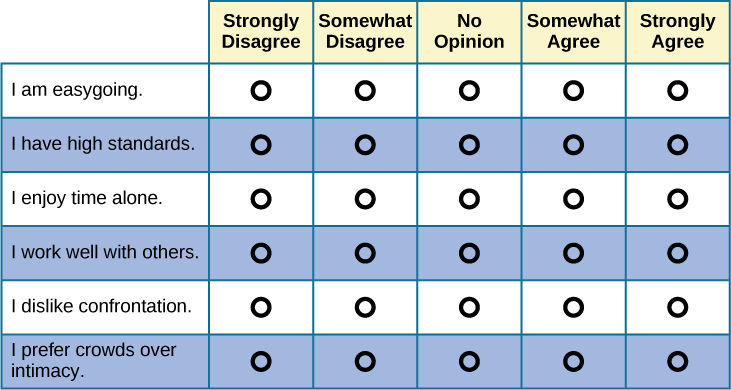
- A Questionnaire is a research instrument composed of a series of questions designed to gather information about a certain topic. It can be administered via paper and pencil, where respondents simply fill out a survey form and send it back by mail or other means.
- Strengths and Weaknesses
- + Can be mathematically analysed
- + Can be replicated and get a wide range of data
- - Can be subject to social desirability and answers may not be truthful
- Sample bias because questionnaire can only be filled out by literate people with time to do it
- Writing good questions: Questions should be clear and not ambiguous, also questions must be non biased and have no leading questions
- Open questions: These invite respondents to provide their own answer rather then to select one, this leads to producing qualitative data
- + Can provide rich detail, giving the researcher new insights
- - Difficult to analyse as there are numerous different answers
- Closed questions: These have a range of questions in which respondents select one
- + They produce Quantitative data
- - Respondents may be forced to select answers that do not represent real thoughts or behaviour
- Open questions: These invite respondents to provide their own answer rather then to select one, this leads to producing qualitative data
- Strengths and Weaknesses
- Writing good questionnaire and interviews:
- Questions should be unthreatening and easy to answer, more challenging questions will be asked once trust is established
- Filler questions may be used that disguise the true aims of the questionnaire/ interview so respondents are more likely to be honest
- Sampling techniques are important in obtaining data because they aim avoid bias, a quota might try to avoid bias by choosing a certain age or social class group
- A pilot study enables questions to be tested on small groups, to refine questions if they provide any difficulty
- A Questionnaire is a research instrument composed of a series of questions designed to gather information about a certain topic. It can be administered via paper and pencil, where respondents simply fill out a survey form and send it back by mail or other means.
Interview
- Unstructured interviews: The questions are unplanned and are usually guided by the participants response
- Strengths and Weaknesses
- + More detailed info can be collected because interviewer can deal with incomplete answers
- + Can access extra info because questions develop according to respondents answer
- - More like to be effected by interviewer bias
- - Requires trained interviewers who can develop insightful unbiased questions on the spot and avoid interviewer bias
- Strengths and Weaknesses
- Structured interviews: These are questions provided in advance and is the same for all participants
- Strengths and Weaknesses
- + Easily repeated
- + Easier to analyse
- - Answers may not be truthful because of leading questions or social desirability bias
- - Answers may be influenced by the way the interviewer asks the question ( interview bias)
- Strengths and Weaknesses
- Unstructured interviews: The questions are unplanned and are usually guided by the participants response
Validity
- Internal validity may be threatened by social desirability bias, leading questions and or interviewer bias
- Internal validity also concerns whether the questionnaire/ interview is measuring what its intended to measure, this can be established by using concurrent validity
- External validity concerns the representativeness of the sample which affects the ability to generalise findings to other people and situations ( affects of population validity and ecological validity)
Reliability
- Internal reliability concerns the consistency of questions used throughout the interview or questionnaire / psychological test.
- To assess the internal reliability the split-half method can be used ( scores responses on both halves of the tests should be consistent)
- Internal reliability also concerns the extent to which two interviewers produce the same outcome for an interview, this is called inter- interviewer reliability
- To assess external reliability the test-retest method can be used when the same questionnaire/interview is used and repeated with the same respondent a few weeks apart, scores responses should be consistent
- Internal reliability concerns the consistency of questions used throughout the interview or questionnaire / psychological test.
Bilder und Dateien der Mindmap


Informationen
- Beschreibung
- To be finished by Wednesday the 29th
- Erstellt von
- Ted Ball
- Aufrufe
- 20
- Bewertung