
Mindmap
DD303 Concepts
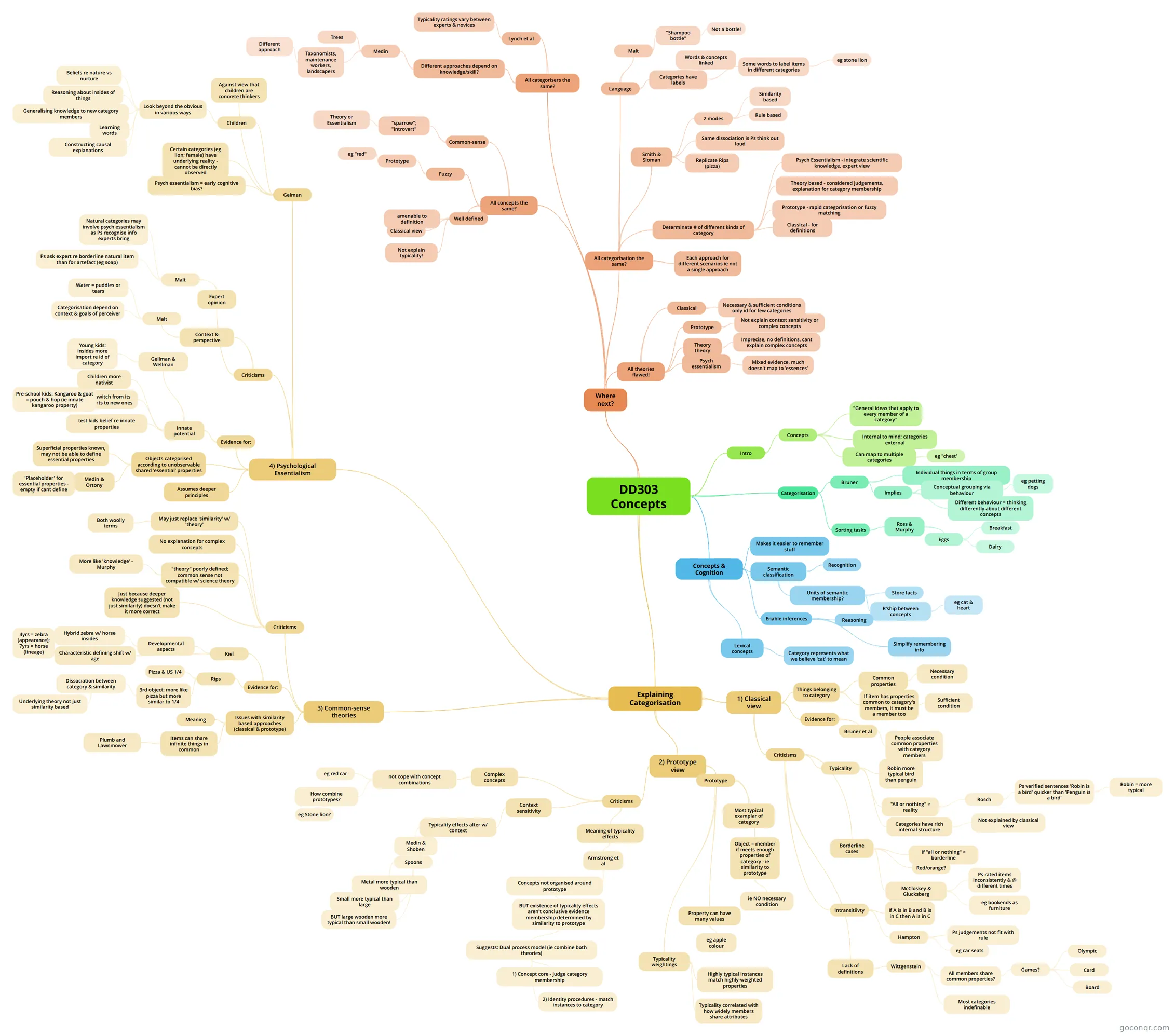
Mind map: DD303 concepts
Inhalt der Mindmap
DD303 Concepts
Intro
- Concepts
- "General ideas that apply to every member of a category"
- Internal to mind; categories external
- Can map to multiple categories
- eg "chest'
- Concepts
Categorisation
- Bruner
- Individual things in terms of group membership
- Implies
- Conceptual grouping via behaviour
- eg petting dogs
- Different behaviour = thinking differently about different concepts
- Conceptual grouping via behaviour
- Sorting tasks
- Ross & Murphy
- Eggs
- Breakfast
- Dairy
- Eggs
- Ross & Murphy
- Bruner
Concepts & Cognition
- Makes it easier to remember stuff
- Semantic classification
- Recognition
- Units of semantic membership?
- Store facts
- R'ship between concepts
- eg cat & heart
- Enable inferences
- Reasoning
- Simplify remembering info
- Lexical concepts
- Category represents what we believe 'cat' to mean
Explaining Categorisation
- 1) Classical view
- Things belonging to category
- Common properties
- Necessary condition
- If item has properties common to category's members, it must be a member too
- Sufficient condition
- Common properties
- Evidence for:
- Bruner et al
- People associate common properties with category members
- Bruner et al
- Criticisms
- Typicality
- Robin more typical bird than penguin
- "All or nothing" ≠ reality
- Rosch
- Ps verified sentences 'Robin is a bird' quicker than 'Penguin is a bird'
- Robin = more typical
- Ps verified sentences 'Robin is a bird' quicker than 'Penguin is a bird'
- Rosch
- Categories have rich internal structure
- Not explained by classical view
- Borderline cases
- If "all or nothing" ≠ borderline
- Red/orange?
- McCloskey & Glucksberg
- Ps rated items inconsistently & @ different times
- eg bookends as furniture
- Intransitiivty
- If A is in B and B is in C then A is in C
- Hampton
- Ps judgements not fit with rule
- eg car seats
- Lack of definitions
- Wittgenstein
- All members share common properties?
- Games?
- Olympic
- Card
- Board
- Games?
- Most categories indefinable
- All members share common properties?
- Wittgenstein
- Typicality
- Things belonging to category
- 2) Prototype view
- Prototype
- Most typical examplar of category
- Object = member if meets enough properties of category - ie similarity to prototype
- ie NO necessary condition
- Property can have many values
- eg apple colour
- Typicality weightings
- Highly typical instances match highly-weighted properties
- Typicality correlated with how widely members share attributes
- Criticisms
- Meaning of typicality effects
- Armstrong et al
- Concepts not organised around prototype
- BUT existence of typicality effects aren't conclusive evidence membership determined by similarity to prototype
- Suggests: Dual process model (ie combine both theories)
- 1) Concept core - judge category membership
- 2) Identity procedures - match instances to category
- Suggests: Dual process model (ie combine both theories)
- BUT existence of typicality effects aren't conclusive evidence membership determined by similarity to prototype
- Concepts not organised around prototype
- Armstrong et al
- Context sensitivity
- Typicality effects alter w/ context
- Medin & Shoben
- Spoons
- Metal more typical than wooden
- Small more typical than large
- BUT large wooden more typical than small wooden!
- Spoons
- Medin & Shoben
- Typicality effects alter w/ context
- Complex concepts
- not cope with concept combinations
- eg red car
- How combine prototypes?
- eg Stone lion?
- not cope with concept combinations
- Meaning of typicality effects
- Prototype
- 3) Common-sense theories
- Issues with similarity based approaches (classical & prototype)
- Meaning
- Items can share infinite things in common
- Plumb and Lawnmower
- Evidence for:
- Rips
- Pizza & US 1/4
- 3rd object: more like pizza but more similar to 1/4
- Dissociation between category & similarity
- Underlying theory not just similarity based
- Dissociation between category & similarity
- Kiel
- Developmental aspects
- Hybrid zebra w/ horse insides
- 4yrs = zebra (appearance); 7yrs = horse (lineage)
- Hybrid zebra w/ horse insides
- Characteristic defining shift w/ age
- Developmental aspects
- Rips
- Criticisms
- Just because deeper knowledge suggested (not just similarity) doesn't make it more correct
- "theory" poorly defined; common sense not compatible w/ science theory
- More like 'knowledge' - Murphy
- No explanation for complex concepts
- May just replace 'similarity' w/ 'theory'
- Both woolly terms
- Issues with similarity based approaches (classical & prototype)
- 4) Psychological Essentialism
- Assumes deeper principles
- Objects categorised according to unobservable shared 'essential' properties
- Superficial properties known, may not be able to define essential properties
- Medin & Ortony
- 'Placeholder' for essential properties - empty if cant define
- Evidence for:
- Innate potential
- test kids belief re innate properties
- Animal switch from its bio parents to new ones
- Pre-school kids: Kangaroo & goat = pouch & hop (ie innate kangaroo property)
- Children more nativist
- Gellman & Wellman
- Young kids: insides more import re id of category
- Innate potential
- Criticisms
- Context & perspective
- Malt
- Categorisation depend on context & goals of perceiver
- Water = puddles or tears
- Malt
- Expert opinion
- Malt
- Ps ask expert re borderline natural item than for artefact (eg soap)
- Natural categories may involve psych essentialism as Ps recognise info experts bring
- Malt
- Context & perspective
- Gelman
- Children
- Look beyond the obvious in various ways
- Learning words
- Generalising knowledge to new category members
- Reasoning about insides of things
- Beliefs re nature vs nurture
- Constructing causal explanations
- Look beyond the obvious in various ways
- Certain categories (eg lion; female) have underlying reality - cannot be directly observed
- Psych essentialism = early cognitive bias?
- Against view that children are concrete thinkers
- Children
- 1) Classical view
Where next?
- All theories flawed!
- Classical
- Necessary & sufficient conditions only id for few categories
- Prototype
- Not explain context sensitivity or complex concepts
- Theory theory
- Imprecise, no definitions, cant explain complex concepts
- Psych essentialism
- Mixed evidence, much doesn't map to 'essences'
- Classical
- All categorisation the same?
- Each approach for different scenarios ie not a single approach
- Determinate # of different kinds of category
- Classical - for definitions
- Prototype - rapid categorisation or fuzzy matching
- Theory based - considered judgements, explanation for category membership
- Psych Essentialism - integrate scientific knowledge, expert view
- Smith & Sloman
- Replicate Rips (pizza)
- Same dissociation is Ps think out loud
- 2 modes
- Similarity based
- Rule based
- Language
- Categories have labels
- Words & concepts linked
- Some words to label items in different categories
- eg stone lion
- Malt
- "Shampoo bottle"
- Not a bottle!
- "Shampoo bottle"
- Categories have labels
- All concepts the same?
- Well defined
- amenable to definition
- Classical view
- Not explain typicality!
- Fuzzy
- Prototype
- eg "red"
- Prototype
- Common-sense
- "sparrow"; "introvert"
- Theory or Essentialism
- "sparrow"; "introvert"
- Well defined
- All categorisers the same?
- Different approaches depend on knowledge/skill?
- Medin
- Trees
- Taxonomists, maintenance workers, landscapers
- Different approach
- Medin
- Lynch et al
- Typicality ratings vary between experts & novices
- Different approaches depend on knowledge/skill?
- All theories flawed!