
Mindmap
Nazi Germany
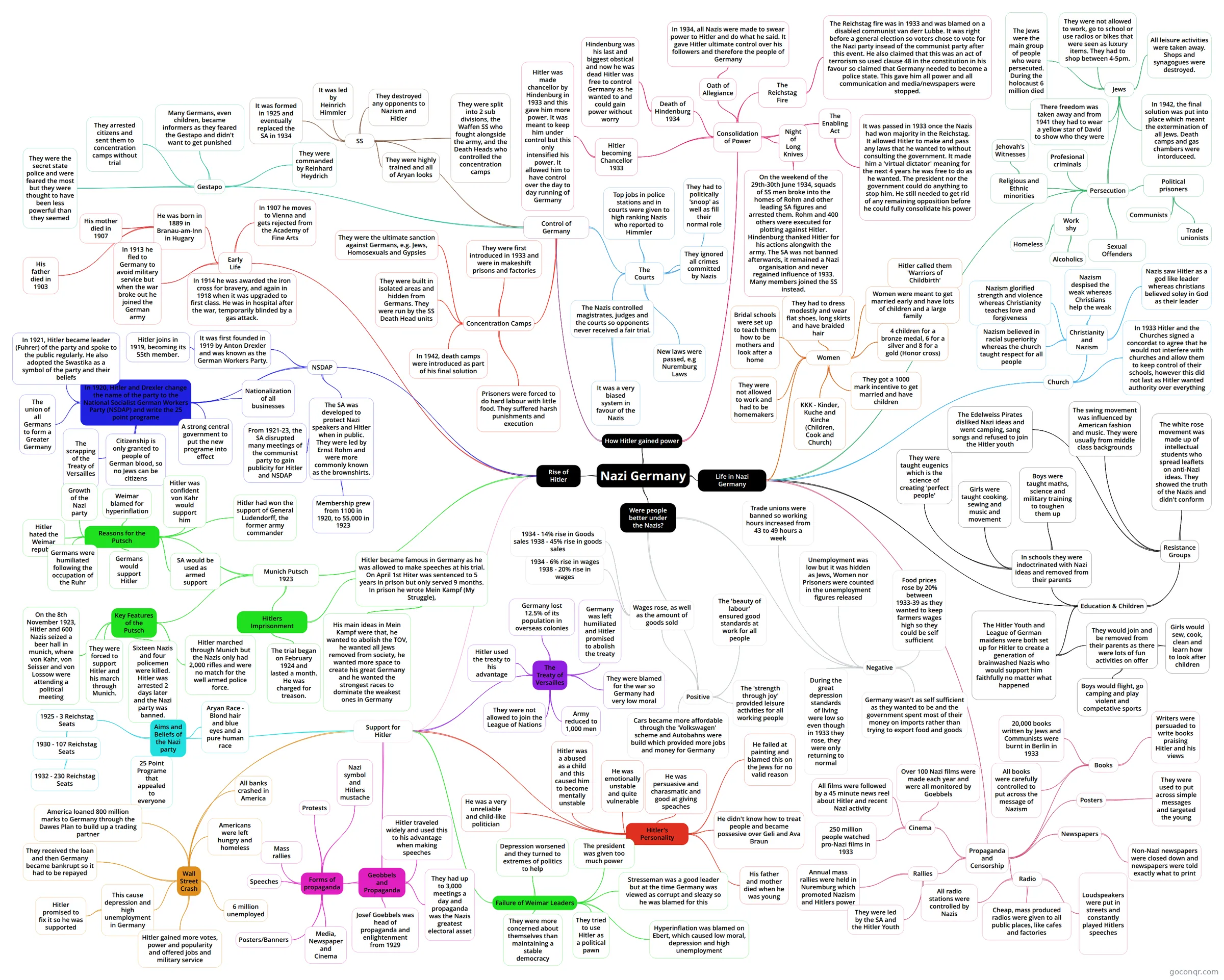
Mind map: Nazi Germany
Inhalt der Mindmap
Nazi Germany
Rise of Hitler
- NSDAP
- It was first founded in 1919 by Anton Drexler and was known as the German Workers Party.
- Hitler joins in 1919, becoming its 55th member.
- In 1920, Hitler and Drexler change the name of the party to the National Socialist German Workers Party (NSDAP) and write the 25 point programe
- The union of all Germans to form a Greater Germany
- The scrapping of the Treaty of Versailles
- Citizenship is only granted to people of German blood, so no Jews can be citizens
- Nationalization of all businesses
- A strong central government to put the new programe into effect
- In 1921, Hitler became leader (Fuhrer) of the party and spoke to the public regularly. He also adopted the Swastika as a symbol of the party and their beliefs
- The SA was developed to protect Nazi speakers and Hitler when in public. They were led by Ernst Rohm and were more commonly known as the brownshirts.
- From 1921-23, the SA disrupted many meetings of the communist party to gain publicity for Hitler and NSDAP
- Membership grew from 1100 in 1920, to 55,000 in 1923
- It was first founded in 1919 by Anton Drexler and was known as the German Workers Party.
- Support for Hitler
- Aims and Beliefs of the Nazi party
- 1925 - 3 Reichstag Seats
- 1930 - 107 Reichstag Seats
- 1932 - 230 Reichstag Seats
- 1930 - 107 Reichstag Seats
- 25 Point Programe that appealed to everyone
- Aryan Race - Blond hair and blue eyes and a pure human race
- 1925 - 3 Reichstag Seats
- Wall Street Crash
- All banks crashed in America
- Americans were left hungry and homeless
- America loaned 800 million marks to Germany through the Dawes Plan to build up a trading partner
- They received the loan and then Germany became bankrupt so it had to be repayed
- This cause depression and high unemployment in Germany
- Hitler promised to fix it so he was supported
- 6 million unemployed
- Hitler gained more votes, power and popularity and offered jobs and military service
- Failure of Weimar Leaders
- Depression worsened and they turned to extremes of politics to help
- They were more concerned about themselves than maintaining a stable democracy
- They tried to use Hitler as a political pawn
- The president was given too much power
- Hyperinflation was blamed on Ebert, which caused low moral, depression and high unemployment
- Stresseman was a good leader but at the time Germany was viewed as corrupt and sleazy so he was blamed for this
- The Treaty of Versailles
- They were not allowed to join the League of Nations
- Hitler used the treaty to his advantage
- Germany lost 12.5% of its population in overseas colonies
- Army reduced to 1,000 men
- They were blamed for the war so Germany had very low moral
- Germany was left humiliated and Hitler promised to abolish the treaty
- Hitler's Personality
- Hitler was a abused as a child and this caused him to become mentally unstable
- He was a very unreliable and child-like politician
- His father and mother died when he was young
- He was persuasive and charasmatic and good at giving speaches
- He didn't know how to treat people and became possesive over Geli and Ava Braun
- He failed at painting and blamed this on the Jews for no valid reason
- He was emotionally unstable and quite vulnerable
- Geobbels and Propaganda
- Josef Goebbels was head of propaganda and enlightenment from 1929
- Forms of propaganda
- Mass rallies
- Posters/Banners
- Speeches
- Protests
- Media, Newspaper and Cinema
- Nazi symbol and Hitlers mustache
- They had up to 3,000 meetings a day and propaganda was the Nazis greatest electoral asset
- Hitler traveled widely and used this to his advantage when making speeches
- Aims and Beliefs of the Nazi party
- Early Life
- He was born in 1889 in Branau-am-Inn in Hugary
- His father died in 1903
- His mother died in 1907
- In 1907 he moves to Vienna and gets rejected from the Academy of Fine Arts
- In 1913 he fled to Germany to avoid military service but when the war broke out he joined the German army
- In 1914 he was awarded the iron cross for bravery, and again in 1918 when it was upgraded to first class. He was in hospital after the war, temporarily blinded by a gas attack.
- He was born in 1889 in Branau-am-Inn in Hugary
- Munich Putsch 1923
- Reasons for the Putsch
- Hitler hated the Weimar republic
- Germans were humiliated following the occupation of the Ruhr
- Germans would support Hitler
- Growth of the Nazi party
- Weimar blamed for hyperinflation
- Hitler was confident von Kahr would support him
- SA would be used as armed support
- Hitler had won the support of General Ludendorff, the former army commander
- Key Features of the Putsch
- On the 8th November 1923, Hitler and 600 Nazis seized a beer hall in munich, where von Kahr, von Seisser and von Lossow were attending a political meeting
- They were forced to support Hitler and his march through Munich.
- Hitler marched through Munich but the Nazis only had 2,000 rifles and were no match for the well armed police force.
- Sixteen Nazis and four policemen were killed. Hitler was arrested 2 days later and the Nazi party was banned.
- Hitlers Imprisonment
- The trial began on February 1924 and lasted a month. He was charged for treason.
- Hitler became famous in Germany as he was allowed to make speeches at his trial. On April 1st Hiter was sentenced to 5 years in prison but only served 9 months. In prison he wrote Mein Kampf (My Struggle),
- His main ideas in Mein Kampf were that, he wanted to abolish the TOV, he wanted all Jews removed from society, he wanted more space to create his great Germany and he wanted the strongest races to dominate the weakest ones in Germany
- Reasons for the Putsch
- NSDAP
How Hitler gained power
- Control of Germany
- Gestapo
- They were the secret state police and were feared the most but they were thought to have been less powerful than they seemed
- They were commanded by Reinhard Heydrich
- They arrested citizens and sent them to concentration camps without trial
- Many Germans, even children, became informers as they feared the Gestapo and didn't want to get punished
- SS
- It was formed in 1925 and eventually replaced the SA in 1934
- It was led by Heinrich Himmler
- They were highly trained and all of Aryan looks
- They destroyed any opponents to Nazism and Hitler
- They were split into 2 sub divisions, the Waffen SS who fought alongside the army, and the Death Heads who controlled the concentration camps
- The Courts
- Top jobs in police stations and in courts were given to high ranking Nazis who reported to Himmler
- They had to politically 'snoop' as well as fill their normal role
- They ignored all crimes committed by Nazis
- New laws were passed, e.g Nuremburg Laws
- The Nazis controlled magistrates, judges and the courts so opponents never received a fair trial.
- It was a very biased system in favour of the Nazis
- Concentration Camps
- They were first introduced in 1933 and were in makeshift prisons and factories
- They were the ultimate sanction against Germans, e.g. Jews, Homosexuals and Gypsies
- They were built in isolated areas and hidden from Germans. They were run by the SS Death Head units
- Prisoners were forced to do hard labour with little food. They suffered harsh punishments and execution
- In 1942, death camps were introduced as part of his final solution
- Gestapo
- Consolidation of Power
- Hitler becoming Chancellor 1933
- Hitler was made chancellor by Hindenburg in 1933 and this gave him more power. It was meant to keep him under control but this only intensified his power. It allowed him to have control over the day to day running of Germany
- Death of Hindenburg 1934
- Hindenburg was his last and biggest obstical and now he was dead Hitler was free to control Germany as he wanted to and could gain power without worry
- Oath of Allegiance
- In 1934, all Nazis were made to swear power to Hitler and do what he said. It gave Hitler ultimate control over his followers and therefore the people of Germany
- The Reichstag Fire
- The Reichstag fire was in 1933 and was blamed on a disabled communist van derr Lubbe. It was right before a general election so voters chose to vote for the Nazi party insead of the communist party after this event. He also claimed that this was an act of terrorism so used clause 48 in the constitution in his favour so claimed that Germany needed to become a police state. This gave him all power and all communication and media/newspapers were stopped.
- The Enabling Act
- It was passed in 1933 once the Nazis had won majority in the Reichstag. It allowed Hitler to make and pass any laws that he wanted to without consulting the government. It made him a 'virtual dictator' meaning for the next 4 years he was free to do as he wanted. The president nor the government could do anything to stop him. He still needed to get rid of any remaining opposition before he could fully consolidate his power
- Night of Long Knives
- On the weekend of the 29th-30th June 1934, squads of SS men broke into the homes of Rohm and other leading SA figures and arrested them. Rohm and 400 others were executed for plotting against Hitler. Hindenburg thanked Hitler for his actions alongwith the army. The SA was not banned afterwards, it remained a Nazi organisation and never regained influence of 1933. Many members joined the SS instead.
- Hitler becoming Chancellor 1933
- Control of Germany
Life in Nazi Germany
- Propaganda and Censorship
- Books
- All books were carefully controlled to put across the message of Nazism
- 20,000 books written by Jews and Communists were burnt in Berlin in 1933
- Writers were persuaded to write books praising Hitler and his views
- Posters
- They were used to put across simple messages and targeted the young
- Newspapers
- Non-Nazi newspapers were closed down and newspapers were told exactly what to print
- Rallies
- Annual mass rallies were held in Nuremburg which promoted Nazism and Hitlers power
- They were led by the SA and the Hitler Youth
- Radio
- All radio stations were controlled by Nazis
- Cheap, mass produced radios were given to all public places, like cafes and factories
- Loudspeakers were put in streets and constantly played Hitlers speeches
- Cinema
- Over 100 Nazi films were made each year and were all monitored by Goebbels
- All films were followed by a 45 minute news reel about Hitler and recent Nazi activity
- 250 million people watched pro-Nazi films in 1933
- Books
- Women
- KKK - Kinder, Kuche and Kirche (Children, Cook and Church)
- They were not allowed to work and had to be homemakers
- They had to dress modestly and wear flat shoes, long skirts and have braided hair
- Women were meant to get married early and have lots of children and a large family
- Hitler called them 'Warriors of Childbirth'
- 4 children for a bronze medal, 6 for a silver and 8 for a gold (Honor cross)
- They got a 1000 mark incentive to get married and have children
- Bridal schools were set up to teach them how to be mothers and look after a home
- Church
- Christianity and Nazism
- Nazism glorified strength and violence whereas Christianity teaches love and forgiveness
- Nazism despised the weak whereas Christians help the weak
- Nazism believed in racial superiority whereas the church taught respect for all people
- Nazis saw Hitler as a god like leader whereas christians believed soley in God as their leader
- In 1933 Hitler and the Churches signed a concordat to agree that he would not interfere with churches and allow them to keep control of their schools, however this did not last as Hitler wanted authority over everything
- Christianity and Nazism
- Education & Children
- The Hitler Youth and League of German maidens were both set up for Hitler to create a generation of brainwashed Nazis who would support him faithfully no matter what happened
- They would join and be removed from their parents as there were lots of fun activities on offer
- Girls would sew, cook, clean and learn how to look after children
- Boys would flight, go camping and play violent and competative sports
- They would join and be removed from their parents as there were lots of fun activities on offer
- In schools they were indoctrinated with Nazi ideas and removed from their parents
- They were taught eugenics which is the science of creating 'perfect people'
- Girls were taught cooking, sewing and music and movement
- Boys were taught maths, science and military training to toughen them up
- Resistance Groups
- The swing movement was influenced by American fashion and music. They were usually from middle class backgrounds
- The Edelweiss Pirates disliked Nazi ideas and went camping, sang songs and refused to join the Hitler youth
- The white rose movement was made up of intellectual students who spread leaflets on anti-Nazi ideas. They showed the truth of the Nazis and didn't conform
- The Hitler Youth and League of German maidens were both set up for Hitler to create a generation of brainwashed Nazis who would support him faithfully no matter what happened
- Persecution
- Jews
- The Jews were the main group of people who were persecuted. During the holocaust 6 million died
- There freedom was taken away and from 1941 they had to wear a yellow star of David to show who they were
- They were not allowed to work, go to school or use radios or bikes that were seen as luxury items. They had to shop between 4-5pm.
- All leisure activities were taken away. Shops and synagogues were destroyed.
- In 1942, the final solution was put into place which meant the extermination of all Jews. Death camps and gas chambers were intorduceed.
- Profesional criminals
- Political prisoners
- Communists
- Trade unionists
- Sexual Offenders
- Work shy
- Homeless
- Alcoholics
- Religious and Ethnic minorities
- Jehovah's Witnesses
- Jews
- Propaganda and Censorship
Were people better under the Nazis?
- Positive
- Wages rose, as well as the amount of goods sold
- 1934 - 6% rise in wages 1938 - 20% rise in wages
- 1934 - 14% rise in Goods sales 1938 - 45% rise in goods sales
- Cars became more affordable through the 'Volkswagen' scheme and Autobahns were build which provided more jobs and money for Germany
- The 'beauty of labour' ensured good standards at work for all people
- The 'strength through joy' provided leisure activities for all working people
- Wages rose, as well as the amount of goods sold
- Negative
- Trade unions were banned so working hours increased from 43 to 49 hours a week
- Unemployment was low but it was hidden as Jews, Women nor Prisoners were counted in the unemployment figures released
- Food prices rose by 20% between 1933-39 as they wanted to keep farmers wages high so they could be self sufficient
- During the great depression standards of living were low so even though in 1933 they rose, they were only returning to normal
- Germany wasn't as self sufficient as they wanted to be and the government spent most of their money on imports rather than trying to export food and goods
- Positive
Informationen
- Beschreibung
- Mindmap am Nazi Germany, erstellt von Lauren1525 am 21/11/2014.
- Erstellt von
- Lauren1525
- Aufrufe
- 34
- Bewertung