
Mindmap
Vietnam
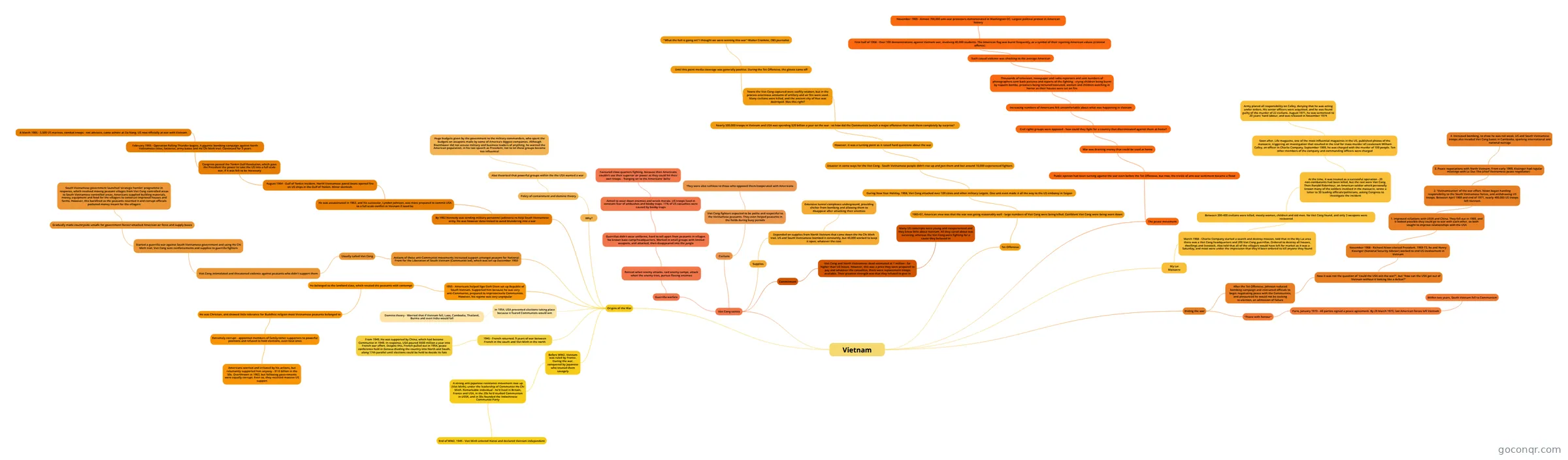
Mind map: Vietnam War
Inhalt der Mindmap
Vietnam
Origins of the War
- Before WW2, Vietnam was ruled by France. During the war, conquered by Japanese who treated them savagely
- A strong anti-Japanese resistance movement rose up (Viet Minh), under the leadership of Communist Ho Chi Minh. Remarkable individual - he'd lived in Britain, France and USA, in the 20s he'd studied Communism in USSR, and in 30s founded the Indochinese Communist Party
- End of WW2, 1945 - Viet Minh entered Hanoi and declared Vietnam independent
- A strong anti-Japanese resistance movement rose up (Viet Minh), under the leadership of Communist Ho Chi Minh. Remarkable individual - he'd lived in Britain, France and USA, in the 20s he'd studied Communism in USSR, and in 30s founded the Indochinese Communist Party
- 1945 - French returned. 9 years of war between French in the south and Viet Minh in the north
- From 1949, Ho was supported by China, which had become Communist in 1949. In response, USA poured $500 million a year into French war effort. Despite this, French pulled out in 1954, peace conference held in Geneva dividing the country into North and South, along 17th parallel until elections could be held to decide its fate
- In 1954, USA prevented elections taking place because it feared Communists would win
- Domino theory - Worried that if Vietnam fell, Laos, Cambodia, Thailand, Burma and even India would fall
- 1955 - Americans helped Ngo Dinh Diem set up Republic of South Vietnam. Supported him because he was very anti-Communist, prepared to imprison/exile Communists. However, his regime was very unpopular
- He belonged to the landlord class, which treated the peasants with contempt
- He was Christian, and showed little tolerance for Buddhist religion most Vietnamese peasants belonged to
- Extremely corrupt - appointed members of family/other supporters to powerful positions and refused to hold elections, even local ones
- Americans worried and irritated by his actions, but reluctantly supported him anyway - $1.6 billion in the 50s. Overthrown in 1963, but following governments were equally corrupt. Even so, they received massive US support
- Extremely corrupt - appointed members of family/other supporters to powerful positions and refused to hold elections, even local ones
- He was Christian, and showed little tolerance for Buddhist religion most Vietnamese peasants belonged to
- He belonged to the landlord class, which treated the peasants with contempt
- Actions of these anti-Communist movements increased support amongst peasant for National Front for the Liberation of South Vietnam (Communist led), which was set up December 1960
- Usually called Viet Cong
- Viet Cong intimidated and threatened violence against peasants who didn't support them
- Started a guerrilla war against South Vietnamese government and using Ho Chi Minh trail, Viet Cong sent reinforcements and supplies to guerrilla fighters
- Gradually made countryside unsafe for government forces+attacked American air force and supply bases
- South Vietnamese government launched 'strategic hamlet' programme in response, which involved moving peasant villages from Viet Cong controlled areas to South Vietnamese controlled areas. Americans supplied building materials, money, equipment and food for the villagers to construct improved houses and farms. However, this backfired as the peasants resented it and corrupt officials pocketed money meant for the villagers
- Gradually made countryside unsafe for government forces+attacked American air force and supply bases
- Started a guerrilla war against South Vietnamese government and using Ho Chi Minh trail, Viet Cong sent reinforcements and supplies to guerrilla fighters
- Viet Cong intimidated and threatened violence against peasants who didn't support them
- Usually called Viet Cong
- By 1962 Kennedy was sending military personnel (advisers) ro help South Vietnamese army. He was however determined to avoid blundering into a war
- He was assassinated in 1963, and his successor, Lyndon Johnson, was more prepared to commit USA to a full scale conflict in Vietnam if need be
- August 1964 - Gulf of Tonkin Incident. North Vietnamese patrol boats opened fire on US ships in the Gulf of Tonkin. Minor skirmish.
- Congress passed the Tonkin Gulf Resolution, which gave the President the power to take the US into a full scale war, if it was felt to be necessary
- February 1965 - Operation Rolling Thunder begins. A gigantic bombing campaign against North Vietnamese cities, factories, army bases and Ho Chi Minh trail. Continued for 3 years
- 8 March 1965 - 3,500 US marines, combat troops - not advisers, came ashore at Da Nang. US now officially at war with Vietnam
- February 1965 - Operation Rolling Thunder begins. A gigantic bombing campaign against North Vietnamese cities, factories, army bases and Ho Chi Minh trail. Continued for 3 years
- Congress passed the Tonkin Gulf Resolution, which gave the President the power to take the US into a full scale war, if it was felt to be necessary
- August 1964 - Gulf of Tonkin Incident. North Vietnamese patrol boats opened fire on US ships in the Gulf of Tonkin. Minor skirmish.
- He was assassinated in 1963, and his successor, Lyndon Johnson, was more prepared to commit USA to a full scale conflict in Vietnam if need be
- Why?
- Policy of containment and domino theory
- Also theorised that powerful groups within the the USA wanted a war
- Huge budgets given by the government to the military commanders, who spent the budgets on weapons made by some of America's biggest companies. Although Eisenhower did not accuse military and business leaders of anything, he warned the American population, in his last speech as President, not to let these groups become too influential
- Also theorised that powerful groups within the the USA wanted a war
- Policy of containment and domino theory
- Before WW2, Vietnam was ruled by France. During the war, conquered by Japanese who treated them savagely
Viet Cong tactics
- Guerrilla warfare
- Retreat when enemy attacks, raid enemy camps, attack when the enemy tries, pursue fleeing enemies
- Guerrillas didn't wear uniforms, hard to tell apart from peasants in villages. No known base camp/headquarters. Worked in small groups with limited weapons, and attacked, then disappeared into the jungle
- Aimed to wear down enemies and wreck morale. US troops lived in constant fear of ambushes and booby traps. 11% of US casualties were caused by booby traps
- Favoured close quarters fighting, because then Americans couldn't use their superior air power as they could hit their own troops - 'hanging on to the Americans' belts'
- Aimed to wear down enemies and wreck morale. US troops lived in constant fear of ambushes and booby traps. 11% of US casualties were caused by booby traps
- Guerrillas didn't wear uniforms, hard to tell apart from peasants in villages. No known base camp/headquarters. Worked in small groups with limited weapons, and attacked, then disappeared into the jungle
- Retreat when enemy attacks, raid enemy camps, attack when the enemy tries, pursue fleeing enemies
- Civilians
- Viet Cong fighters expected to be polite and respectful to the Vietnamese peasants. They even helped peasants in the fields during busy periods
- They were also ruthless to those who opposed them/cooperated with Americans
- Viet Cong fighters expected to be polite and respectful to the Vietnamese peasants. They even helped peasants in the fields during busy periods
- Supplies
- Depended on supplies from North Vietnam that came down the Ho Chi Minh trail. US and South Vietnamese bombed it constantly, but 40,000 worked to keep it open, whatever the cost
- Extensive tunnel complexes underground, providing shelter from bombing and allowing them to disappear after attacking their enemies
- Depended on supplies from North Vietnam that came down the Ho Chi Minh trail. US and South Vietnamese bombed it constantly, but 40,000 worked to keep it open, whatever the cost
- Commitment
- Viet Cong and North Vietnamese dead estimated at 1 million - far higher than US losses. However, this was a price they were prepared to pay and whatever the casualties, there were replacement troops available. Their greatest strength was that they refused to give in
- Many US conscripts were young and inexperienced and they knew little about Vietnam. All they cared about was surviving, whereas the Viet Cong were fighting for a cause they believed in
- Viet Cong and North Vietnamese dead estimated at 1 million - far higher than US losses. However, this was a price they were prepared to pay and whatever the casualties, there were replacement troops available. Their greatest strength was that they refused to give in
- Guerrilla warfare
Tet Offensive
- 1965-67, American view was that the war was going reasonably well - large numbers of Viet Cong were being killed. Confident Viet Cong were being worn down
- During New Year Holiday, 1968, Viet Cong attacked over 100 cities and other military targets. One unit even made it all the way to the US embassy in Saigon
- Disaster in some ways for the Viet Cong - South Vietnamese people didn't rise up and join them and lost around 10,000 experienced fighters
- However, it was a turning point as it raised hard questions about the war
- Nearly 500,000 troops in Vietnam and USA was spending $20 billion a year on the war - so how did the Communists launch a major offensive that took them completely by surprise?
- Towns the Viet Cong captured were swiftly retaken, but in the process enormous amounts of artillery and air fire were used. Many civilians were killed, and the ancient city of Hue was destroyed. Was this right?
- Until this point media coverage was generally positive. During the Tet Offensive, the gloves came off
- "What the hell is going on? I thought we were winning this war"-Walter Cronkite, CBS journalist
- Until this point media coverage was generally positive. During the Tet Offensive, the gloves came off
- Towns the Viet Cong captured were swiftly retaken, but in the process enormous amounts of artillery and air fire were used. Many civilians were killed, and the ancient city of Hue was destroyed. Was this right?
- Nearly 500,000 troops in Vietnam and USA was spending $20 billion a year on the war - so how did the Communists launch a major offensive that took them completely by surprise?
- However, it was a turning point as it raised hard questions about the war
- Disaster in some ways for the Viet Cong - South Vietnamese people didn't rise up and join them and lost around 10,000 experienced fighters
- During New Year Holiday, 1968, Viet Cong attacked over 100 cities and other military targets. One unit even made it all the way to the US embassy in Saigon
- 1965-67, American view was that the war was going reasonably well - large numbers of Viet Cong were being killed. Confident Viet Cong were being worn down
The peace movement
- Public opinion had been turning against the war even before the Tet Offensive, but now, the trickle of anti-war sentiment became a flood
- War was draining money that could be used at home
- Civil rights groups were opposed - how could they fight for a country that discriminated against them at home?
- Increasing numbers of Americans felt uncomfortable about what was happening in Vietnam
- Thousands of television, newspaper and radio reporters and vast numbers of photographers sent back pictures and reports of the fighting - crying children being burnt by napalm bombs, prisoners being tortured/executed, women and children watching in horror as their houses were set on fire
- Such casual violence was shocking to the average American
- First half of 1968 - Over 100 demonstrations against Vietnam war, involving 40,000 students. The American flag was burnt frequently, as a symbol of their rejecting American values (criminal offence)
- November 1969 - Almost 700,000 anti-war protesters demonstrated in Washington DC. Largest political protest in American history
- First half of 1968 - Over 100 demonstrations against Vietnam war, involving 40,000 students. The American flag was burnt frequently, as a symbol of their rejecting American values (criminal offence)
- Such casual violence was shocking to the average American
- Thousands of television, newspaper and radio reporters and vast numbers of photographers sent back pictures and reports of the fighting - crying children being burnt by napalm bombs, prisoners being tortured/executed, women and children watching in horror as their houses were set on fire
- Increasing numbers of Americans felt uncomfortable about what was happening in Vietnam
- Civil rights groups were opposed - how could they fight for a country that discriminated against them at home?
- War was draining money that could be used at home
- Public opinion had been turning against the war even before the Tet Offensive, but now, the trickle of anti-war sentiment became a flood
My Lai Massacre
- March 1968 - Charlie Company started a search and destroy mission, told that in the My Lai area there was a Viet Cong headquarters and 200 Viet Cong guerrillas. Ordered to destroy all houses, dwellings and livestock. Also told that all of the villagers would have left for market as it was a Saturday, and most were under the impression that they'd been ordered to kill anyone they found
- Between 300-400 civilians were killed, mostly women, children and old men. No Viet Cong found, and only 3 weapons were recovered
- At the time, it was treated as a successful operation - 20 non-combatants had been killed, but the rest were Viet Cong. Then Ronald Ridenhour, an American soldier who'd personally known many of the soldiers involved in the massacre, wrote a letter to 30 leading officials/politicians, asking Congress to investigate the incident
- Soon after, Life magazine, one of the most influential magazines in the US, published photos of the massacre, triggering an investigation that resulted in the trial for mass murder of Lieutenant William Calley, an officer in Charlie Company. September 1969, he was charged with the murder of 109 people. Ten other members of the company and commanding officers were charged
- Army placed all responsibility on Calley, denying that he was acting under orders. His senior officers were acquitted, and he was found guilty of the murder of 22 civilians. August 1971, he was sentenced to 20 years' hard labour, and was released in November 1974
- Soon after, Life magazine, one of the most influential magazines in the US, published photos of the massacre, triggering an investigation that resulted in the trial for mass murder of Lieutenant William Calley, an officer in Charlie Company. September 1969, he was charged with the murder of 109 people. Ten other members of the company and commanding officers were charged
- At the time, it was treated as a successful operation - 20 non-combatants had been killed, but the rest were Viet Cong. Then Ronald Ridenhour, an American soldier who'd personally known many of the soldiers involved in the massacre, wrote a letter to 30 leading officials/politicians, asking Congress to investigate the incident
- Between 300-400 civilians were killed, mostly women, children and old men. No Viet Cong found, and only 3 weapons were recovered
- March 1968 - Charlie Company started a search and destroy mission, told that in the My Lai area there was a Viet Cong headquarters and 200 Viet Cong guerrillas. Ordered to destroy all houses, dwellings and livestock. Also told that all of the villagers would have left for market as it was a Saturday, and most were under the impression that they'd been ordered to kill anyone they found
Ending the war
- After the Tet Offensive, Johnson reduced bombing campaign and instructed officials to begin negotiating peace with the Communists, and announced he would not be seeking re-election, an admission of failure
- Now it was not the question of "could the USA win the war?", but "how can the USA get out of Vietnam without it looking like a defeat?"
- November 1968 - Richard Nixon elected President. 1969-73, he and Henry Kissinger (National Security Adviser) worked to end US involvement in Vietnam
- 1. Improved rellations with USSR and China. They fell out in 1969, and it looked possible they could go to war with each other, so both sought to improve relationships with the USA
- 2. 'Vietnamization' of the war effort. Nixon began handing responsibility to the South Vietnamese forces, and withdrawing US troops. Between April 1969 and end of 1971, nearly 400,000 US troops left Vietnam
- 3. Peace negotiations with North Vietnam. From early 1969, Kissinger had regular meetings with Le Duc Tho (chief Vietnamese peace negotiator)
- 4. Increased bombing, to show he was not weak. US and South Vietnamese troops also invaded Viet Cong bases in Cambodia, sparking international and national outrage
- 3. Peace negotiations with North Vietnam. From early 1969, Kissinger had regular meetings with Le Duc Tho (chief Vietnamese peace negotiator)
- 2. 'Vietnamization' of the war effort. Nixon began handing responsibility to the South Vietnamese forces, and withdrawing US troops. Between April 1969 and end of 1971, nearly 400,000 US troops left Vietnam
- 1. Improved rellations with USSR and China. They fell out in 1969, and it looked possible they could go to war with each other, so both sought to improve relationships with the USA
- November 1968 - Richard Nixon elected President. 1969-73, he and Henry Kissinger (National Security Adviser) worked to end US involvement in Vietnam
- Now it was not the question of "could the USA win the war?", but "how can the USA get out of Vietnam without it looking like a defeat?"
- "Peace with honour"
- Paris, January 1973 - All parties signed a peace agreement. By 29 March 1973, last American forces left Vietnam
- Within two years, South Vietnam fell to Communism
- Paris, January 1973 - All parties signed a peace agreement. By 29 March 1973, last American forces left Vietnam
- After the Tet Offensive, Johnson reduced bombing campaign and instructed officials to begin negotiating peace with the Communists, and announced he would not be seeking re-election, an admission of failure
Informationen
- Beschreibung
- History Mindmap am Vietnam, erstellt von Sophie J Evans am 26/05/2019.
- Erstellt von
- Sophie J Evans
- Aufrufe
- 2
- Bewertung