
Mindmap
Attachment
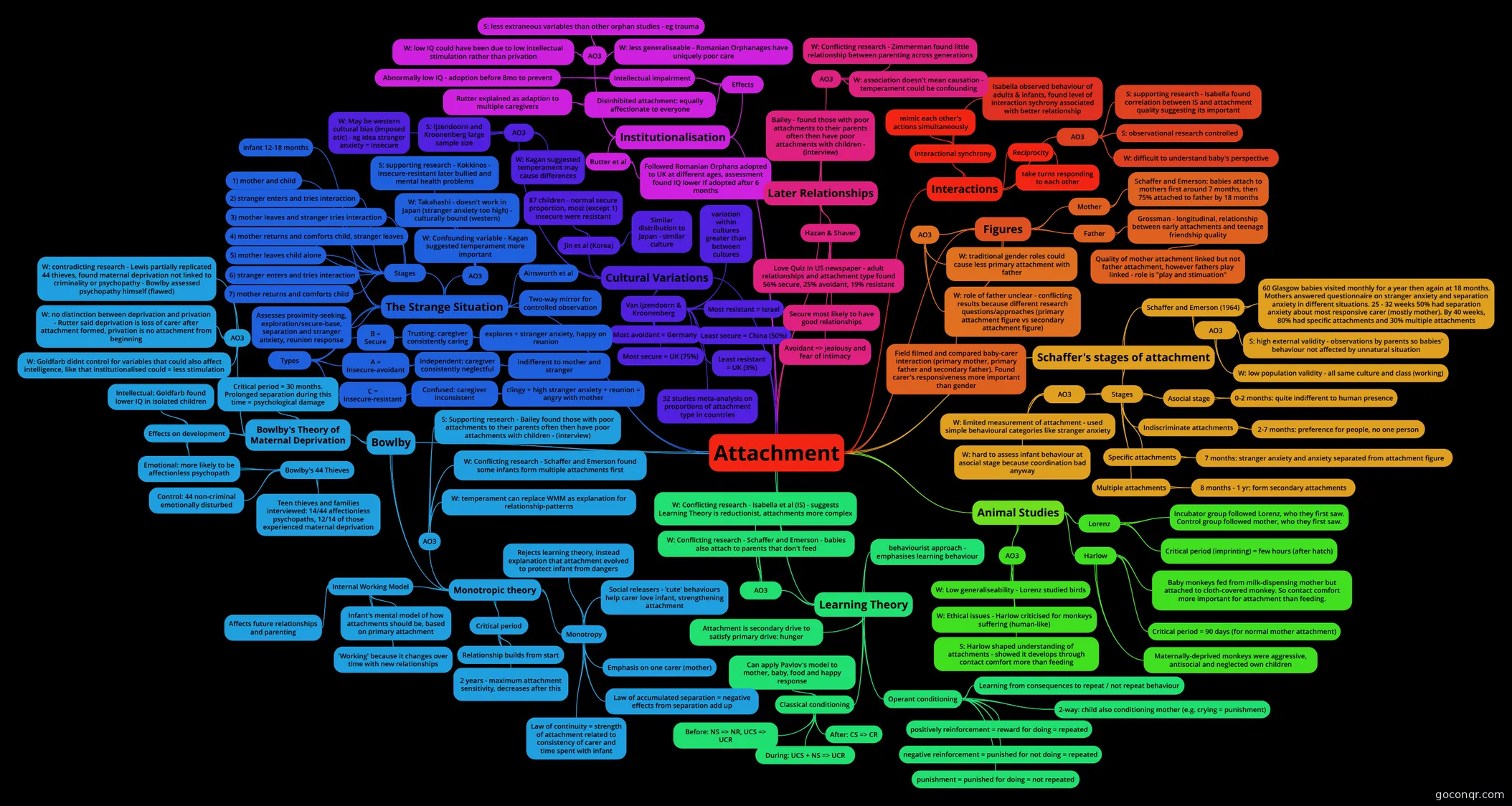
Mind map: Attachment
Inhalt der Mindmap
Attachment
Interactions
- Reciprocity
- take turns responding to each other
- Interactional synchrony
- mimic each other's actions simultaneously
- Isabella observed behaviour of adults & infants, found level of interaction sychrony associated with better relationship
- AO3
- W: difficult to understand baby's perspective
- S: observational research controlled
- S: supporting research - Isabella found correlation between IS and attachment quality suggesting its important
- Reciprocity
Figures
- Mother
- Schaffer and Emerson: babies attach to mothers first around 7 months, then 75% attached to father by 18 months
- Father
- Grossman - longitudinal, relationship between early attachments and teenage friendship quality
- Quality of mother attachment linked but not father attachment, however fathers play linked - role is "play and stimuation"
- Grossman - longitudinal, relationship between early attachments and teenage friendship quality
- AO3
- W: role of father unclear - conflicting results because different research questions/approaches (primary attachment figure vs secondary attachment figure)
- W: traditional gender roles could cause less primary attachment with father
- Field filmed and compared baby-carer interaction (primary mother, primary father and secondary father). Found carer's responsiveness more important than gender
- Mother
Schaffer's stages of attachment
- Schaffer and Emerson (1964)
- 60 Glasgow babies visited monthly for a year then again at 18 months. Mothers answered questionnaire on stranger anxiety and separation anxiety in different situations. 25 - 32 weeks 50% had separation anxiety about most responsive carer (mostly mother). By 40 weeks, 80% had specific attachments and 30% multiple attachments
- AO3
- S: high external validity - observations by parents so babies' behaviour not affected by unnatural situation
- W: low population validity - all same culture and class (working)
- Stages
- Asocial stage
- 0-2 months: quite indifferent to human presence
- Indiscriminate attachments
- 2-7 months: preference for people, no one person
- Specific attachments
- 7 months: stranger anxiety and anxiety separated from attachment figure
- Multiple attachments
- 8 months - 1 yr: form secondary attachments
- AO3
- W: hard to assess infant behaviour at asocial stage because coordination bad anyway
- W: limited measurement of attachment - used simple behavioural categories like stranger anxiety
- Asocial stage
- Schaffer and Emerson (1964)
Animal Studies
- Lorenz
- Incubator group followed Lorenz, who they first saw. Control group followed mother, who they first saw.
- Critical period (imprinting) = few hours (after hatch)
- Harlow
- Baby monkeys fed from milk-dispensing mother but attached to cloth-covered monkey. So contact comfort more important for attachment than feeding.
- Critical period = 90 days (for normal mother attachment)
- Maternally-deprived monkeys were aggressive, antisocial and neglected own children
- AO3
- W: Low generaliseability - Lorenz studied birds
- W: Ethical issues - Harlow criticised for monkeys suffering (human-like)
- S: Harlow shaped understanding of attachments - showed it develops through contact comfort more than feeding
- Lorenz
Learning Theory
- Classical conditioning
- During: UCS + NS => UCR
- Before: NS => NR, UCS => UCR
- Can apply Pavlov's model to mother, baby, food and happy response
- After: CS => CR
- behaviourist approach - emphasises learning behaviour
- Operant conditioning
- Learning from consequences to repeat / not repeat behaviour
- positively reinforcement = reward for doing = repeated
- negative reinforcement = punished for not doing = repeated
- punishment = punished for doing = not repeated
- 2-way: child also conditioning mother (e.g. crying = punishment)
- Attachment is secondary drive to satisfy primary drive: hunger
- AO3
- W: Conflicting research - Isabella et al (IS) - suggests Learning Theory is reductionist, attachments more complex
- W: Conflicting research - Schaffer and Emerson - babies also attach to parents that don't feed
- Classical conditioning
Bowlby
- Monotropic theory
- Monotropy
- Rejects learning theory, instead explanation that attachment evolved to protect infant from dangers
- Emphasis on one carer (mother)
- Social releasers - 'cute' behaviours help carer love infant, strengthening attachment
- Law of continuity = strength of attachment related to consistency of carer and time spent with infant
- Law of accumulated separation = negative effects from separation add up
- Critical period
- Relationship builds from start
- 2 years - maximum attachment sensitivity, decreases after this
- Internal Working Model
- Infant's mental model of how attachments should be, based on primary attachment
- 'Working' because it changes over time with new relationships
- Affects future relationships and parenting
- AO3
- W: temperament can replace WMM as explanation for relationship-patterns
- W: Conflicting research - Schaffer and Emerson found some infants form multiple attachments first
- S: Supporting research - Bailey found those with poor attachments to their parents often then have poor attachments with children - (interview)
- Monotropy
- Bowlby's Theory of Maternal Deprivation
- Effects on development
- Intellectual: Goldfarb found lower IQ in isolated children
- Emotional: more likely to be affectionless psychopath
- Bowlby's 44 Thieves
- Teen thieves and families interviewed: 14/44 affectionless psychopaths, 12/14 of those experienced maternal deprivation
- Control: 44 non-criminal emotionally disturbed
- Bowlby's 44 Thieves
- Critical period = 30 months. Prolonged separation during this time = psychological damage
- AO3
- W: contradicting research - Lewis partially replicated 44 thieves, found maternal deprivation not linked to criminality or psychopathy - Bowlby assessed psychopathy himself (flawed)
- W: no distinction between deprivation and privation - Rutter said deprivation is loss of carer after attachment formed, privation is no attachment from beginning
- W: Goldfarb didnt control for variables that could also affect intelligence, like that institutionalised could = less stimulation
- Effects on development
- Monotropic theory
The Strange Situation
- Ainsworth et al
- Stages
- 1) mother and child
- 2) stranger enters and tries interaction
- 3) mother leaves and stranger tries interaction
- 4) mother returns and comforts child, stranger leaves
- 5) mother leaves child alone
- 6) stranger enters and tries interaction
- 7) mother returns and comforts child
- Two-way mirror for controlled observation
- Assesses proximity-seeking, exploration/secure-base, separation and stranger anxiety, reunion response
- Types
- A = Insecure-avoidant
- Independent: caregiver consistently neglectful
- indifferent to mother and stranger
- Independent: caregiver consistently neglectful
- B = Secure
- Trusting: caregiver consistently caring
- explores + stranger anxiety, happy on reunion
- Trusting: caregiver consistently caring
- C = Insecure-resistant
- Confused: caregiver inconsistent
- clingy + high stranger anxiety + reunion = angry with mother
- Confused: caregiver inconsistent
- A = Insecure-avoidant
- AO3
- S: supporting research - Kokkinos - insecure-resistant later bullied and mental health problems
- W: Takahashi - doesn't work in Japan (stranger anxiety too high) - culturally bound (western)
- W: Confounding variable - Kagan suggested temperament more important
- infant 12-18 months
Cultural Variations
- Van Ijzendoorn & Kroonenberg
- 32 studies meta-analysis on proportions of attachment type in countries
- Most secure = UK (75%)
- Least secure = China (50%)
- Least resistant = UK (3%)
- Most avoidant = Germany
- Most resistant = Israel
- variation within cultures greater than between cultures
- Jin et al (Korea)
- 87 children - normal secure proportion, most (except 1) insecure were resistant
- Similar distribution to Japan - similar culture
- AO3
- S: Ijzendoorn and Kroonenberg large sample size
- W: May be western cultural bias (imposed etic) - eg idea stranger anxiety = insecure
- W: Kagan suggested temperament may cause differences
- Van Ijzendoorn & Kroonenberg
Institutionalisation
- Rutter et al
- Followed Romanian Orphans adopted to UK at different ages, assessment found IQ lower if adopted after 6 months
- Effects
- Disinhibited attachment: equally affectionate to everyone
- Rutter explained as adaption to multiple caregivers
- Intellectual impairment
- Abnormally low IQ - adoption before 8mo to prevent
- Disinhibited attachment: equally affectionate to everyone
- AO3
- S: less extraneous variables than other orphan studies - eg trauma
- W: less generaliseable - Romanian Orphanages have uniquely poor care
- W: low IQ could have been due to low intellectual stimulation rather than privation
- Rutter et al
Later Relationships
- Hazan & Shaver
- Love Quiz in US newspaper - adult relationships and attachment type found 56% secure, 25% avoidant, 19% resistant
- Secure most likely to have good relationships
- Avoidant => jealousy and fear of intimacy
- Bailey - found those with poor attachments to their parents often then have poor attachments with children - (interview)
- AO3
- W: Conflicting research - Zimmerman found little relationship between parenting across generations
- W: association doesn't mean causation - temperament could be confounding
- Hazan & Shaver
Informationen
- Beschreibung
- A level Psychology Mindmap am Attachment, erstellt von James Warne am 10/05/2020.
- Erstellt von
- James Warne
- Aufrufe
- 1
- Bewertung