
Mindmap
Operations Management
Inhalt der Mindmap
Operations Management
- the operations function of the organization is the arrangement of those resources which are devoted to the production and delivery of its products and services
- DIRECT - steering operations and processes DESGIN -shaping processes, products and services DELIVER - Planning and controlling ongoing operations DEVELOP - Improving the operations capabilities
Core functions
- Marketing: responsible for communicating Operations: fulfilling costumers requests; operations represent a major cost of the company but is also a major source for competitive advantage eg. Ryanair Process Innovation: creating new products
input-transformation-output model
- Input: that that will be transformed eg. material, information, customer or that that will do the transforming within the operation eg. people, facilities Transformation processes include: 1. physical characteristics of materials or customers 2.location of materials, information or customers 3.ownership of materials or information 4.storage or accommodation of materials, information or customers 5.purpose or form of information 6.physiological or psychological state of customers. Output: Products or services produced by transformation Difference in tangibility the life of service is much shorter eg. accommodation is a one day thing
- Objectives: -minimize cost -increase quality -guarantee flexibility -questionable sustainability
Lean Operations
- Four elements of lean production: 1. customer-based demand triggers 2.items should flow smoothly 3.high involvement behavior to avoid idle time 4.waste elimination by avoiding irregular flow, inexact supply, inflexible response
- Taylorism
- Basis of mass production: -splitting up work into smaller components -aim to keep everything occupied to 100%- that is machines and employees Results of this are: high inventory and rates of scrap; opportunities to improve are missed out on
- Kanban
- At each step of the process the work piece has a kanban card attached; cards circulate -the number of cards sets a maximum to inventory -only exact number of parts indicated on the kanban are produced
- Jidouka: when a fault is detected, everything is immediately stopped until fault is corrected
- Quality circles
- group of co-workers meet regularly -problems are discussed, solutions are established and overall problem is tackled as a team -failed in Western Europe and North America
Planning and Control
- Planning - developing of plans for how resources/ processes will be used in the future to ensure that resources will be available eg. room bookings Planning can help find the source of uncertainty and remove them
- Materials Requirement Planning
- Necessary to know are: the structure of components going into demand -data on current inventory and items on order -data about each specific part: batch quantity, expected scrap etc.
- Uncertainty led to by scrap, variable achieved times, variations in demand
- Enterprise Resources Planning
- applied to planning in industries beyond just manufacturing eg. hospitals, universities -these are widely used to improve planning, effectiveness depends on accuracy of data Issues:-dissatisfied users-often no one in an organisation really understands how system behaves-vendors like to lock customers inAdapting standard software modules to suit operational practices can be costly to adapt, easier to gain acceptance within organisation
Supply Chain Management
- managing supply chains is about managing relationships; different relationships appropriate in different circumstances -most businesses will have a selection of different relationships
- Contract based transactional
- involve purchasing goods and services in a pure market fashion; seeking best supplier every time -relationship may be short term; no guarantee of further trading Advantages: maintain competition between alternative suppliers; supplier specialization, flexibility of outsourced supplies: if demand changes, customers can change number and type of suppliers -innovations can be exploited no matter where they originate Disadvantages: -suppliers owe little loyalty to customers -choosing supplier takes time and effort
- Long-term "partnerships"
- suppliers and customers are expected to cooperate, even to the extent of sharing skills and resources, to achieve joint benefits beyond those they could have achieved by acting alone -sharing success -long-term expectations -joint learning -few relationships -trust -joint problem solving
- Supply-Chain Management
- the management of relationships and flows between operations and processes; a string of operations or processes
- managed across organizational boundaries -objective of supply chain management is to meet the requirements of end customers by supplying appropriate products and services when they are needed at a competitive cost five objectives: 1.quality 2.speed 3.depnedability 4.flexibility 5.cost
- Purchasing
- Orthodox: focus on price, spot buying, large number of vendors; this leads to unwillingness to share information Alternative Partnership: long-term commitment, smaller number of vedors, focus on total acquisition, wider range of contacts,
- supply chain integration
- close alignment and coordination within a supply chain, often with the use of shared management information systems (MIS). A supply chain is made up of all parties involved in fulfilling a purchase, including raw materials, manufacturing the product, transporting completed items, and supporting services.supply chain is all the processes needed to complete a products
- Manufacturer --> third party logistics centre --> retail stores The data from the bar codes is captured and quick response distribution is expected. Co-operation between retailers is required
- Outsourcing
- doubts about economies of scale and scope cause focusing on core processes to become more important -outsourcing can actually reduce cost -->partnership model can help -emergence of companies specialized in outsourcing: Electronics Manufacturing Services specialized in electronics assembly -
Operations Improvement
- all operations are capable of improvement; (DEVELOP: improving the operation's capabilities) -closing the gap between the current and the desired performance of an operation or process Two steps: determining what the gap between the two is and then deciding what aspects of performance to measure
- Quality circles
- co-workers meet regularly -tackle problem together
- Six Sigma
- a system for achieving, sustaining and maximising business success. Close understanding of what customer needs -first used by Motorola: ultimate goal--> complete customer satisfaction
- improve quality of process outputs and remove the cause of defects
- Levels: Master Black belt Black belt: leader of the team Green belt: not full-time position
- DMAIC
- 6 sigma improvement method Define: voice of the customer; project goals Measure: the key aspects of current project and collect data Analyse the data Improve current process based on data analysisControl future state so as to prevent the defect
- Methods used: Control Chart Defect Measurement Pareto Diagram (Bar char with graph thing) Process Mapping Root Cause Analysis Statistical Process Control
- Brainstorming
- team members put forward ideas about causes of the problems; aim to determine most likely causes; aim for everyone to participate diagrams such as Ishikawa fishbone diagram can be used to structure knowledge gained from brainstorming
- formal knowledge
- theoretically based knowledge which may be rationally justified -->scientific management
- tacit knowledge
- knowledge rooted in experience and observation -->six sigma/ quality circles
- BPR
- Business Process Reengineering criticized for over-focus on technical improvement and focusing on ignoring human dimensions
- Breakthrough improvement
- Some operational improvements are difficult or impossible to achieve incrementally, so interest in “reengineering” and in “break-through improvement” are very much alive. Business Process Engineering-Failure of IT to deliver productivity improvements, especially in service industries -Need for radical change in industries opened up tocompetition/deregulation e.g. financial services, banks -Failure of top-down incremental change initiatives
- Scientific management
- Taylorism: applying science to the correct scientific methods; -planning work and its execution -Studying how long a process step takes to get estimates for the time it should take -Wages based on productivity -Prescribing the daily workload
Management quality
Operational Risk
- failures in the operation eg. Fukushima Daichi power station Avoiding operational failures through: developing and reviewing procedures and ensuring these are right, keeping records Proceduralization can be attractive but can have unforeseeable consequences
- ISO9000
- audited management systems -widely adopted in the UK -quality management system -help organizations ensure that they meet the needs of customers and other stakeholders while meeting statutory and regulatory requirements related to a product -Creates a more efficient, effective operation Increases customer satisfaction and retention -Reduces audits -Enhances marketing -Improves employee motivation, awareness, and morale -Promotes international tradeIncreases profit -Reduces waste and increases productivity -Common tool for standardization Criticism: -unnecessary paperwork
- Normative
- Avoid failures by specifying procedures, as seen in ISO9001
- Reflexive
- Avoid failures by forcing people to reflect on possible failure, as seen in “high reliability organisations
Innovation
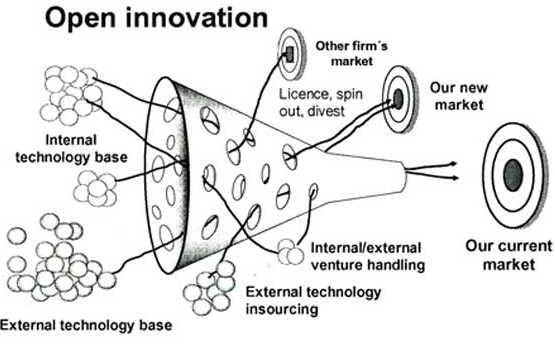
- organizations need new processes, products and business models As organisations seek to innovate: Less emphasis on: • only using your own ideas; • assuming you will be the exploiter of your own ideas; Increasing emphasis on: • Open software; • Open standards • “Crowdsourcing” • Web 2.0 • User groups
- Closed innovation
- Develop products internally, make them oneself and market it oneself -Skilled people in the field already work within the company -profit fully from r&D -control intellectual property (IP) so competitors do not benefit from their research
- Open innovation
- -Not all the smart people in the field work for us. We need to work with smart people inside and outside the company. -R&D is valuable; internal is needed to create some portion of the value -building a better business model is more important than just releasing it first to the market -profit from others' IP-making best use of internal and external ideas Chesbrough open innovation diagram
- EXAMPLES: Nintendo: software developed by partners -Apple: most things are shared features but operating system is closed innovation
Operations Strategy
- -total pattern of decisions and actions which set the role, objectives and activities of the operation so that they contribute to and support the organization's business strategy
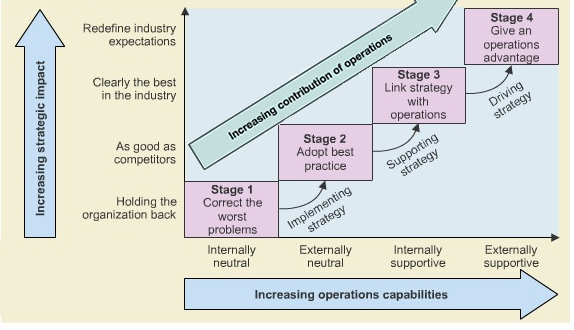
- Hayes and Wheelwright's model
- Internally neutral
- poorest level of contribution to the operations function -other functions regard this as holding them back from competing effectively -little positive to contributing towards success
- avoid bigger mistakes; correct problems
- Externally neutral
- operations function is beginning to compare itself with similar companies or organizations in the outside market -trying to be appropriate by adopting best practice for them
- adopt best practice
- Internally supportive
- operations have reached first division in their market -may no be better than their competitors on every aspect of operations performance but they are up with the best -providing a credible operations strategy
- Externally supportive
- subtle difference to stage 3 -operations look to the long term -operations function is becoming central to strategy-making; stage 4 operations are creative and proactive
- Internally neutral
- Objectives
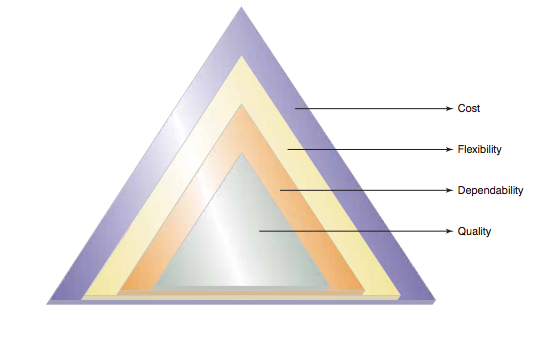
- the sandcone model of operational excellence -quality: doing things right and providing fit services dependability: doing things on time; keeping delivery promises -flexibility: changing what you do or how you do it; ability to adapt -cost: doing things cheaply
- going beyond lean and aiming for agility and flexibility
- Basic Questions
- How do customers see us? Customer perspective What must we excel at? Internal perspective Can we continue to improve andcreate value? Innovation and learning perspective How do we look to shareholders? Financial perspective
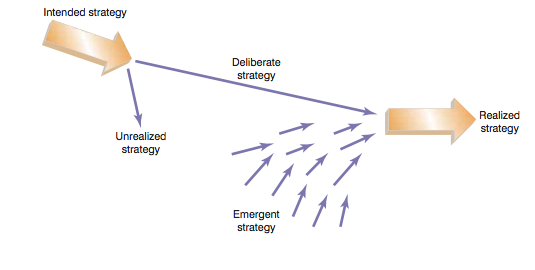
- strategy formation process
- Henry and Mintzberg's view that strategy is formed by a combination of deliberate and emergent actions. An organization has a deliberate strategy, but other strategies will emerge along the way
Bilder und Dateien der Mindmap
Informationen
- Beschreibung
- Mindmap am Operations Management, erstellt von m.andres.brunete am 09/04/2015.
- Erstellt von
- m.andres.brunete
- Aufrufe
- 6
- Bewertung