
Mindmap
Biodiversity
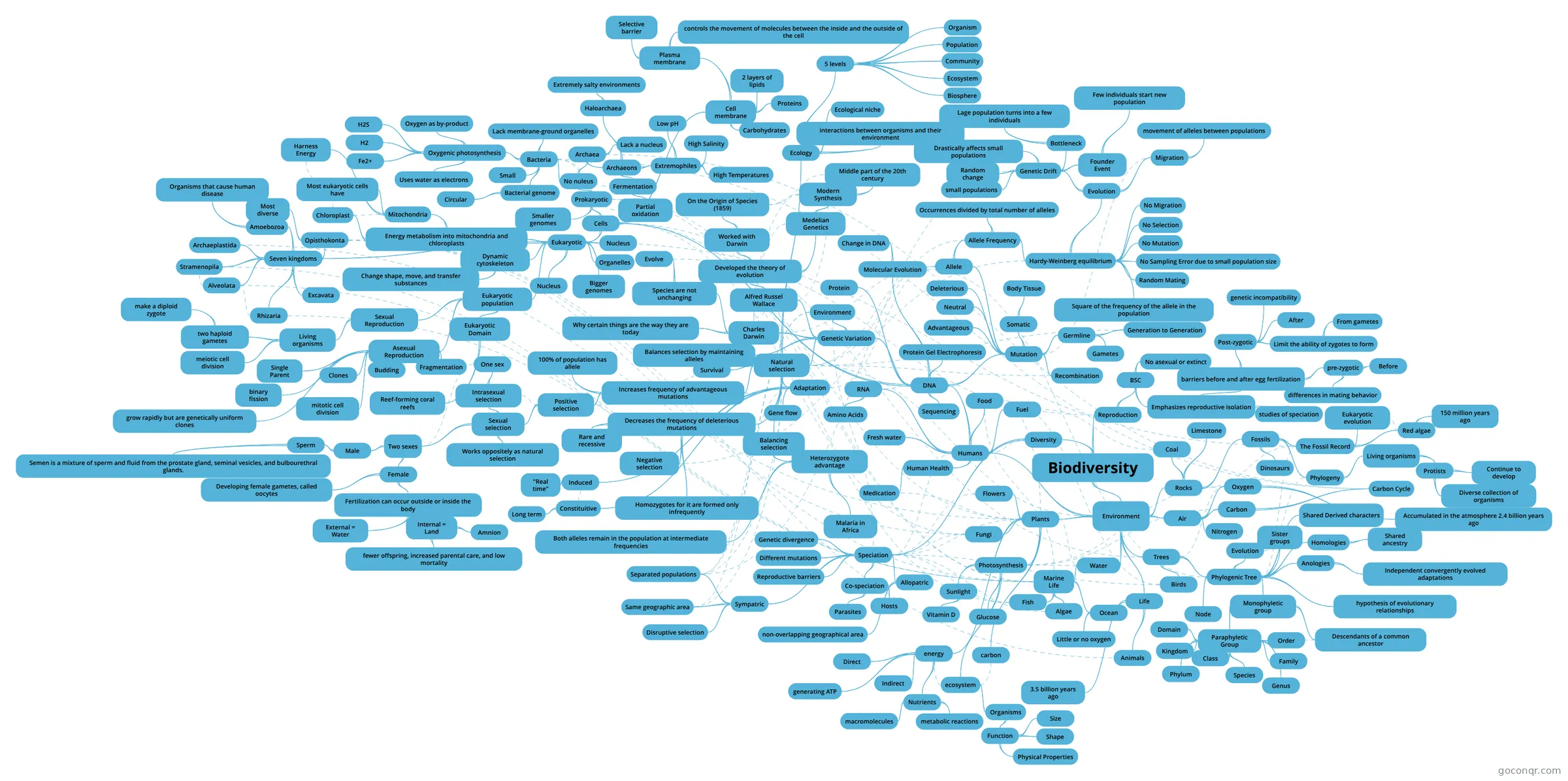
Mind map: Biodiversity
Inhalt der Mindmap
Biodiversity
Environment
- Trees
- Birds
- Phylogenic Tree
- hypothesis of evolutionary relationships
- Sister groups
- Evolution
- Node
- Monophyletic group
- Descendants of a common ancestor
- Paraphyletic Group
- Domain
- Kingdom
- Phylum
- Class
- Order
- Family
- Genus
- Species
- Shared Derived characters
- Homologies
- Shared ancestry
- Anologies
- Independent convergently evolved adaptations
- Water
- Marine Life
- Fish
- Algae
- Ocean
- Little or no oxygen
- Marine Life
- Rocks
- Coal
- Limestone
- Fossils
- Dinosaurs
- The Fossil Record
- Red algae
- 150 million years ago
- Eukaryotic evolution
- Red algae
- Phylogeny
- Living organisms
- Protists
- Diverse collection of organisms
- Continue to develop
- Protists
- Living organisms
- Air
- Oxygen
- Accumulated in the atmosphere 2.4 billion years ago
- Carbon
- Carbon Cycle
- Nitrogen
- Oxygen
- Plants
- Flowers
- Fungi
- Photosynthesis
- Sunlight
- Vitamin D
- Glucose
- ecosystem
- Organisms
- Function
- Size
- Shape
- Physical Properties
- Function
- Organisms
- Sunlight
- energy
- Direct
- Indirect
- Nutrients
- macromolecules
- metabolic reactions
- generating ATP
- carbon
- Humans
- Human Health
- Medication
- Fresh water
- Food
- Fuel
- DNA
- Protein
- Mutation
- Recombination
- Somatic
- Body Tissue
- Germline
- Gametes
- Generation to Generation
- Allele
- Allele Frequency
- Occurrences divided by total number of alleles
- Hardy-Weinberg equilibrium
- Evolution
- Genetic Drift
- small populations
- Random change
- Drastically affects small populations
- Bottleneck
- Lage population turns into a few individuals
- Founder Event
- Few individuals start new population
- Migration
- movement of alleles between populations
- Genetic Drift
- No Selection
- No Migration
- No Mutation
- No Sampling Error due to small population size
- Random Mating
- Square of the frequency of the allele in the population
- Evolution
- Allele Frequency
- Deleterious
- Neutral
- Advantageous
- Genetic Variation
- Environment
- Natural selection
- Survival
- Adaptation
- Gene flow
- Induced
- "Real time"
- Constituitive
- Long term
- Increases frequency of advantageous mutations
- 100% of population has allele
- Positive selection
- Sexual selection
- Works oppositely as natural selection
- Intrasexual selection
- One sex
- Two sexes
- Male
- Sperm
- Semen is a mixture of sperm and fluid from the prostate gland, seminal vesicles, and bulbourethral glands.
- Sperm
- Female
- Fertilization can occur outside or inside the body
- External = Water
- Internal = Land
- Amnion
- fewer offspring, increased parental care, and low mortality
- Developing female gametes, called oocytes
- Fertilization can occur outside or inside the body
- Male
- Sexual selection
- Decreases the frequency of deleterious mutations
- Negative selection
- Rare and recessive
- Homozygotes for it are formed only infrequently
- Balancing selection
- Heterozygote advantage
- Both alleles remain in the population at intermediate frequencies
- Malaria in Africa
- Heterozygote advantage
- Ecology
- Ecological niche
- interactions between organisms and their environment
- 5 levels
- Organism
- Population
- Community
- Ecosystem
- Biosphere
- Charles Darwin
- Species are not unchanging
- Evolve
- Why certain things are the way they are today
- Species are not unchanging
- Alfred Russel Wallace
- Developed the theory of evolution
- Worked with Darwin
- On the Origin of Species (1859)
- Medelian Genetics
- Modern Synthesis
- Middle part of the 20th century
- Modern Synthesis
- Worked with Darwin
- Developed the theory of evolution
- Balances selection by maintaining alleles
- Protein Gel Electrophoresis
- Sequencing
- Molecular Evolution
- Change in DNA
- Cells
- Prokaryotic
- No nuleus
- Bacteria
- Small
- Lack membrane-ground organelles
- Bacterial genome
- Circular
- Oxygenic photosynthesis
- Uses water as electrons
- Oxygen as by-product
- H2S
- H2
- Fe2+
- Archaea
- Lack a nucleus
- Archaeons
- Extremophiles
- Low pH
- High Salinity
- High Temperatures
- Fermentation
- Partial oxidation
- Haloarchaea
- Extremely salty environments
- Extremophiles
- Bacteria
- Smaller genomes
- No nuleus
- Eukaryotic
- Nucleus
- Organelles
- Nucleus
- Dynamic cytoskeleton
- Change shape, move, and transfer substances
- Energy metabolism into mitochondria and chloroplasts
- Mitochondria
- Most eukaryotic cells have
- Harness Energy
- Chloroplast
- Mitochondria
- Bigger genomes
- Eukaryotic population
- Sexual Reproduction
- Living organisms
- two haploid gametes
- make a diploid zygote
- meiotic cell division
- two haploid gametes
- Living organisms
- Eukaryotic Domain
- Reef-forming coral reefs
- Asexual Reproduction
- Single Parent
- binary fission
- mitotic cell division
- Clones
- Budding
- Fragmentation
- grow rapidly but are genetically uniform clones
- Sexual Reproduction
- Seven kingdoms
- Excavata
- Rhizaria
- Alveolata
- Amoebozoa
- Organisms that cause human disease
- Archaeplastida
- Stramenopila
- Opisthokonta
- Most diverse
- Cell membrane
- 2 layers of lipids
- Proteins
- Carbohydrates
- Plasma membrane
- Selective barrier
- controls the movement of molecules between the inside and the outside of the cell
- Prokaryotic
- RNA
- Amino Acids
- Human Health
- Life
- 3.5 billion years ago
- Animals
- Trees
Reproduction
- BSC
- No asexual or extinct
- Emphasizes reproductive isolation
- studies of speciation
- barriers before and after egg fertilization
- pre-zygotic
- differences in mating behavior
- Before
- Post-zygotic
- genetic incompatibility
- Limit the ability of zygotes to form
- From gametes
- After
- pre-zygotic
- BSC
Diversity
- Speciation
- Genetic divergence
- Different mutations
- Reproductive barriers
- Allopatric
- non-overlapping geographical area
- Sympatric
- Same geographic area
- Disruptive selection
- Separated populations
- Co-speciation
- Parasites
- Hosts
- Speciation
Informationen
- Beschreibung
- Mindmap am Biodiversity, erstellt von Lucas Rogers am 28/08/2020.
- Erstellt von
- Lucas Rogers
- Aufrufe
- 0
- Bewertung