
Mindmap
Thinking
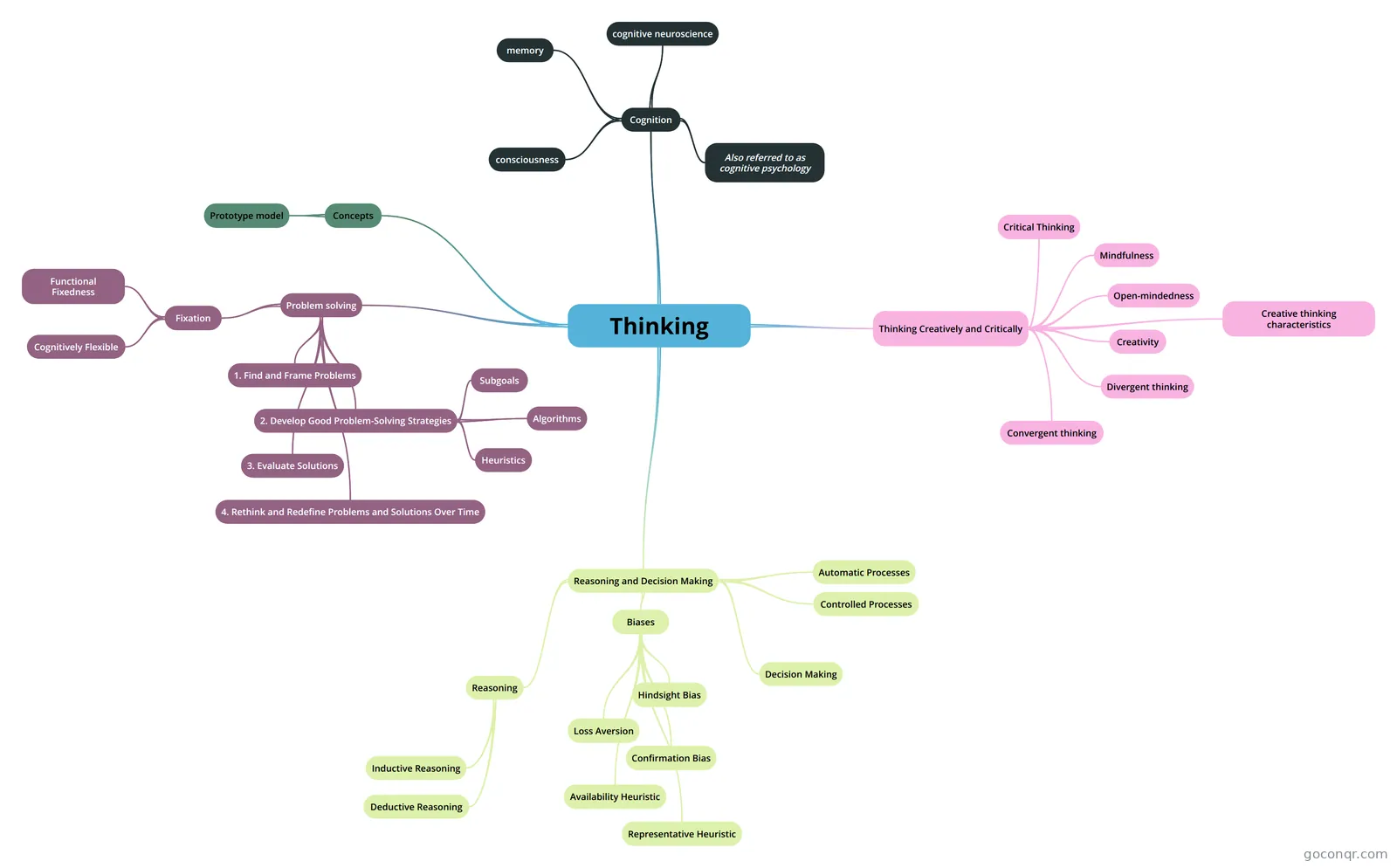
Mind map: Thinking in cognitive psychology
Inhalt der Mindmap
Thinking
- involves manipulating information mentally by forming concepts, solving problems, making decisions, and reflecting in a critical or creative manner.
Cognition
- refers to the way the information is processed and manipulated in remembering, thinking, and knowing; everything we do in our head and the activities we think of as part of the mind
- consciousness
- memory
- cognitive neuroscience
- Also referred to as cognitive psychology
Concepts
- mental categories that are used to group objects, events, and characteristics; allow us to generalize
- Prototype model
- a model emphasizing that when people evaluate whether a given item reflects a certain concept, they compare the item(s) in that category and look for a "family resemblance" with that item's properties
Problem solving
- finding an appropriate way to attain a goal when the goal is not readily available; following many steps and overcoming mental obstacles
- 1. Find and Frame Problems
- recognizing that a problem exists and then considering exactly what the problem involves
- 2. Develop Good Problem-Solving Strategies
- we need to develop strategies for solving the problem
- Subgoals
- intermediate goals or intermediate problems we devise to put us in a better position for reaching a final goal or solution
- Algorithms
- strategies- including formulas, instructions, and the testing of all possible solutions- that guarantee a solution to a problem
- Heuristics
- Shortcut strategies or guidelines that suggest a solution to a problem but do not guarantee an answer
- 3. Evaluate Solutions
- finding how effective our solution is when we try solving the problem
- 4. Rethink and Redefine Problems and Solutions Over Time
- good problem solvers tend to be more motivated than the average person to improve on their past performances
- Fixation
- using a prior strategy and failing to look at a problem from a new perspective
- Functional Fixedness
- failing to solve a problem as a result of fixation on a thing's usual functions
- Cognitively Flexible
- recognizing that options are available and adapting to the situation
Reasoning and Decision Making
- Reasoning
- mental activity of transformation information to reach a conclusion; weighing arguments, applying rules of logic, and coming up with sound conclusions
- Inductive Reasoning
- involves reasoning from specific observations to make generalizations; bottom-up processing
- Deductive Reasoning
- reasoning from a general principle that we know to be true to a specific instance; drawing conclusions based on facts
- Decision Making
- the mental activity of evaluating alternatives and choosing among them; some information might be missing when a final claim is made
- Automatic Processes
- occur without awareness or effort
- Controlled Processes
- deliberate reflection and conscious control of action
- Biases
- Loss Aversion
- the tendency to strongly prefer to avoid losses compared to acquiring gains
- Confirmation Bias
- the tendency to search for and use information that supports our ideas rather than refutes
- Hindsight Bias
- the tendency to report falsely, after the fact, that we accurately predicted an outcome
- Availability Heuristic
- prediction about probability of an event based on the ease of recalling or imagining similar events
- Representative Heuristic
- the tendency to make judgements about group membership based on physical appearance or the match between a person and one's stereotype of a group rather than on available base rate information
- Loss Aversion
- Reasoning
Thinking Creatively and Critically
- Critical Thinking
- thinking reflectively and productively and evaluating the evidence; grasping the deeper meaning, maintaining a sense of humility about what we know, vital to effective problem solving
- Mindfulness
- the state of being alert and mentally present for one's everyday activities
- Open-mindedness
- the state of being receptive to other ways of looking at things
- Creativity
- the ability to think about something in novel and unusual ways and to devise unconventional solutions to problems
- Divergent thinking
- produces many solutions to the same problem; occurs during brainstorming
- Convergent thinking
- produces the single best solution to a problem
- Creative thinking characteristics
- flexibility and playful thinking; work goes smoothly if taken lightly
- inner motivation; creative people are motivated by the joy of creating, they are motivated by internal factors
- willingness to face risk; creative people make more mistakes than less creative people
- objective evaluation of work; strive to evaluate work objectively, will further creative thinking improve work?
- Critical Thinking
Informationen
- Beschreibung
- Psychology (Thinking) Mindmap am Thinking, erstellt von Emily DeMinico am 03/11/2020.
- Erstellt von
- Emily DeMinico
- Aufrufe
- 0
- Bewertung
Mehr zu Problem Solving and Creativity