
Mindmap
Job Analysis
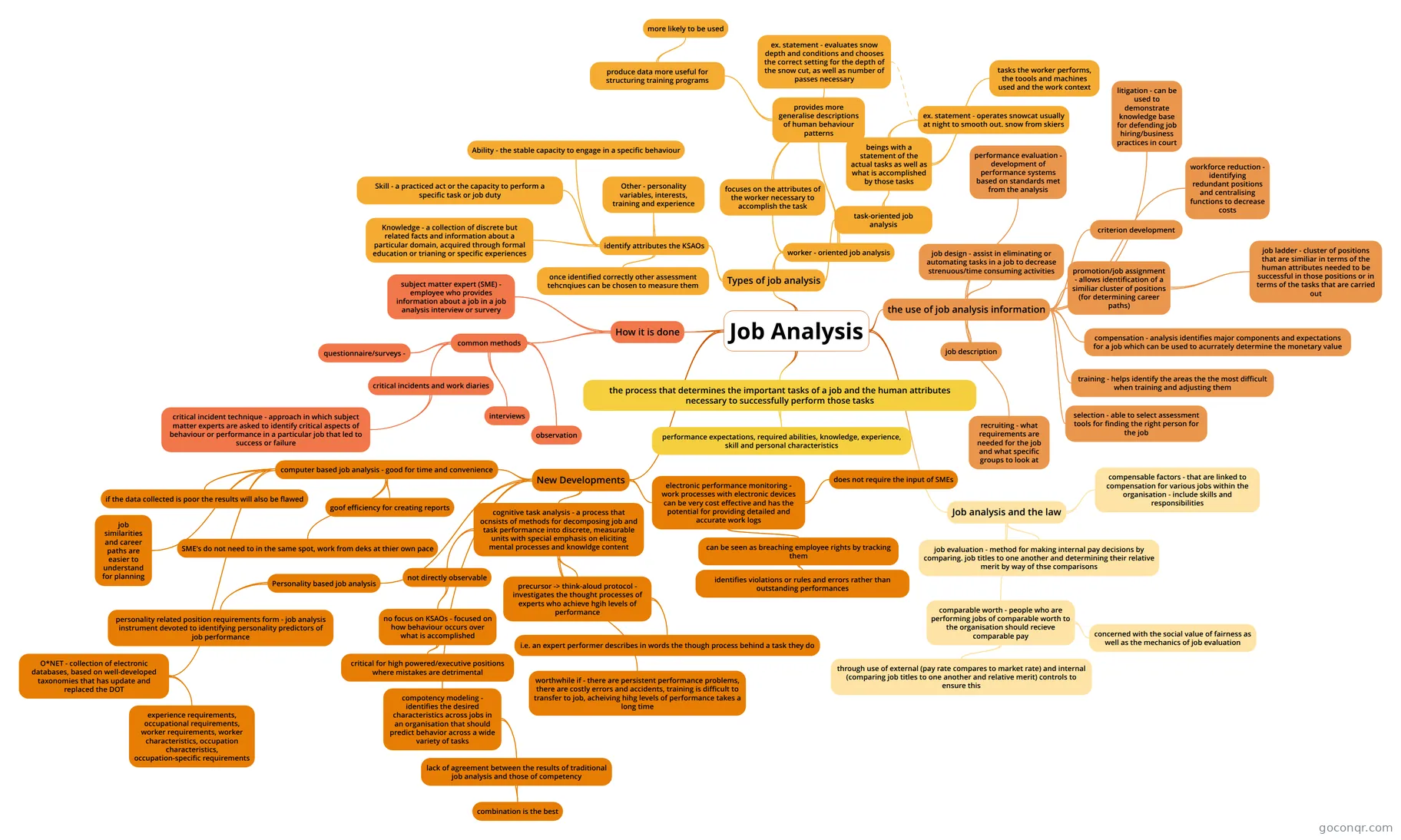
Mind map: job analysis
Inhalt der Mindmap
Job Analysis
the process that determines the important tasks of a job and the human attributes necessary to successfully perform those tasks
- performance expectations, required abilities, knowledge, experience, skill and personal characteristics
the use of job analysis information
- job description
- recruiting - what requirements are needed for the job and what specific groups to look at
- selection - able to select assessment tools for finding the right person for the job
- training - helps identify the areas the the most difficult when training and adjusting them
- compensation - analysis identifies major components and expectations for a job which can be used to acurrately determine the monetary value
- promotion/job assignment - allows identification of a similiar cluster of positions (for determining career paths)
- job ladder - cluster of positions that are similiar in terms of the human attributes needed to be successful in those positions or in terms of the tasks that are carried out
- job design - assist in eliminating or automating tasks in a job to decrease strenuous/time consuming activities
- workforce reduction - identifying redundant positions and centralising functions to decrease costs
- criterion development
- performance evaluation - development of performance systems based on standards met from the analysis
- litigation - can be used to demonstrate knowledge base for defending job hiring/business practices in court
Types of job analysis
- task-oriented job analysis
- beings with a statement of the actual tasks as well as what is accomplished by those tasks
- ex. statement - operates snowcat usually at night to smooth out. snow from skiers
- tasks the worker performs, the toools and machines used and the work context
- beings with a statement of the actual tasks as well as what is accomplished by those tasks
- worker - oriented job analysis
- focuses on the attributes of the worker necessary to accomplish the task
- ex. statement - evaluates snow depth and conditions and chooses the correct setting for the depth of the snow cut, as well as number of passes necessary
- provides more generalise descriptions of human behaviour patterns
- produce data more useful for structuring training programs
- more likely to be used
- produce data more useful for structuring training programs
- focuses on the attributes of the worker necessary to accomplish the task
- identify attributes the KSAOs
- Ability - the stable capacity to engage in a specific behaviour
- Knowledge - a collection of discrete but related facts and information about a particular domain, acquired through formal education or trianing or specific experiences
- Skill - a practiced act or the capacity to perform a specific task or job duty
- Other - personality variables, interests, training and experience
- once identified correctly other assessment tehcnqiues can be chosen to measure them
- task-oriented job analysis
How it is done
- subject matter expert (SME) - employee who provides information about a job in a job analysis interview or survery
- common methods
- observation
- interviews
- critical incidents and work diaries
- critical incident technique - approach in which subject matter experts are asked to identify critical aspects of behaviour or performance in a particular job that led to success or failure
- questionnaire/surveys -
New Developments
- electronic performance monitoring - work processes with electronic devices can be very cost effective and has the potential for providing detailed and accurate work logs
- does not require the input of SMEs
- can be seen as breaching employee rights by tracking them
- identifies violations or rules and errors rather than outstanding performances
- cognitive task analysis - a process that ocnsists of methods for decomposing job and task performance into discrete, measurable units with special emphasis on eliciting mental processes and knowldge content
- precursor -> think-aloud protocol - investigates the thought processes of experts who achieve hgih levels of performance
- i.e. an expert performer describes in words the though process behind a task they do
- not directly observable
- no focus on KSAOs - focused on how behaviour occurs over what is accomplished
- critical for high powered/executive positions where mistakes are detrimental
- no focus on KSAOs - focused on how behaviour occurs over what is accomplished
- worthwhile if - there are persistent performance problems, there are costly errors and accidents, training is difficult to transfer to job, acheiving hihg levels of performance takes a long time
- precursor -> think-aloud protocol - investigates the thought processes of experts who achieve hgih levels of performance
- Personality based job analysis
- personality related position requirements form - job analysis instrument devoted to identifying personality predictors of job performance
- computer based job analysis - good for time and convenience
- SME's do not need to in the same spot, work from deks at thier own pace
- goof efficiency for creating reports
- job similarities and career paths are easier to understand for planning
- if the data collected is poor the results will also be flawed
- O*NET - collection of electronic databases, based on well-developed taxonomies that has update and replaced the DOT
- experience requirements, occupational requirements, worker requirements, worker characteristics, occupation characteristics, occupation-specific requirements
- compotency modeling - identifies the desired characteristics across jobs in an organisation that should predict behavior across a wide variety of tasks
- lack of agreement between the results of traditional job analysis and those of competency
- combination is the best
- lack of agreement between the results of traditional job analysis and those of competency
- electronic performance monitoring - work processes with electronic devices can be very cost effective and has the potential for providing detailed and accurate work logs
Job analysis and the law
- job evaluation - method for making internal pay decisions by comparing. job titles to one another and determining their relative merit by way of thse comparisons
- compensable factors - that are linked to compensation for various jobs within the organisation - include skills and responsibilities
- comparable worth - people who are performing jobs of comparable worth to the organisation should recieve comparable pay
- through use of external (pay rate compares to market rate) and internal (comparing job titles to one another and relative merit) controls to ensure this
- concerned with the social value of fairness as well as the mechanics of job evaluation
Informationen
- Beschreibung
- Psychology Mindmap am Job Analysis, erstellt von Brooke hannah am 07/11/2020.
- Erstellt von
- Brooke hannah
- Aufrufe
- 1
- Bewertung
Mehr zu Job Analysis and Design