
Mindmap
Loftus and Palmer 1974
Inhalt der Mindmap
Loftus and Palmer 1974
Experiment 1
- Method
- Lab experiment
- 1hr 30
- 45 participants (University of Washington)
- 5 conditions (5 groups of 9)
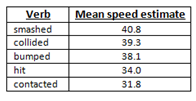
- 'About how fast were the cars going when they ***** each other?'
- SMASHED, HIT, COLLIDED, BUMPED, CONTACTED
- 5 conditions (5 groups of 9)
- Hypothesis: "The participants estimate of speed will increase with the degree of violence suggested by the question concerning the car crash."
- Aim: Whether the wording of a question can influence the memory recalled.
- DV: the estimated speed
- IV: verb in critical question
- Aim: Whether the wording of a question can influence the memory recalled.
- 7 film-clips of traffic accidents
- After each clip, students were asked to write an account of the accident they had just seen
- short excerpts from safety films made for driver education
- Lab experiment
- Results
- Conclusions/ Findings
- The form of a question can affect a witness' answer.
- Humans are inaccurate at judging the speed of vehicles.
- results may have been distorted the memory of the participant: it may have been distorted by the verbal label which had been used to characterise the intensity of the crash.
- 'smashed' elicited the highest speed estimate, and 'contacted' the lowest.
- Conclusions/ Findings
- Method
Experiment 2
- Method
- Aim: they wanted to find out if the participants memories really had been distorted by the verbal label.
- IV: Wording of question (hit/smashed)
- DV: answer to critical Q (Y/N)
- Lab Experiment
- 150 student participants
- Independent Measures
- Participants returned one week later and answered questions about the accident.
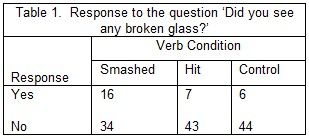
- Critical question: 'Did you see any broken glass?' was part of a series of questions in a random position on each participants question paper. There was no broken glass in the film.
- all viewed a short (1 minute) film which contained a 4 second scene of a multiple car accident
- 3 condition groups of 50 (SMASHED, HIT, CONTROL)
- How fast were the cars going when they ****** each other??
- Aim: they wanted to find out if the participants memories really had been distorted by the verbal label.
- Results
- the verb 'smashed' had a significant effect on the mis-perception of glass in the film. Participants in the 'smashed' group were more than twice as likely to recall seeing broken glass.
- Practical Applications
- highlights the danger of 'leading questions' and shows how eye witness testimonies are unreliable for legal authorities such as the Police.
- Method
Evaluation
- Strengths
- Lab experiment- high and precise controls
- Cause and effect relationship could be established
- Precise controls of variables e.g. being asked the same question etc
- Lab experiment- high and precise controls
- Weaknesses
- Low ecological validity- set in a lab.
- Demand Characteristics
- response-bias- participants may be unsure of the speed and adjust estimate to fit expectations of the questioner.
- Sample: Students are not representative of the general population
- they may be less experienced drivers and therefore less confident in their ability to estimate speeds
- Strengths
Background
- demonstrate that memory is not a factual recording of an event and can become distorted by other information which occurs after the event.
- demonstrated through leading questions how it is possible to distort a person’s memory of an event.
- demonstrate that memory is not a factual recording of an event and can become distorted by other information which occurs after the event.
Bilder und Dateien der Mindmap
Informationen
- Beschreibung
- Loftus, E.F. & Palmer, J.C. (1974) Reconstruction of auto-mobile destruction: An example of the interaction between language and memory.
- Erstellt von
- katherine.crick · Nov 2013
- Aktualisiert
- 7 Jun 2016
- Aufrufe
- 505
- Tags
- Bewertung