
Mindmap
Byzantine Iconoclasm
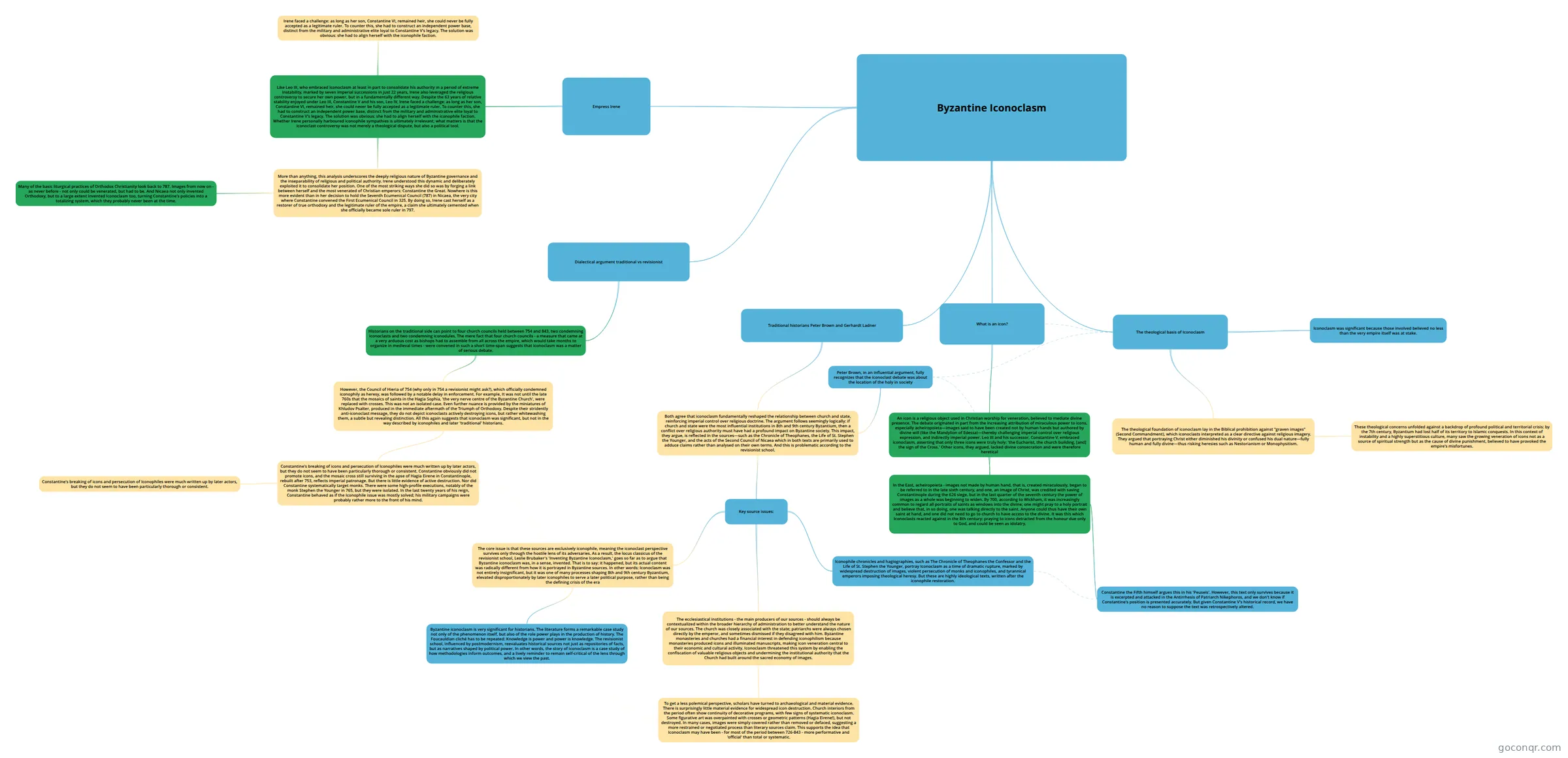
Mind map: Byzantine iconoclasm
Inhalt der Mindmap
Byzantine Iconoclasm
What is an icon?
- An icon is a religious object used in Christian worship for veneration, believed to mediate divine presence. The debate originated in part from the increasing attribution of miraculous power to icons, especially acheiropoieta—images said to have been created not by human hands but authored by divine will (like the Mandylion of Edessa)—thereby challenging imperial control over religious expression, and indirectly imperial power. Leo III and his successor, Constantine V, embraced iconoclasm, asserting that only three icons were truly holy: 'the Eucharist, the church building, [and] the sign of the Cross.' Other icons, they argued, lacked divine consecration and were therefore heretical
- In the East, acheiropoieta - images not made by human hand, that is, created miraculously, began to be referred to in the late sixth century, and one, an image of Christ, was credited with saving Constantinople during the 626 siege. but in the last quarter of the seventh century the power of images as a whole was beginning to widen. By 700, according to Wickham, it was increasingly common to regard all portraits of saints as windows into the divine; one might pray to a holy portrait and believe that, in so doing, one was talking directly to the saint. Anyone could thus have their own saint at hand, and one did not need to go to church to have access to the divine. It was this which Iconoclasts reacted against in the 8th century: praying to icons detracted from the honour due only to God, and could be seen as idolatry.
- Constantine the Fifth himself argues this in his 'Peuseis'. However, this text only survives because it is excerpted and attacked in the Antirrhesis of Patriarch Nikephoros, and we don't know if Constantine's position is presented accurately. But given Constantine V's historical record, we have no reason to suppose the text was retrospectively altered.
- In the East, acheiropoieta - images not made by human hand, that is, created miraculously, began to be referred to in the late sixth century, and one, an image of Christ, was credited with saving Constantinople during the 626 siege. but in the last quarter of the seventh century the power of images as a whole was beginning to widen. By 700, according to Wickham, it was increasingly common to regard all portraits of saints as windows into the divine; one might pray to a holy portrait and believe that, in so doing, one was talking directly to the saint. Anyone could thus have their own saint at hand, and one did not need to go to church to have access to the divine. It was this which Iconoclasts reacted against in the 8th century: praying to icons detracted from the honour due only to God, and could be seen as idolatry.
- An icon is a religious object used in Christian worship for veneration, believed to mediate divine presence. The debate originated in part from the increasing attribution of miraculous power to icons, especially acheiropoieta—images said to have been created not by human hands but authored by divine will (like the Mandylion of Edessa)—thereby challenging imperial control over religious expression, and indirectly imperial power. Leo III and his successor, Constantine V, embraced iconoclasm, asserting that only three icons were truly holy: 'the Eucharist, the church building, [and] the sign of the Cross.' Other icons, they argued, lacked divine consecration and were therefore heretical
Traditional historians Peter Brown and Gerhardt Ladner
- Both agree that iconoclasm fundamentally reshaped the relationship between church and state, reinforcing imperial control over religious doctrine. The argument follows seemingly logically: if church and state were the most influential institutions in 8th and 9th century Byzantium, then a conflict over religious authority must have had a profound impact on Byzantine society. This impact, they argue, is reflected in the sources—such as the Chronicle of Theophanes, the Life of St. Stephen the Younger, and the acts of the Second Council of Nicaea which in both texts are primarily used to adduce claims rather than analysed on their own terms. And this is problematic according to the revisionist school.
- Key source issues:
- The core issue is that these sources are exclusively iconophile, meaning the iconoclast perspective survives only through the hostile lens of its adversaries. As a result, the locus classicus of the revisionist school, Leslie Brubaker's 'Inventing Byzantine Iconoclasm,' goes so far as to argue that Byzantine iconoclasm was, in a sense, invented. That is to say: it happened, but its actual content was radically different from how it is portrayed in Byzantine sources. In other words: Iconoclasm was not entirely insignificant, but it was one of many processes shaping 8th and 9th century Byzantium, elevated disproportionately by later iconophiles to serve a later political purpose, rather than being the defining crisis of the era
- Byzantine iconoclasm is very significant for historians. The literature forms a remarkable case study not only of the phenomenon itself, but also of the role power plays in the production of history. The Foucauldian cliché has to be repeated: Knowledge is power and power is knowledge. The revisionist school, influenced by postmodernism, reevaluates historical sources not just as repositories of facts, but as narratives shaped by political power. In other words, the story of iconoclasm is a case study of how methodologies inform outcomes, and a lively reminder to remain self-critical of the lens through which we view the past.
- The ecclesiastical institutions - the main producers of our sources - should always be contextualized within the broader hierarchy of administration to better understand the nature of our sources. The church was closely associated with the state; patriarchs were always chosen directly by the emperor, and sometimes dismissed if they disagreed with him. Byzantine monasteries and churches had a financial interest in defending iconophilism because monasteries produced icons and illuminated manuscripts, making icon veneration central to their economic and cultural activity. Iconoclasm threatened this system by enabling the confiscation of valuable religious objects and undermining the institutional authority that the Church had built around the sacred economy of images.
- To get a less polemical perspective, scholars have turned to archaeological and material evidence. There is surprisingly little material evidence for widespread icon destruction. Church interiors from the period often show continuity of decorative programs, with few signs of systematic iconoclasm. Some figurative art was overpainted with crosses or geometric patterns (Hagia Eirene!), but not destroyed. In many cases, images were simply covered rather than removed or defaced, suggesting a more restrained or negotiated process than literary sources claim. This supports the idea that Iconoclasm may have been - for most of the period between 726-843 - more performative and 'official' than total or systematic.
- Iconophile chronicles and hagiographies, such as The Chronicle of Theophanes the Confessor and the Life of St. Stephen the Younger, portray Iconoclasm as a time of dramatic rupture, marked by widespread destruction of images, violent persecution of monks and iconophiles, and tyrannical emperors imposing theological heresy. But these are highly ideological texts, written after the iconophile restoration.
- The core issue is that these sources are exclusively iconophile, meaning the iconoclast perspective survives only through the hostile lens of its adversaries. As a result, the locus classicus of the revisionist school, Leslie Brubaker's 'Inventing Byzantine Iconoclasm,' goes so far as to argue that Byzantine iconoclasm was, in a sense, invented. That is to say: it happened, but its actual content was radically different from how it is portrayed in Byzantine sources. In other words: Iconoclasm was not entirely insignificant, but it was one of many processes shaping 8th and 9th century Byzantium, elevated disproportionately by later iconophiles to serve a later political purpose, rather than being the defining crisis of the era
- Peter Brown, in an influential argument, fully recognizes that the iconoclast debate was about the location of the holy in society
- Key source issues:
- Both agree that iconoclasm fundamentally reshaped the relationship between church and state, reinforcing imperial control over religious doctrine. The argument follows seemingly logically: if church and state were the most influential institutions in 8th and 9th century Byzantium, then a conflict over religious authority must have had a profound impact on Byzantine society. This impact, they argue, is reflected in the sources—such as the Chronicle of Theophanes, the Life of St. Stephen the Younger, and the acts of the Second Council of Nicaea which in both texts are primarily used to adduce claims rather than analysed on their own terms. And this is problematic according to the revisionist school.
Dialectical argument traditional vs revisionist
- Historians on the traditional side can point to four church councils held between 754 and 843, two condemning iconoclasts and two condemning iconodules. The mere fact that four church councils - a measure that came at a very arduous cost as bishops had to assemble from all across the empire, which would take months to organize in medieval times - were convened in such a short time-span suggests that iconoclasm was a matter of serious debate.
- However, the Council of Hieria of 754 (why only in 754 a revisionist might ask?), which officially condemned iconophily as heresy, was followed by a notable delay in enforcement. For example, It was not until the late 760s that the mosaics of saints in the Hagia Sophia, 'the very nerve centre of the Byzantine Church', were replaced with crosses. This was not an isolated case. Even further nuance is provided by the miniatures of Khludov Psalter, produced in the immediate aftermath of the Triumph of Orthodoxy. Despite their stridently anti-iconoclast message, they do not depict iconoclasts actively destroying icons, but rather whitewashing them, a subtle but revealing distinction. All this again suggests that iconoclasm was significant, but not in the way described by iconophiles and later 'traditional' historians.
- Constantine's breaking of icons and persecution of Iconophiles were much written up by later actors, but they do not seem to have been particularly thorough or consistent. Constantine obviously did not promote icons, and the mosaic cross still surviving in the apse of Hagia Eirene in Constantinople, rebuilt after 753, reflects imperial patronage. But there is little evidence of active destruction. Nor did Constantine systematically target monks. There were some high-profile executions, notably of the monk Stephen the Younger in 765, but they were isolated. In the last twenty years of his reign, Constantine behaved as if the Iconophile issue was mostly solved; his military campaigns were probably rather more to the front of his mind.
- Constantine's breaking of icons and persecution of Iconophiles were much written up by later actors, but they do not seem to have been particularly thorough or consistent.
- Constantine's breaking of icons and persecution of Iconophiles were much written up by later actors, but they do not seem to have been particularly thorough or consistent. Constantine obviously did not promote icons, and the mosaic cross still surviving in the apse of Hagia Eirene in Constantinople, rebuilt after 753, reflects imperial patronage. But there is little evidence of active destruction. Nor did Constantine systematically target monks. There were some high-profile executions, notably of the monk Stephen the Younger in 765, but they were isolated. In the last twenty years of his reign, Constantine behaved as if the Iconophile issue was mostly solved; his military campaigns were probably rather more to the front of his mind.
- However, the Council of Hieria of 754 (why only in 754 a revisionist might ask?), which officially condemned iconophily as heresy, was followed by a notable delay in enforcement. For example, It was not until the late 760s that the mosaics of saints in the Hagia Sophia, 'the very nerve centre of the Byzantine Church', were replaced with crosses. This was not an isolated case. Even further nuance is provided by the miniatures of Khludov Psalter, produced in the immediate aftermath of the Triumph of Orthodoxy. Despite their stridently anti-iconoclast message, they do not depict iconoclasts actively destroying icons, but rather whitewashing them, a subtle but revealing distinction. All this again suggests that iconoclasm was significant, but not in the way described by iconophiles and later 'traditional' historians.
- Historians on the traditional side can point to four church councils held between 754 and 843, two condemning iconoclasts and two condemning iconodules. The mere fact that four church councils - a measure that came at a very arduous cost as bishops had to assemble from all across the empire, which would take months to organize in medieval times - were convened in such a short time-span suggests that iconoclasm was a matter of serious debate.
Empress Irene
- Like Leo III, who embraced Iconoclasm at least in part to consolidate his authority in a period of extreme instability, marked by seven imperial successions in just 22 years, Irene also leveraged the religious controversy to secure her own power, but in a fundamentally different way. Despite the 63 years of relative stability enjoyed under Leo III, Constantine V and his son, Leo IV, Irene faced a challenge: as long as her son, Constantine VI, remained heir, she could never be fully accepted as a legitimate ruler. To counter this, she had to construct an independent power base, distinct from the military and administrative elite loyal to Constantine V's legacy. The solution was obvious: she had to align herself with the iconophile faction. Whether Irene personally harboured iconophile sympathies is ultimately irrelevant; what matters is that the iconoclast controversy was not merely a theological dispute, but also a political tool.
- More than anything, this analysis underscores the deeply religious nature of Byzantine governance and the inseparability of religious and political authority. Irene understood this dynamic and deliberately exploited it to consolidate her position. One of the most striking ways she did so was by forging a link between herself and the most venerated of Christian emperors: Constantine the Great. Nowhere is this more evident than in her decision to hold the Seventh Ecumenical Council (787) in Nicaea, the very city where Constantine convened the First Ecumenical Council in 325. By doing so, Irene cast herself as a restorer of true orthodoxy and the legitimate ruler of the empire, a claim she ultimately cemented when she officially became sole ruler in 797.
- Many of the basic liturgical practices of Orthodox Christianity look back to 787. Images from now on - as never before - not only could be venerated, but had to be. And Nicaea not only invented Orthodoxy, but to a large extent invented Iconoclasm too, turning Constantine's policies into a totalizing system, which they probably never been at the time.
- Irene faced a challenge: as long as her son, Constantine VI, remained heir, she could never be fully accepted as a legitimate ruler. To counter this, she had to construct an independent power base, distinct from the military and administrative elite loyal to Constantine V's legacy. The solution was obvious: she had to align herself with the iconophile faction.
- More than anything, this analysis underscores the deeply religious nature of Byzantine governance and the inseparability of religious and political authority. Irene understood this dynamic and deliberately exploited it to consolidate her position. One of the most striking ways she did so was by forging a link between herself and the most venerated of Christian emperors: Constantine the Great. Nowhere is this more evident than in her decision to hold the Seventh Ecumenical Council (787) in Nicaea, the very city where Constantine convened the First Ecumenical Council in 325. By doing so, Irene cast herself as a restorer of true orthodoxy and the legitimate ruler of the empire, a claim she ultimately cemented when she officially became sole ruler in 797.
- Like Leo III, who embraced Iconoclasm at least in part to consolidate his authority in a period of extreme instability, marked by seven imperial successions in just 22 years, Irene also leveraged the religious controversy to secure her own power, but in a fundamentally different way. Despite the 63 years of relative stability enjoyed under Leo III, Constantine V and his son, Leo IV, Irene faced a challenge: as long as her son, Constantine VI, remained heir, she could never be fully accepted as a legitimate ruler. To counter this, she had to construct an independent power base, distinct from the military and administrative elite loyal to Constantine V's legacy. The solution was obvious: she had to align herself with the iconophile faction. Whether Irene personally harboured iconophile sympathies is ultimately irrelevant; what matters is that the iconoclast controversy was not merely a theological dispute, but also a political tool.
The theological basis of Iconoclasm
- The theological foundation of iconoclasm lay in the Biblical prohibition against "graven images" (Second Commandment), which iconoclasts interpreted as a clear directive against religious imagery. They argued that portraying Christ either diminished his divinity or confused his dual nature—fully human and fully divine—thus risking heresies such as Nestorianism or Monophysitism.
- These theological concerns unfolded against a backdrop of profound political and territorial crisis: by the 7th century, Byzantium had lost half of its territory to Islamic conquests. In this context of instability and a highly superstitious culture, many saw the growing veneration of icons not as a source of spiritual strength but as the cause of divine punishment, believed to have provoked the empire's misfortunes.
- Iconoclasm was significant because those involved believed no less than the very empire itself was at stake.
- The theological foundation of iconoclasm lay in the Biblical prohibition against "graven images" (Second Commandment), which iconoclasts interpreted as a clear directive against religious imagery. They argued that portraying Christ either diminished his divinity or confused his dual nature—fully human and fully divine—thus risking heresies such as Nestorianism or Monophysitism.
Informationen
- Beschreibung
- A level History Mindmap am Byzantine Iconoclasm, erstellt von pepijn spijkers am 24/04/2025.
- Erstellt von
- pepijn spijkers
- Aufrufe
- 0
- Bewertung