
Mindmap
The Psychodynamic Perspective
Inhalt der Mindmap
The Psychodynamic Perspective
- Founded by Sigmund Freud
Assumptions of the Psychdynamic Prospective
- Much of our behaviour is driven by unconscious motives.
- Childhood is a critical period in development.
- Mental disorders arise from unresolved unconscious conflicts originating from childhood.
- Resolution occurs by accessing and coming to terms with repressed ideas and conflicts.
- All bahaviours are shaped by unconscious desires/fears.
- Behaviours are driven by internal factors rather than external factors.
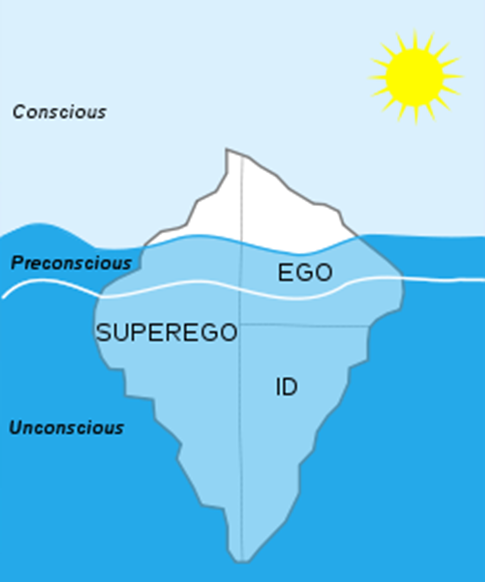
Freud's Tripartite Model
- The Tripartite Model is Frueds way of explaining that the human psych has more than one aspect.
- The part of the mind we are aware of - everyday thoughts and feelings.
- Thoughts and memories not accesable at all times but easily recalled.
- Repressed thoughts, feelings, memories and conflicts.
- Ego - Reality Principal
- Considerate, realistic, rational.
- Ego - Develops around the age of three.
- Superego - Morality Principal
- Uptight, follows rules, worries constantly, wants to be in control.
- Superego - Appears around the age of five.
- ID - Pleasure Princpal
- Selfish, seeks pleasure no matter the coast, hedonistic (engaged in the pursuit of self-indulgence).
- ID - Present at birth.
Defence Mechanisms
- Denial
- Completely rejecting a thought, feeling, memory and so on.
- Projection
- You attribute your own socially unacceptable thought or feeling upon another person/object.
- Suppression
- You are vaugly aware of that thought or feeling but try to hide it.
- Displacement
- You redirect your feelings or thoughts to another target. Place the blame on someone or somewhere else.
- Regression
- You resort back to an old, usually immature, behaviour. For example, curling into the featal position when upset is seen as an act of regression.
- Sublimination
- You redirect the feeling into a socially productive activity. Artists for example will paint, a singer may create a new album, a football player may kick ass (or epically fail) on a football pitch and so on.
- Rationalisation
- You try to justify uncomfortable thoughts or feelings with socially acceptable motives.
- Reaction Formula
- You turn the feeling into it's opposite. (e.g. almost like faking your emotion or deceiting yourself that instead of being sad you are elated.)
- Denial
Freudian Slip
- A Freudian slip is an error in speech, memory or physical action that is interprated as occuring due to the interuption of an unconsious subdued wish, conflict or train of thought guided by the superego and the rules of correct behaviour.
Psychosexual Stages
- Freud believed that every child is born with a libido- a pleasure (sexual) urge.
- There are multiple stages in which children develop and seek a specific 'object' in which they derive pleasure from.
- To be psychologically healthy, every child must successfully complete each stage - mental abnormality can occur is a stage isn't successfully complete and they can become 'fixated'.
- 1) The Oral Stage
- From birth to 16 months
- Oral fixation may result in a passive, immature, gullibal and manipulative personalities.
- Oral receptive (Not allowed to suck freely) - May be passive, needy and sensitive to rejection. Could could excessive smoking, kissing, eating and oral sexual practices.
- Oral aggressive (allowed to suck too often/ to long) - May become hostile, verbally abusive and sarcastic. May cause excessive chewing of the gum and the end of pencils, ect.
- Oral fixation may result in a passive, immature, gullibal and manipulative personalities.
- Obtaining pleasure from the mouth.
- Completion of this stage if successful weening (eating independantly).
- From birth to 16 months
- 2) The Anal Stage
- From 16 months to 3 years
- Anal expulsive and relentive.
- Anal expulsive - Adults who are anally exspulsive will happily share things with you and tend to be of a more disorganised, rebellious and messy persona.
- Anal relentive - Obsessively tidy, hates mess, punctual and respectful of authority. Stubborn and possessive with possessions.
- Anal expulsive and relentive.
- Obtaining pleasure from excreting or retaining feaces.
- Successful completion is marked upon potty training.
- From 16 months to 3 years
- 3) The Phallic Stage
- From 3 to 6 years
- A fixation here can lead to someone being reckless, self-assured, excessively vain and proud.
- Failure to resolve a conflict during this stage can lead to a person being afraid or incapable of relatioships.
- A fixation here can lead to someone being reckless, self-assured, excessively vain and proud.
- Obtaining pleasure from the genital area. This stage is where children identify their sex and the difference between sexes.
- Boys experience the Oedipus complex and Girls the Electra complex.
- Oedipus complex - A boy wanting his mother to be his 'primary love object'.
- Electra Complex is a girl forming an attraction to her father.
- From 3 to 6 years
- 4) The Latency Stage
- From between 4-6 years through to puberty.
- Sexual unfulfillment if fixation occurs at this stage.
- Sexual drives are repressed and/or subliminated into other hobbies, e.g sport.
- Focus on developing into same-sex relationships.
- No specific requirment for successful completion.
- From between 4-6 years through to puberty.
- 5) The Genital Stage
- From puberty and onwards.
- Fridigity, impotency, unsatisfactory relationships.
- Start to develop healthy adult relationships. Pleasure revolves mainly on the genital area.
- "Completion" is sexual intercourse (how riverting).
- Genital stage should occur if earlier stages have been completed.
- From puberty and onwards.
- Time (From and to)
- Estimated
- Consequences of psychological fixation
- What it is and what completion means
Psychoanalysis
- The belief that people could be cured (say a horse phobia) by making an unconscious though conscious. Like Little Hans and his horse/father interpreted issue.
- The aim of Psychoanalysis therepy is to release repressed emotion and memories experiences from the unconscious mind into the conscious mind. It is most commonly used to treat depression and anxiety disorders.
- It is only in having a cathartic* release/experience that someone can be 'cured'.
- Cathartic - Providing psychological relief through the open expression of strong emotions. This can occur through crying, emotional rants, physical activity, ect.
- Assumptions
- Psychoanalytical psychologists see psychological problems as ones rooted to the unconscious mind.
- And to think at the start of this course i couldn't spell 'Psychology' correctly.
- Manifest symptoms are caused by hidden disturbances.
- To 'manifest symptoms' is for symtoms of somthing (say a disorder) to start showing.
- 'Hidden disturbances' may be hidden due to a defence mechanism interfering.
- Typical causes include unresolved issues during development or repressed truma.
- Unresolved issues like the Little Hans Study.
- Treatment focussed on bringing the respressed conflict to the conscious mind, where the patient can deal with it.
- Psychoanalytical psychologists see psychological problems as ones rooted to the unconscious mind.
Bilder und Dateien der Mindmap
Informationen
- Beschreibung
- Finished (Unless I've made a ridiculous mistake, then do feel free to make said mistake apparent).
- Erstellt von
- Robyn Chamberlain
- Aufrufe
- 275
- Tags
- Bewertung