
Mindmap
Adaptation
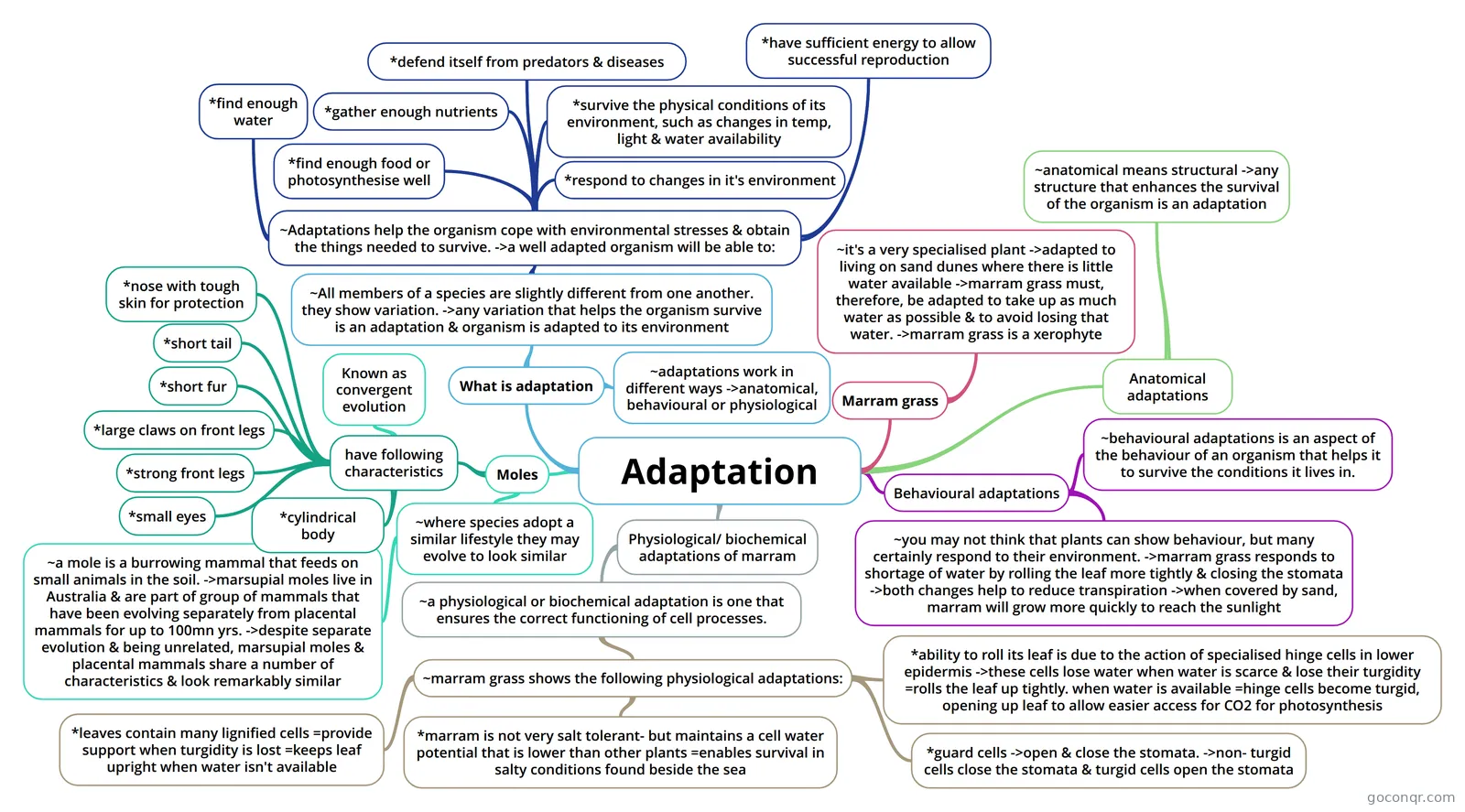
Mind map: Adaptation in biology
Inhalt der Mindmap
Adaptation
What is adaptation
- ~All members of a species are slightly different from one another. they show variation. ->any variation that helps the organism survive is an adaptation & organism is adapted to its environment
- ~Adaptations help the organism cope with environmental stresses & obtain the things needed to survive. ->a well adapted organism will be able to:
- *find enough food or photosynthesise well
- *find enough water
- *gather enough nutrients
- *defend itself from predators & diseases
- *survive the physical conditions of its environment, such as changes in temp, light & water availability
- *respond to changes in it's environment
- *have sufficient energy to allow successful reproduction
- ~Adaptations help the organism cope with environmental stresses & obtain the things needed to survive. ->a well adapted organism will be able to:
- ~adaptations work in different ways ->anatomical, behavioural or physiological
- ~All members of a species are slightly different from one another. they show variation. ->any variation that helps the organism survive is an adaptation & organism is adapted to its environment
Marram grass
- ~it's a very specialised plant ->adapted to living on sand dunes where there is little water available ->marram grass must, therefore, be adapted to take up as much water as possible & to avoid losing that water. ->marram grass is a xerophyte
Anatomical adaptations
- ~anatomical means structural ->any structure that enhances the survival of the organism is an adaptation
Behavioural adaptations
- ~behavioural adaptations is an aspect of the behaviour of an organism that helps it to survive the conditions it lives in.
- ~you may not think that plants can show behaviour, but many certainly respond to their environment. ->marram grass responds to shortage of water by rolling the leaf more tightly & closing the stomata ->both changes help to reduce transpiration ->when covered by sand, marram will grow more quickly to reach the sunlight
Physiological/ biochemical adaptations of marram
- ~a physiological or biochemical adaptation is one that ensures the correct functioning of cell processes.
- ~marram grass shows the following physiological adaptations:
- *ability to roll its leaf is due to the action of specialised hinge cells in lower epidermis ->these cells lose water when water is scarce & lose their turgidity =rolls the leaf up tightly. when water is available =hinge cells become turgid, opening up leaf to allow easier access for CO2 for photosynthesis
- *guard cells ->open & close the stomata. ->non- turgid cells close the stomata & turgid cells open the stomata
- *marram is not very salt tolerant- but maintains a cell water potential that is lower than other plants =enables survival in salty conditions found beside the sea
- *leaves contain many lignified cells =provide support when turgidity is lost =keeps leaf upright when water isn't available
- ~marram grass shows the following physiological adaptations:
- ~a physiological or biochemical adaptation is one that ensures the correct functioning of cell processes.
Moles
- ~where species adopt a similar lifestyle they may evolve to look similar
- ~a mole is a burrowing mammal that feeds on small animals in the soil. ->marsupial moles live in Australia & are part of group of mammals that have been evolving separately from placental mammals for up to 100mn yrs. ->despite separate evolution & being unrelated, marsupial moles & placental mammals share a number of characteristics & look remarkably similar
- have following characteristics
- *cylindrical body
- *small eyes
- *strong front legs
- *large claws on front legs
- *short fur
- *short tail
- *nose with tough skin for protection
- Known as convergent evolution
- ~where species adopt a similar lifestyle they may evolve to look similar
Informationen
- Beschreibung
- AS - Level AS Biology Mindmap am Adaptation, erstellt von S M am 11/04/2016.
- Erstellt von
- S M
- Aufrufe
- 0
- Bewertung