
Mindmap
Piaget's Theory of Cognitive Development
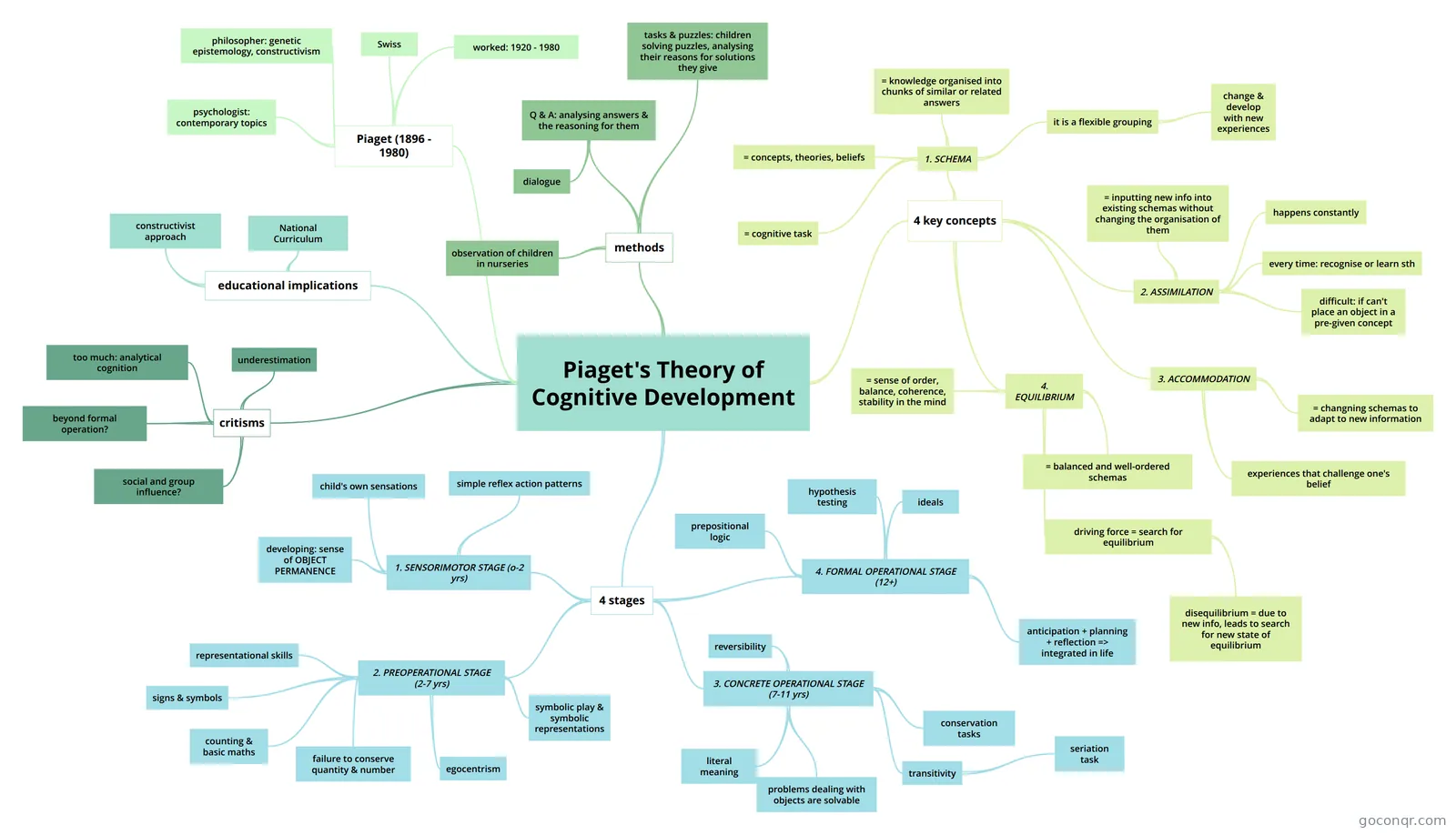
Mind map: Piaget's theory of cognitive development
Inhalt der Mindmap
Piaget's Theory of Cognitive Development
Piaget (1896 - 1980)
- Swiss
- worked: 1920 - 1980
- philosopher: genetic epistemology, constructivism
- psychologist: contemporary topics
methods
- observation of children in nurseries
- Q & A: analysing answers & the reasoning for them
- dialogue
- tasks & puzzles: children solving puzzles, analysing their reasons for solutions they give
4 key concepts
- e.g. equilibrium: familiar with birds - thinks all flying objects are birdsassimiliation: sees an airplane and calls it a birddisequilibrium: notices that places don't have feathers or flat their wingsaccommodation: concludes that places are not birds, but placesorganisation
- 1. SCHEMA
- = knowledge organised into chunks of similar or related answers
- = concepts, theories, beliefs
- it is a flexible grouping
- change & develop with new experiences
- = cognitive task
- 2. ASSIMILATION
- = inputting new info into existing schemas without changing the organisation of them
- happens constantly
- every time: recognise or learn sth
- difficult: if can't place an object in a pre-given concept
- 3. ACCOMMODATION
- = changning schemas to adapt to new information
- experiences that challenge one's belief
- 4. EQUILIBRIUM
- = sense of order, balance, coherence, stability in the mind
- = balanced and well-ordered schemas
- driving force = search for equilibrium
- disequilibrium = due to new info, leads to search for new state of equilibrium
4 stages
- child relies on different type of thinking than an adult does => they go through stages of intellectual growth
- 1. SENSORIMOTOR STAGE (o-2 yrs)
- child's own sensations
- looks at a rattle: does not perceive iit as permanent, independent object => looks away, rattle does not exist anymore
- simple reflex action patterns
- reaching, grasping, sucking
- developing: sense of OBJECT PERMANENCE
- The conviction that an object exists even when it is out of sight. Piaget believed infants didn't develop this level of understanding until the age of at least eight months.
- child's own sensations
- 2. PREOPERATIONAL STAGE (2-7 yrs)
- representational skills
- 1st attempt = a person, usually with a circle for head and two vertical lines for legs
- signs & symbols
- counting & basic maths
- symbolic play & symbolic representations
- through drawing & making models
- failure to conserve quantity & number
- egocentrism
- unable to take the viewpoint of others
- representational skills
- 3. CONCRETE OPERATIONAL STAGE (7-11 yrs)
- know how to interrelate their mental representations concrete operation = ability to abstract a quality from concrete objects (e.g. quantity, weight, number, colour, volume, type)
- problems dealing with objects are solvable
- literal meaning
- conservation tasks
- reversibility
- e.g. mathematica sums & equations can work backwards reversibility difficulties: e.g. mummy and daddy got married twice - mummy got married to daddy and daddy got married to mummy
- transitivity
- A < B, and B < C, therefore A < C
- seriation task
- ability to sort objects or situations according to any characteristic, such as size, color, shape, or type
- 4. FORMAL OPERATIONAL STAGE (12+)
- physics, maths, literature, history
- hypothesis testing
- can guess the outcome of an event before it starts
- anticipation + planning + reflection => integrated in life
- prepositional logic
- if - then statements
- ideals
- motivating visions of the future
educational implications
- constructivist approach
- teaching isn't direct
- National Curriculum
- constructivist approach
critisms
- underestimation
- too much: analytical cognition
- beyond formal operation?
- social and group influence?
Informationen
- Beschreibung
- Other Psychology (General Foundations of Psychology) Mindmap am Piaget's Theory of Cognitive Development, erstellt von Anja Starc am 25/04/2016.
- Erstellt von
- Anja Starc
- Aufrufe
- 1.919
- Tags
- Bewertung