
Mindmap
Enzymes
Inhalt der Mindmap
Enzymes
What are they?
- Function
- Most reactions in living organisms are enzyme- controlled. Without them we the rate of reactions would be slow. This would cause a serious amount of damage.
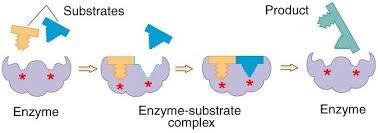
- Enzymes are proteins and have a very specific shape. This means that they are specific to reactions that they catalyse. Meaning one enzyme will react with molecules of one substrate.
- The reactions take place in an area on the surface of the proteins called the active site. Also because the active site for all molecules of one enzyme will be made up of the same arrangement of amino acidsit has a very specific shape.
- Chymotrypsin and trypsin both catalyse the hydrolysis if peptide bond due to their shapes. Also the active site of chymotryspin will only split its bond after an aromatic amino acid. However, trypsin only splits bonds after a basic or a straight chain amino acid.
- Function
The lock and key hypothesis
- Even though the lock and key hypothesis is true, it has been discovered that enzymes for the active site, which are similar shape to the substrate, could fit even though they are larger than the substrate. This means that substrates and active sites are more flexible than the lock and key model portrays.
- Induced fit model
- When the enzyme an substrate bind together, structural changes occur so that the active site fits precisely around the substrate. The reaction will then take place and the product of the different shaped substrate then moves away from the active site. The active site then returns to its original shape before the reaction.
Enzyme controlled reactions
- Reactions continue because the products have less energy than the substrates. However most substrates need an input of energy for the reaction to take place. This is called activation energy.
- When the substrates react they need to form the transition state, a form of complex, before the reaction occurs. The transaction state has a higher energy level than the substrates and the product.
- High temperatures from outside the body usually supply the energy required for a reaction, however this can not be mimicked inside the body. This is why we have enzymes that provide an alternate way with a different transition state and lower activation energy.
- When the substrates react they need to form the transition state, a form of complex, before the reaction occurs. The transaction state has a higher energy level than the substrates and the product.
- Reactions continue because the products have less energy than the substrates. However most substrates need an input of energy for the reaction to take place. This is called activation energy.
Factors affecting the rate of reaction
- Temperature
- Enzymes work best at an optimum temperature. An increase in temperature will provide more kinetic energy to the molecules in the reaction. The rate will increase because the number of collisions between enzymes and substrates will increase
- PH Level
- Enzymes have an optimum PH. If the PH changes much from this the chemical nature of the amino acids can change. This can change in the bind and the structure may break down. This means the active site will be disrupted and the enzyme will be denatured
- Enzyme concentration
- If the enzyme concentration is low this means there is great competition for the active site and the rate of reaction is low. Also if the concentration of the enzyme increases, there will be more active sites and the reaction be done at a faster rate.
- Substrate concentration
- If the substrate concentration is low there will be more active sites, meaning less will be reacted, slowing the reaction rate down. If the concentration increases more enzyme-sustrate complexes can be formed, because there are more active sites, the speed on the reaction will increase.
- Temperature
Cofactors
- Most enzymes need help from cofactors, there are two made types needed.
- Coenzymes - There are organic compound and they usually contain a vitamin molecule in there structure temporary
- Metal ions - most of the time they speed up for formation of the enzyme-substrate comple, this is done by altering the charge in the active site.
- Most enzymes need help from cofactors, there are two made types needed.
Inhibitors
- Inhibitors slow down the rate of the reaction
- competitive reversible inhibitors - they have a similar molecule substrate, so they will bind temporary with the active site.
- Non-competitive reversible inhibitors - these molecules are not like the substrate shape at all. They bind with the enzyme and not the active site. However it does change the shape of the enzyme so the reaction rate slows down
- Irreversible inhibitors - they bind permanently with the enzyme molecule so the enzyme concentration will decrease. This will limit the rate of the reaction of the enzyme
- Inhibitors slow down the rate of the reaction
Bilder und Dateien der Mindmap
Informationen
- Beschreibung
- Mindmap am Enzymes, erstellt von Emily Snelling am 27/09/2016.
- Erstellt von
- Emily Snelling
- Aufrufe
- 0
- Bewertung