
Mindmap
Models of Memory Overview
Inhalt der Mindmap
Models of Memory Overview
Stages of Memory
- Input
- Information enters the memory process using all 5 senses
- Encoding
- The way information is represented in the memory store. E.G. by sound, meaning or image
- Storage
- Holding information in memory until it is needed
- Retrieval
- Locating information in memory ad recovering it from/getting it out when needed
- Output
- Memories
- Input
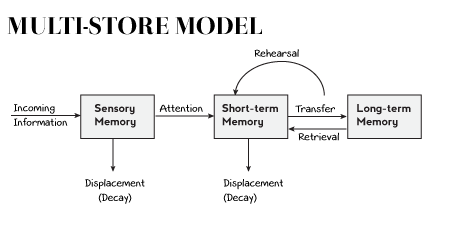
Multi-store Model of Memory
- Sensory Memory
- Encoding
- Multi-modle (through senses)
- Capacity
- Very large
- Duration
- Mili-seconds
- Encoding
- Short-term Memory
- Encoding
- Acoustic
- Capacity
- 7 (+- 2 items)
- Duration
- 18-20 seconds
- Encoding
- Long-term Memory
- Encoding
- Semantic
- Capacity
- Unlimited
- Duration
- Lifetime
- Encoding
- Sensory Memory
Evaluation of the Multi-store Model of Memory
- Positives
- Serial Position Effect
- Technique used to investigate STM and LTM. Participants study long lists of words and are asked to recall as many as possible in any order
- Researchers found that words at the end of the list are recalled because they are circulating in the STM
- Researchers found that words at the start of the list had been rehearsed so it had passed into the LTM
- Researchers found that words in the middle of the list didn't have enough time to be rehearsed and so decayed
- Case Studies - KF
- KF was involved in a motorcycle accident that caused brain damage
- He was left unable to process new STM's, however he could retrieve his LTM's
- This supports the MSM as it shows there is different parts to memory
- Serial Position Effect
- Negatives
- The model is over-simplified and fails to take into account the complexity of human memory and the brain
- The MSM fails to take into account the enjoyment of a task and how that effects memory
- If you enjoy the task you will remember something quicker and more of it
- Rehearsal is the only way to remember information according to the MSM
- Something traumatic however can create an emotional memroy leaving an imprint on the brain
- Positives
Working Memory Model
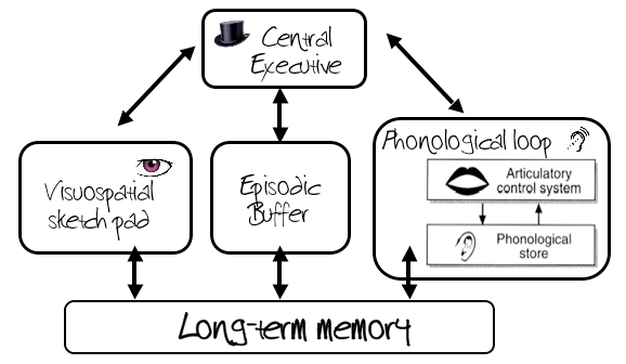
- Central Executive
- Directs attention to particular tasks
- It controls the other systems (slaves) by determining how resources will be allocated
- Drives the system
- Episodic Buffer
- A general store that was added later to the model to account for things that use both visual and acoustic information at the same time
- E.G. When watching the television
- It integrates information from the central executive, phonological loop, and the visuo-spatial sketchpad
- A general store that was added later to the model to account for things that use both visual and acoustic information at the same time
- Visuo-spatial Sketchpad
- Process visual and spatial information
- Holds visual information for a very short time
- E.G. Used when planning a spatial task
- Phonological Loop
- Controls auditory information
- Central Executive
Bilder und Dateien der Mindmap
Informationen
- Beschreibung
- Overview of the Models of Memory
- Erstellt von
- Jack Burdett
- Aufrufe
- 216
- Tags
- Bewertung