
Mindmap
Is Psychology a Science?
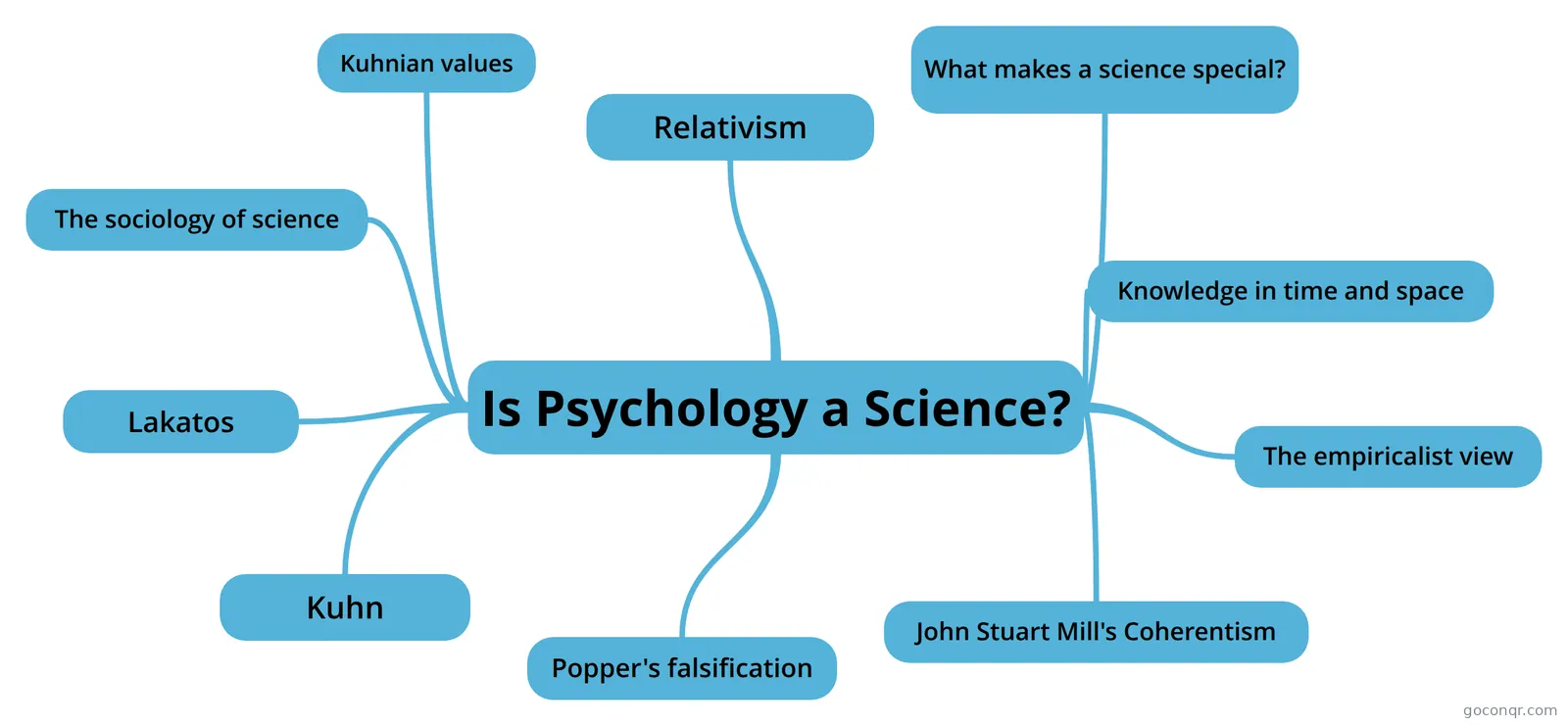
Mind map: Is psychology a science
Inhalt der Mindmap
Is Psychology a Science?
What makes a science special?
- Science means knowledge- it gets us closer to the truth. It has empirical foundations, its based on observations of the natural world. The scientific method- the use of specific methods of observation e.g. experiments, allow us to infer causality. Scientists follow the scientific methods to infer theories and explain and predict behaviour in the natural world. Prediction allows us to test the theory. Scientists have an accepted criterion for deciding between theories and a value that's applied in an unbiased way.
Knowledge in time and space
- Empirical knowledge- needs to be certain across time and space. This can be a problem for psychology a a psychological evidence and attitudes change over time.
- According to Descartes science should be based on a 'certain' knowledge. He says it is 'a general rule that the things we conceive very clearly and distinctly are all true'. This rule was deployed to establish that God exists, 'we imperfect beings could not even have the idea that God exists unless it was placed in us by something which truly possesses the sum of all perfections. Contemporaries are quick to point out however, that he seems to follow that 'you... cannot know anything clearly and distnictly until you have achieved knowledge of God'. The problem with this is that proof of God's existence itself relies on some prior knowledge of some clear and distinct truths.
- Knowledge should be based on precise procedures so we can justify scientific laws or explanations. Using deduction restricts what we can know to mathematics. Scientific theories contain generalizations that apply to all examples of a kind e.g. Pasteur's Germ theory. However what can seem true at one point turns out not to be true later. Widely accepeted scientific generalizations go beyond the observed; some things may be different in the future, some things cannot be seen by the 'naked' eye.
The empiricalist view
- Knowledge is developed through empirical understanding. Scientific knowledge is special because it depends n systematic observation and measurement. Observation and measurement are not straightforward, they are imbued with theory.
- Newton suggested that scientists justify their generalizations using the inductive method. E.g; I have seen a lot of black ravens. My friends have seen a lot of black ravens. Neither I, nor my friends have seen a white raven. Therefore all ravens are black. Hume pointed out the problem that even if the initial statements are true, there is no guarantee that the conclusion is true. Even if the initial statements are true there is no probability that we can attach to the conclusion.
- The generalization 'All ravens are black' cannot be conclusively verified by observation, since maybe in the infinite future there will be a white raven. Karl Popper (1902-94) suggested that its scientific credentials resided in its being conclusively falsifiable by observation of a non-black raven. But then the problem shifts to the status of a statement like 'A white raven exists' which cannot be falsified by a finite number of observations.
John Stuart Mill's Coherentism
- Descartes' 'certainty' requires the impossible. We need to develop a general theory of induction. Some kinds of inductive enumerations are more likely to lead to false deductions than others; e.g. all cats are black vs all mammals have brains. There is no purely logical method for deciding which enumerations are more believable.However this is an empirical issue, we use higher level enumerations to justify lower level enumerations. Doubt should apply to each indivdual claim and not the general theory of induction. The judgement of the quality of inductions depends on how they cohere with current and future inductions.
- Gottlob Frege (1848-1925) on Mill's view of mathematical truths as inductive generalizations asks 'How can 1,000,000= 999,999+1, describe what we observe when no one wittingly perceives such large groups of objects?' He goes on to say 'Psychology, should not imagine that it can contribute anything to the foundation of arithmetic'.
Popper's falsification
- Popper argues that there is no problem of induction.We do not discover 'true' regularities rather we make conditional statements which may be true. We can identify 'true' conjectures through falsification i.e. establishing the falseness of such conjectures. Falsification is purely deductive so induction is not a problem.
- Popper claims that typical theories make highly probable statements but 'good' theories make improbable claims. For example, he found that when looking at theories of human behaviour, Freud and Adler's theories fitted well into almost every single one. He formed the position that it is easy to obtain confirmations or verfications for nearly every theory if we look for confirmations. He stated that confirmation should only count if they are a result of risky predictions e.g. Einsteins theory of relativity, that is to say we should expect an event which incompatible with the theory which would have refuted the theory. The more a scientific theory forbids, the better it is. A theory which is non-refutable is non scientific according to Popper.
- What constitutes an improbable claim? Ritter and Bibby (2008)- carried out a simple fault finding task with multiple trials; Prediction 1; a correlation between problem solving time and number of trials Prediction 2; Time taken will be positively correlated with the number of problem solving operators applied Prediction 3; Time taken will be predicted by the number of problem solving operators applied and each operator will take ~100ms. As the precision of hypothesis increases, so does its falsifiability.
Lakatos
- Lakatos had 3 criticisms of Poppers account; The normative nature of science should be tested to see if its falsifiable. Naive falsificationism- we should refute a theory whenever it seems contradicted by experience Falsificationists sometimes talk as if just one theory is being tested; however scientists don't abandon theories until something better comes along, its usually takes some time to develop a theory sufficiently to decide how good it is.
- Lakatos suggested that in science, a theory is really a succession of slightly sifferent theories and experimental techniques developed over time that all share a common core claim; named the research programme. Scientists working within a given research programme shield the core from falsification with auxillary hypotheses. Research programmes generate novel facts.
- Problems; novel facts may arise by mere coincidence. We don't just compare programs against each other we compare them against the world. Sometimes there is only one research program. Sometimes no research program is accepted.
Kuhn
- Thomas Kuhn challenged Popper's views and said they were historically inaccurate and an over simplistic, idealist view of science. Pre- paradigm; deep disagreement about fundamental theory and fairly random fact gathering Paradigms- some scientific puzzles have been set and solved using various empirical and conceptual techniques Normal science- puzzles are solved in the manner of exemplary work, factual knowledge increases, technological developments arise, new unsolved puzzles arise. Crisis- anomalies arise that cannot be explained within the paradigm leading to a paradigm shift. Revolutions- older scientists stick to the old paradigm new scientists adopt the new paradigm
- Kuhn stated that normal science is the only sense in which a scientist can be testing a theory. What can be tested are 'statements of an individual's best guesses as to how to connect his own research problem to that of accepted scientific knowledge.
- Feyeraband argues that 'solving puzzles' is not the main aim of science, its about the overarching, general development of theories. Science sometimes involves the active, complicit development of rival theories. A single paradigm is not necessary, many paradigms can co-exist. It is imporatnt to consider the wasting of time and effort on implausible alternatives.
- Worrall (2003) argues that Kuhn believed that experiments should be designed assuming core ideas so that falsification targets auxillary hypothesis. Popper believed that experiments should target the core rather than the auxiliary hypothesis. Kuhn argued scientists tend to believe core theory vs Popper who argued scientists know that their theories are conjectures. Popper believed that scientists essentially try and falsify their theories vs Kuhn who believed that scientists tend to hold their own theories as 'sacred' but collapse under the weight of evidence built up in the puzzle solving period.
The sociology of science
- Merton (1973) Universalism- ideas should be evaluated according to impersonal criteria that are universally agreed within the scientific community. Communalism- Knowledge should be viewed as common heritage and shared freely within the scientific community. Scepticism- Disinterestedness- scientists should not seek to gain for themselves through questionable means Scepticism- scienists should not be credulous, jump to conclusions but weigh evidence in a considered manner.
- Mitzroff (1974)- scientists find ways to restrict what information they find relevant by considering 'well-known' practitioners as more reliable- not universalists Mulkay (1976)-Scientists adopt practices that defend their independence and relative freedom from external scrutiny
Kuhnian values
- A theory should be internally consistent. A theory should be consistent with other currently accepted theories. A theory's consequence should extend beyond the particular observations, laws or sub-theries it was designed to explain. A theory ought to order phenomena that in its absence would be isolated and confused. The theory should be fruitful of new research findings.
- Mulkay and Gilbert (1984)- interviewed biochemists concerning the basis of mitochondrial function. Scientists often depict theory choice as independent to themselves and not by some accepted set of values. Scientists do no always agree what an experiment actually means. Mulkay and Gilbert (1982)- Advocates of particular theories recurrently claimed that their beliefs were supported by evidence whilst other's were impaired by psychological or cultural distortions or other contingent or non-contingent difficulties.
Relativism
- The sociology of science can be seen to support relativism- the belief that different theories or beliefs can be equally true relative to different standards. Science is concerned with the 'epistemic' truth- things that we know to be true no matter who believes them. Science according to Kuhn, Lakatos, Popper and Feyerabend can all withstand some kind of relavitism since this may be best for arriving at an objective truth.
- Relavtism 1 - Scientific knowledge is purely the product of social forces. If evidence undermines knowledge/theories then so does social/political context. If you believ that your beliefs are socially constructed then surely that belief is also socially constructed.
- Relavitism 2- There is no absolute truth; true or falso is always relative to someone's perspective. Problems; this is 'an absolute truth' so it contradicts itself. This is a relative truth.
- Relavitism 3; physical reality is a social and linguistic construct. Problem; This confuses representation with fact. A fact is something which exists in the external world whether we know it or not. A belief is a representaion of a fact which could be wrong. The fact doesn't change but in time the representation does. If you get hit by a car and break bones and have bruises how is that socially constructed?
- Relavistism 4; The science of one society is no more valid than that of another. Some beliefs of different cultures will be true so we shouldn't be culturally ignorant. E.g mushrooms arelow in purines which helps with rheumatism which chinese doctors have known for years. However these statments are true/false because of independet fact and not just because of what the culture believes. Some cultures beliefs are simply wrong e.g. the spanish fly is an aphrodesiac- during urination it causes swelling of the genitals due to irritation of the urinal tract, its a result of serious inflmmation and can be very painful
Informationen
- Beschreibung
- Psychology (Conceptual and Historical Issues) Mindmap am Is Psychology a Science?, erstellt von Ella Kay am 14/01/2017.
- Erstellt von
- Ella Kay
- Aufrufe
- 1
- Bewertung
Mehr zu Psychology as a Science