
Mindmap
Memory
Inhalt der Mindmap
Memory
Types of Memory
- Sensory Resgister
- Temporarily stores information collected from our senses - (EG - Our environment) It's always collecting information from around us
- If we don't pay attention to it, it fades through spontaneous decay.
- Limited capacity
- Limited duration
- STM
- Limited Capacity
- Limited duration
- Coding is usually acoustic (Sound)
- Where if information is temporarily stored is we pay attention to it or we recall it
- LTM
- Holds the information which we rehearse.
- Unlimited capacity
- Three types of LTM:
- Semantic Memory = Stores facts and knowledge that we've learnt and can consciously recall
- Episodic Memory = Stores information about events you've actually experienced. It can contain information about time and place, emotions you felt, and the details of what happened
- Procedural Memory = Stores information on how to do things.
- Sensory Resgister
Models of Memory
- Atkinson and Shiffrin: Multi-Store Model of Memory
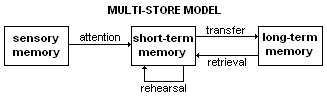
- The multi-store model of memory consists of three stores; Sensory Register, STM and LTM. Information has to travel through each of these to become a memory
- Information from our environment comes from our sensory register. If we don't notice the stuff, the information fades through spontaneous decay. If we do pay attention, information will pass into STM.
- STM has a limited capacity and duration. But if information is rehearsed then it can be transferred to LTM. Information then remains there unless you need to retrieve the memory to your STM.
- The Primacy Effect
- Atkinson and Shiffrin: Multi-Store Model of Memory
Duration of Memory
- Sperling - Sensory Register
- A lab experiment - Participants shown 3 x 4 grid containing different letters for 50 milliseconds - Had to immediately recall either the whole grid or a specific row indicated by a tone
- When participants had to recall the whole grid they recalled four or five letters (on average)
- When participants had to recall a specific row, participants could recall three items (on average)
- The participants could recall items for a specific row, therefore implying that they remembered the entire grid as it was held in their sensory register. They couldn't report the whole grid, because the letters faded through spontaneous decay
- A Lab Exp = The study was highly scientific and the variables were highly controlled
- The participants could recall items for a specific row, therefore implying that they remembered the entire grid as it was held in their sensory register. They couldn't report the whole grid, because the letters faded through spontaneous decay
- When participants had to recall a specific row, participants could recall three items (on average)
- When participants had to recall the whole grid they recalled four or five letters (on average)
- A lab experiment - Participants shown 3 x 4 grid containing different letters for 50 milliseconds - Had to immediately recall either the whole grid or a specific row indicated by a tone
- Peterson & Peterson - STM
- Participants were shown nonsense trigrams (Eg - MJG) and asked to recall them after either 3, 6, 9, 12, 15 or 18 seconds
- They were asked to count backwards in threes from a given number. This was an 'interference task' to prevent them from repeating the letters internally
- After 3 seconds = Recall = 80%
- After 18 seconds = recall = 10%
- Very little can stay in the STM for any longer than 18 seconds
- A Lab Exp = study was scientific, variables were easy to control than in a field experiment
- Artificial = The study doesn't necessary mean STM can last longer than 18 seconds. Given its artificial setting and the information was not what we usually have to recall, it may mean that more memorable information in a more natural setting would we be more easier to recall
- Stimulus = They only looked at one type of stimulus. Therefore the duration of STM may differ depending on the type of stimulus
- Confusion = Each participant saw many trigrams. Thus leading to confusion, reducing the validity of the experiment
- They were asked to count backwards in threes from a given number. This was an 'interference task' to prevent them from repeating the letters internally
- Participants were shown nonsense trigrams (Eg - MJG) and asked to recall them after either 3, 6, 9, 12, 15 or 18 seconds
- Bahrick et al = LTM
- 392 people were requested to do a free recall test = they had to list the names of their ex-classmates
- They then had to either to...
- Photo-recognition test = Shown photos of ex-classmates and asked to recall the names of classmates
- Name-recognition test = They were provided names and requested to match the name to the face of the classmate in the photo
- Within 15 years of leaving = Participants could recall 90% of names and faces
- Within 30 years of leaving = Free recall declined to about 30% accuracy
- Within 48 years, name-recognition was about 80% accurate, and photo-recognition about 40% accurate
- The study is evident of LTMs in a real life setting. Recognition is better than recalll
- Ecological Validity = As it is a field experiment
- Information may have been recalled beforehand as ex-classmates may be new friends
- Meaningful Information = Raises ecological validity
- The study is evident of LTMs in a real life setting. Recognition is better than recalll
- Within 48 years, name-recognition was about 80% accurate, and photo-recognition about 40% accurate
- Within 30 years of leaving = Free recall declined to about 30% accuracy
- They then had to either to...
- 392 people were requested to do a free recall test = they had to list the names of their ex-classmates
- Sperling - Sensory Register
Capacity of Memory
- Jacobs - STM
- Jacobs - STM
Bilder und Dateien der Mindmap
Informationen
- Beschreibung
- A2 Psychology (Memory) Mindmap am Memory, erstellt von Ashleigh Gildroy am 02/02/2017.
- Erstellt von
- Ashleigh Gildroy
- Aufrufe
- 2
- Bewertung