
Mindmap
Attachment
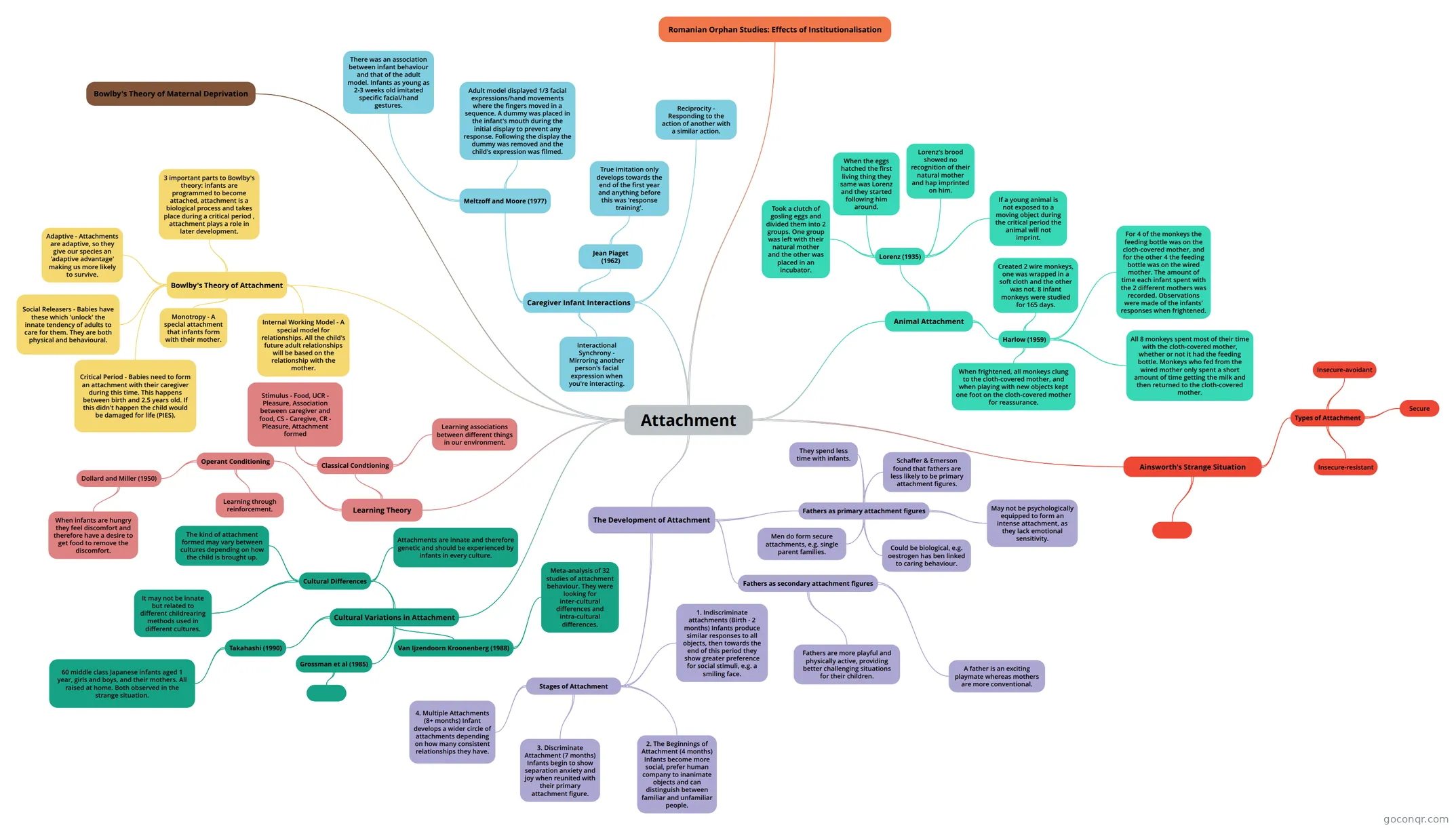
Mind map: Attachment psychology
Inhalt der Mindmap
Attachment
Caregiver Infant Interactions
- Reciprocity - Responding to the action of another with a similar action.
- Interactional Synchrony - Mirroring another person's facial expression when you're interacting.
- Meltzoff and Moore (1977)
- Adult model displayed 1/3 facial expressions/hand movements where the fingers moved in a sequence. A dummy was placed in the infant's mouth during the initial display to prevent any response. Following the display the dummy was removed and the child's expression was filmed.
- There was an association between infant behaviour and that of the adult model. Infants as young as 2-3 weeks old imitated specific facial/hand gestures.
- Jean Piaget (1962)
- True imitation only develops towards the end of the first year and anything before this was 'response training'.
The Development of Attachment
- Stages of Attachment
- 1. Indiscriminate attachments (Birth - 2 months) Infants produce similar responses to all objects, then towards the end of this period they show greater preference for social stimuli, e.g. a smiling face.
- 2. The Beginnings of Attachment (4 months) Infants become more social, prefer human company to inanimate objects and can distinguish between familiar and unfamiliar people.
- 3. Discriminate Attachment (7 months) Infants begin to show separation anxiety and joy when reunited with their primary attachment figure.
- 4. Multiple Attachments (8+ months) Infant develops a wider circle of attachments depending on how many consistent relationships they have.
- Fathers as primary attachment figures
- Schaffer & Emerson found that fathers are less likely to be primary attachment figures.
- They spend less time with infants.
- May not be psychologically equipped to form an intense attachment, as they lack emotional sensitivity.
- Could be biological, e.g. oestrogen has ben linked to caring behaviour.
- Men do form secure attachments, e.g. single parent families.
- Fathers as secondary attachment figures
- Fathers are more playful and physically active, providing better challenging situations for their children.
- A father is an exciting playmate whereas mothers are more conventional.
- Stages of Attachment
Animal Attachment
- Lorenz (1935)
- Took a clutch of gosling eggs and divided them into 2 groups. One group was left with their natural mother and the other was placed in an incubator.
- When the eggs hatched the first living thing they same was Lorenz and they started following him around.
- Lorenz's brood showed no recognition of their natural mother and hap imprinted on him.
- If a young animal is not exposed to a moving object during the critical period the animal will not imprint.
- Harlow (1959)
- All 8 monkeys spent most of their time with the cloth-covered mother, whether or not it had the feeding bottle. Monkeys who fed from the wired mother only spent a short amount of time getting the milk and then returned to the cloth-covered mother.
- When frightened, all monkeys clung to the cloth-covered mother, and when playing with new objects kept one foot on the cloth-covered mother for reassurance.
- Created 2 wire monkeys, one was wrapped in a soft cloth and the other was not. 8 infant monkeys were studied for 165 days.
- For 4 of the monkeys the feeding bottle was on the cloth-covered mother, and for the other 4 the feeding bottle was on the wired mother. The amount of time each infant spent with the 2 different mothers was recorded. Observations were made of the infants' responses when frightened.
- Lorenz (1935)
Learning Theory
- Classical Condtioning
- Learning associations between different things in our environment.
- Stimulus - Food, UCR - Pleasure, Association between caregiver and food, CS - Caregive, CR - Pleasure, Attachment formed
- Operant Conditioning
- Learning through reinforcement.
- Dollard and Miller (1950)
- When infants are hungry they feel discomfort and therefore have a desire to get food to remove the discomfort.
- Classical Condtioning
Bowlby's Theory of Attachment
- 3 important parts to Bowlby's theory: infants are programmed to become attached, attachment is a biological process and takes place during a critical period , attachment plays a role in later development.
- Adaptive - Attachments are adaptive, so they give our species an 'adaptive advantage' making us more likely to survive.
- Social Releasers - Babies have these which 'unlock' the innate tendency of adults to care for them. They are both physical and behavioural.
- Critical Period - Babies need to form an attachment with their caregiver during this time. This happens between birth and 2.5 years old. If this didn't happen the child would be damaged for life (PIES).
- Monotropy - A special attachment that infants form with their mother.
- Internal Working Model - A special model for relationships. All the child's future adult relationships will be based on the relationship with the mother.
Ainsworth's Strange Situation
- Types of Attachment
- Secure
- Insecure-avoidant
- Insecure-resistant
- Types of Attachment
Bowlby's Theory of Maternal Deprivation
Romanian Orphan Studies: Effects of Institutionalisation
Cultural Variations in Attachment
- Cultural Differences
- Attachments are innate and therefore genetic and should be experienced by infants in every culture.
- The kind of attachment formed may vary between cultures depending on how the child is brought up.
- It may not be innate but related to different childrearing methods used in different cultures.
- Takahashi (1990)
- 60 middle class Japanese infants aged 1 year, girls and boys, and their mothers. All raised at home. Both observed in the strange situation.
- Van Ijzendoorn Kroonenberg (1988)
- Meta-analysis of 32 studies of attachment behaviour. They were looking for inter-cultural differences and intra-cultural differences.
- Grossman et al (1985)
- Cultural Differences
Informationen
- Beschreibung
- A level Psychology Mindmap am Attachment, erstellt von Jasmin Woolliss am 16/02/2017.
- Erstellt von
- Jasmin Woolliss
- Aufrufe
- 2
- Bewertung