
Mindmap
Cognitive Approach (1)
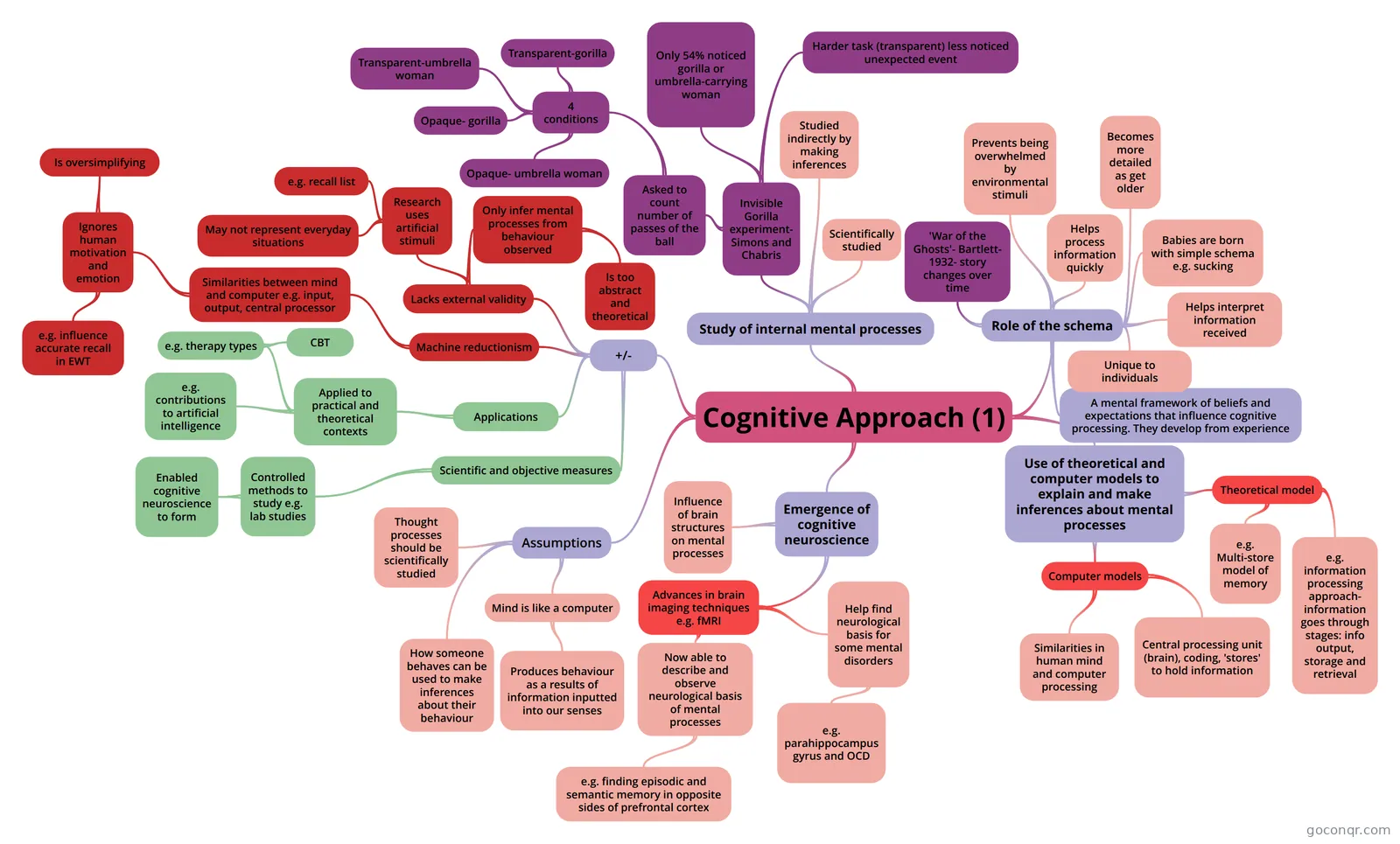
Mind map: Cognitive approach
Inhalt der Mindmap
Cognitive Approach (1)
Study of internal mental processes
- Scientifically studied
- Studied indirectly by making inferences
- Invisible Gorilla experiment- Simons and Chabris
- Only 54% noticed gorilla or umbrella-carrying woman
- Asked to count number of passes of the ball
- 4 conditions
- Transparent-gorilla
- Transparent-umbrella woman
- Opaque- gorilla
- Opaque- umbrella woman
- 4 conditions
- Harder task (transparent) less noticed unexpected event
Role of the schema
- A mental framework of beliefs and expectations that influence cognitive processing. They develop from experience
- Helps interpret information received
- Babies are born with simple schema e.g. sucking
- Becomes more detailed as get older
- Helps process information quickly
- Prevents being overwhelmed by environmental stimuli
- Unique to individuals
- 'War of the Ghosts'- Bartlett- 1932- story changes over time
Use of theoretical and computer models to explain and make inferences about mental processes
- Computer models
- Similarities in human mind and computer processing
- Central processing unit (brain), coding, 'stores' to hold information
- Theoretical model
- e.g. Multi-store model of memory
- e.g. information processing approach- information goes through stages: info output, storage and retrieval
- Computer models
Emergence of cognitive neuroscience
- Influence of brain structures on mental processes
- Advances in brain imaging techniques e.g. fMRI
- Now able to describe and observe neurological basis of mental processes
- e.g. finding episodic and semantic memory in opposite sides of prefrontal cortex
- Help find neurological basis for some mental disorders
- e.g. parahippocampus gyrus and OCD
- Now able to describe and observe neurological basis of mental processes
+/-
- Scientific and objective measures
- Controlled methods to study e.g. lab studies
- Enabled cognitive neuroscience to form
- Controlled methods to study e.g. lab studies
- Applications
- Applied to practical and theoretical contexts
- e.g. contributions to artificial intelligence
- e.g. therapy types
- CBT
- Applied to practical and theoretical contexts
- Machine reductionism
- Similarities between mind and computer e.g. input, output, central processor
- Ignores human motivation and emotion
- e.g. influence accurate recall in EWT
- Is oversimplifying
- Ignores human motivation and emotion
- Similarities between mind and computer e.g. input, output, central processor
- Lacks external validity
- Only infer mental processes from behaviour observed
- Is too abstract and theoretical
- Research uses artificial stimuli
- e.g. recall list
- May not represent everyday situations
- Only infer mental processes from behaviour observed
- Scientific and objective measures
Assumptions
- Thought processes should be scientifically studied
- How someone behaves can be used to make inferences about their behaviour
- Mind is like a computer
- Produces behaviour as a results of information inputted into our senses