
Mindmap
Health: social development MALARIA
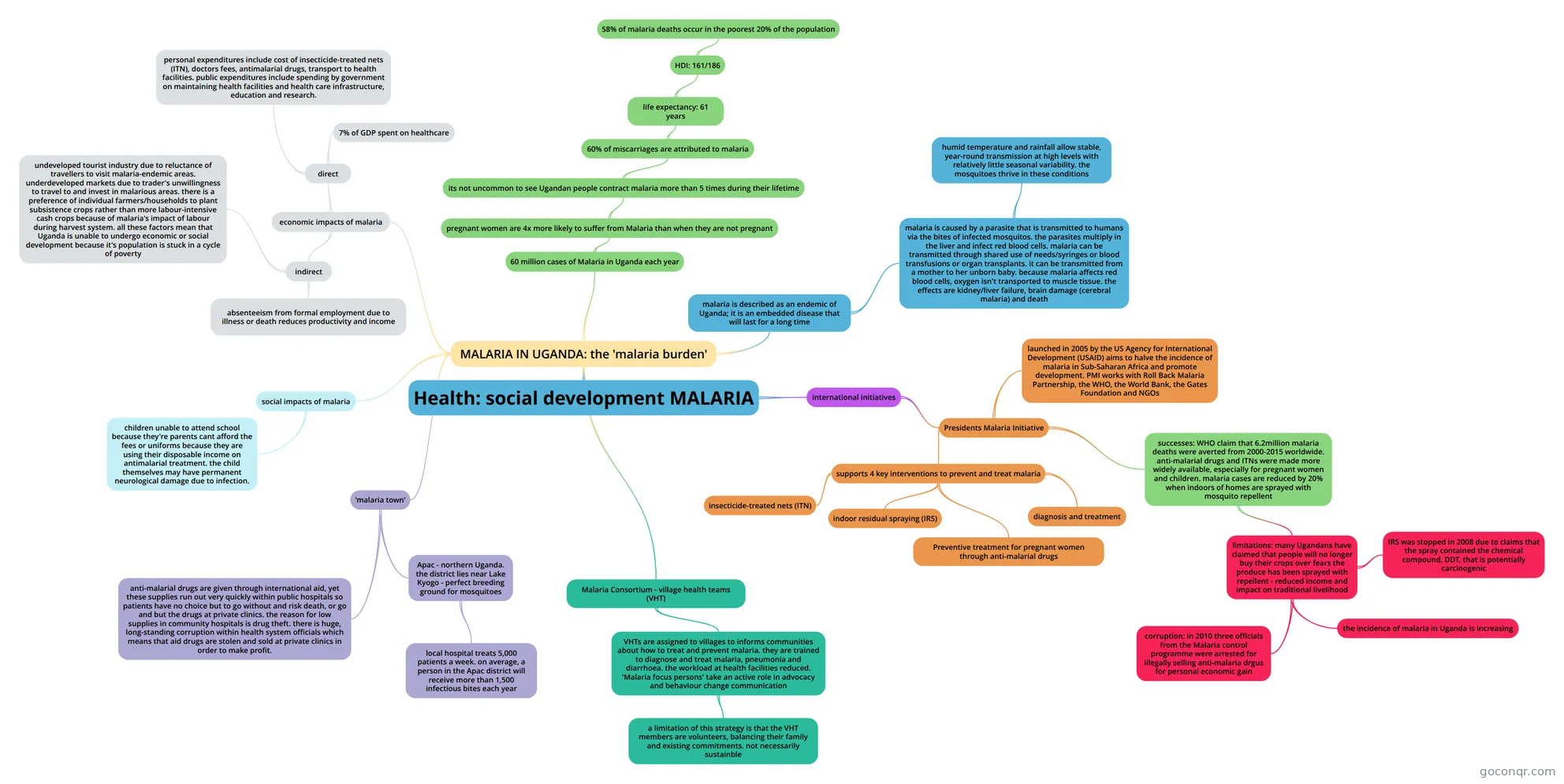
Mind map: Malaria in Uganda
Inhalt der Mindmap
Health: social development MALARIA
MALARIA IN UGANDA: the 'malaria burden'
- malaria is described as an endemic of Uganda; it is an embedded disease that will last for a long time
- malaria is caused by a parasite that is transmitted to humans via the bites of infected mosquitos. the parasites multiply in the liver and infect red blood cells. malaria can be transmitted through shared use of needs/syringes or blood transfusions or organ transplants. it can be transmitted from a mother to her unborn baby. because malaria affects red blood cells, oxygen isn't transported to muscle tissue. the effects are kidney/liver failure, brain damage (cerebral malaria) and death
- humid temperature and rainfall allow stable, year-round transmission at high levels with relatively little seasonal variability. the mosquitoes thrive in these conditions
- malaria is caused by a parasite that is transmitted to humans via the bites of infected mosquitos. the parasites multiply in the liver and infect red blood cells. malaria can be transmitted through shared use of needs/syringes or blood transfusions or organ transplants. it can be transmitted from a mother to her unborn baby. because malaria affects red blood cells, oxygen isn't transported to muscle tissue. the effects are kidney/liver failure, brain damage (cerebral malaria) and death
- 60 million cases of Malaria in Uganda each year
- pregnant women are 4x more likely to suffer from Malaria than when they are not pregnant
- its not uncommon to see Ugandan people contract malaria more than 5 times during their lifetime
- 60% of miscarriages are attributed to malaria
- life expectancy: 61 years
- HDI: 161/186
- 58% of malaria deaths occur in the poorest 20% of the population
- HDI: 161/186
- life expectancy: 61 years
- 60% of miscarriages are attributed to malaria
- its not uncommon to see Ugandan people contract malaria more than 5 times during their lifetime
- pregnant women are 4x more likely to suffer from Malaria than when they are not pregnant
- economic impacts of malaria
- indirect
- absenteeism from formal employment due to illness or death reduces productivity and income
- undeveloped tourist industry due to reluctance of travellers to visit malaria-endemic areas. underdeveloped markets due to trader's unwillingness to travel to and invest in malarious areas. there is a preference of individual farmers/households to plant subsistence crops rather than more labour-intensive cash crops because of malaria's impact of labour during harvest system. all these factors mean that Uganda is unable to undergo economic or social development because it's population is stuck in a cycle of poverty
- direct
- personal expenditures include cost of insecticide-treated nets (ITN), doctors fees, antimalarial drugs, transport to health facilities. public expenditures include spending by government on maintaining health facilities and health care infrastructure, education and research.
- 7% of GDP spent on healthcare
- indirect
- social impacts of malaria
- children unable to attend school because they're parents cant afford the fees or uniforms because they are using their disposable income on antimalarial treatment. the child themselves may have permanent neurological damage due to infection.
- 'malaria town'
- Apac - northern Uganda. the district lies near Lake Kyogo - perfect breeding ground for mosquitoes
- local hospital treats 5,000 patients a week. on average, a person in the Apac district will receive more than 1,500 infectious bites each year
- anti-malarial drugs are given through international aid, yet these supplies run out very quickly within public hospitals so patients have no choice but to go without and risk death, or go and but the drugs at private clinics. the reason for low supplies in community hospitals is drug theft. there is huge, long-standing corruption within health system officials which means that aid drugs are stolen and sold at private clinics in order to make profit.
- Apac - northern Uganda. the district lies near Lake Kyogo - perfect breeding ground for mosquitoes
- Malaria Consortium - village health teams (VHT)
- VHTs are assigned to villages to informs communities about how to treat and prevent malaria. they are trained to diagnose and treat malaria, pneumonia and diarrhoea. the workload at health facilities reduced. 'Malaria focus persons' take an active role in advocacy and behaviour change communication
- a limitation of this strategy is that the VHT members are volunteers, balancing their family and existing commitments. not necessarily sustainble
- VHTs are assigned to villages to informs communities about how to treat and prevent malaria. they are trained to diagnose and treat malaria, pneumonia and diarrhoea. the workload at health facilities reduced. 'Malaria focus persons' take an active role in advocacy and behaviour change communication
- malaria is described as an endemic of Uganda; it is an embedded disease that will last for a long time
international initiatives
- Presidents Malaria Initiative
- launched in 2005 by the US Agency for International Development (USAID) aims to halve the incidence of malaria in Sub-Saharan Africa and promote development. PMI works with Roll Back Malaria Partnership, the WHO, the World Bank, the Gates Foundation and NGOs
- supports 4 key interventions to prevent and treat malaria
- insecticide-treated nets (ITN)
- indoor residual spraying (IRS)
- Preventive treatment for pregnant women through anti-malarial drugs
- diagnosis and treatment
- successes: WHO claim that 6.2million malaria deaths were averted from 2000-2015 worldwide. anti-malarial drugs and ITNs were made more widely available, especially for pregnant women and children. malaria cases are reduced by 20% when indoors of homes are sprayed with mosquito repellent
- limitations: many Ugandans have claimed that people will no longer buy their crops over fears the produce has been sprayed with repellent - reduced income and impact on traditional livelihood
- IRS was stopped in 2008 due to claims that the spray contained the chemical compound, DDT, that is potentially carcinogenic
- corruption: in 2010 three officials from the Malaria control programme were arrested for illegally selling anti-malaria drgus for personal economic gain
- the incidence of malaria in Uganda is increasing
- limitations: many Ugandans have claimed that people will no longer buy their crops over fears the produce has been sprayed with repellent - reduced income and impact on traditional livelihood
- Presidents Malaria Initiative
Informationen
- Beschreibung
- world development Mindmap am Health: social development MALARIA, erstellt von Tyde D am 30/03/2018.
- Erstellt von
- Tyde D
- Aufrufe
- 1
- Bewertung