
Mindmap
Attachment
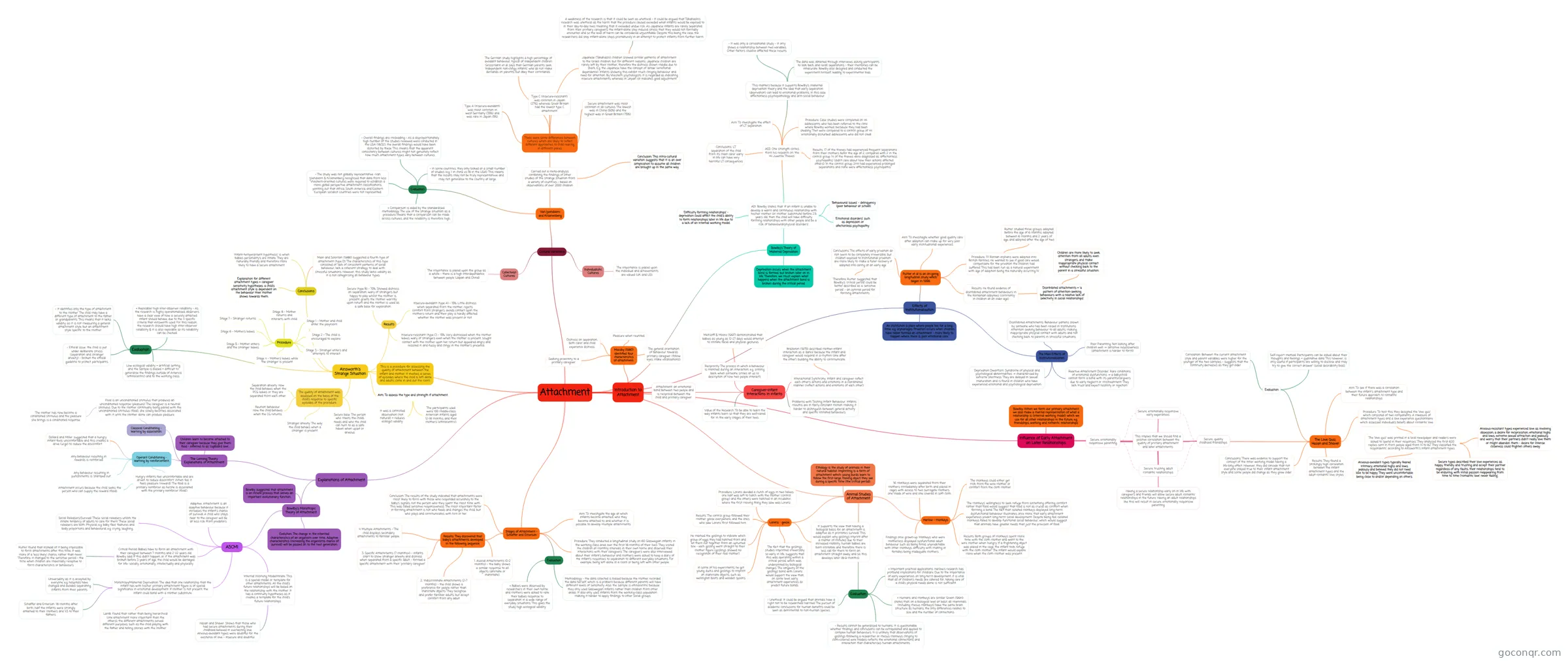
Mind map: Attachment psychology
Inhalt der Mindmap
Attachment
Introduction to Attachment
- Attachment: an emotional bond between two people and is reciprocal between the child and primary caregiver.
- Macoby (1980) identified four characteristics of attachment:
- Seeking proximity to a primary caregiver.
- Distress on separation, both carer and child experience distress.
- Pleasure when reunited.
- The general orientation of behaviour towards primary caregiver (follow eyes, make vocalisations).
Caregiver-infant Interactions in infants
- Reciprocity: The process in which a behaviour is matched during an interaction, e.g. smiling back when someone smiles at us (a description of how two people interact).
- Meltzoff & Moore (1997) demonstrated that babies as young as 12-27 days would attempt to imitate facial and physical gestures.
- Interactional Synchrony: Infant and caregiver reflect each other's actions and emotions in a coordinated manner (reflect actions and emotions of each other).
- Brazleton (1975) described mother-infant interaction as a 'dance' because the infant and caregiver would respond in a rhythm (one after the other), building the ability to communicate.
- Problems with Testing Infant Behaviour: Infants mouths are in fairly constant motion making it harder to distinguish between general activity and specific imitated behaviours.
- Value of the Research: To be able to learn the way infants learn so that they are well-cared for in the early stages of their lives.
- Reciprocity: The process in which a behaviour is matched during an interaction, e.g. smiling back when someone smiles at us (a description of how two people interact).
Stages of Attachment - Schaffer and Emerson
- Aim: To investigate the age at which infants become attached, who they become attached to, and whether it is possible to develop multiple attachments.
- Procedure: They conducted a longitudinal study on 60 Glaswegian infants in the working class area over the first 18 months of their lives. They visited the children at monthly intervals in their own home and observed their interactions with their caregivers. The caregivers were also interviewed about their infant's behaviour and mothers were asked to keep a diary of the infant's responses to separation to different everyday situations. For example, being left alone in a room or being left with other people.
- Results: They discovered that baby's attachments developed in the following sequence.
- 1. Asocial Attachments (0-2 months) - the baby shows a similar response to all objects (animate or inanimate).
- 2,. Indiscriminate Attachments (2-7 months) - the child shows a preference for people rather than inanimate objects. They recognise and prefer familiar adults, but accept comfort from any adult.
- 3. Specific Attachments (7 months+) - infants start to show stranger anxiety and distress when separated from a specific adult - formed a specific attachment with their 'primary caregiver'.
- 4. Multiple Attachments - The child displays secondary attachments to familiar people..
- Conclusion: The results of the study indicated that attachments were most likely to form with those who responded accurately to the baby's signals, not the person who they spent the most time with. This was called sensitive responsiveness. The most important factor in forming attachment is not who feeds and changes the child, but who plays and communicates with him or her.
- Evaluation
- Methodology - the data collected is biased because the mother recorded the data herself, which is a problem because different parents will have different levels of sensitivity. Also, the sample is ethnocentric because they only used Glaswegian infants rather than children from other areas. It also only uses infants from the working-class population making it harder to apply findings to other social groups.
- + Babies were observed by researchers in their own home and mothers were asked to rate their babies response to separation in a wide range of everyday situations. This gives the study high ecological validity.
Animal Studies of Attachment
- Lorenz - geese:
- Procedure: Lorenz devided a clutch of eggs in two halves: one half was left to hatch with the mother (control group) and the others were hatched in an incubator, where the first moving thing they saw was Lorenz.
- Results: The control group followed their mother goose everywhere, and the ones who saw Lorenz first followed him.
- He marked the goslings to indicate which group of eggs they had hatched from and let them out together from an upturned box - each gosling went straight to their mother figure (goslings showed no recognition of their real mother).
- In some of his experiments, he got young ducks and goslings to imprint on inanimate objects, such as wellington boots and wooden spoons.
- It supports the view that having a biological basis for an attachment is adaptive as it promotes survival. This would explain why goslings imprint after a matter of minutes due to their increased mobility; human babies are born immobile and therefore there is less call for them to form an attachment straight away, and so, this develops later (8-9 months).
- The fact that the goslings studies imprinted irreversibly so early in life, suggests that this was operating within a critical period, which was underpinned by biological changes. The longevity of the goslings’ bond with Lorenz would support the view that, on some level, early attachment experiences do predict future bonds.
- Harlow - monkeys:
- 16 monkeys were separated from their mothers immediately after birth and placed in cages with access to two surrogate mothers, one made of wire and one covered in soft cloth.
- The monkeys could either get milk from the wire mother or comfort from the cloth mother.
- Results: Both groups of monkeys spent more time with the cloth mother and went to the wire mother when hungry. If a frightening object was placed in the cage, the infant took refuge with the cloth mother. The infant would explore more when the cloth mother was present.
- Findings once grown-up: Monkeys who were motherless displayed sysfunctional adult behaviour such as being timid, unpredictable with other monkeys, difficulty with mating or females being inadequate mothers.
- The monkeys' willingness to seek refuge from something offering comfort rather than food would suggest that food is not as crucial as comfort when forming a bond. The fact that isolated monkeys displayed long-term dysfunctional behaviour illustrates, once more, that early attachment experiences predict long-term social development. Despite being fed, isolated monkeys failed to develop functional social behaviour, which would suggest that animals have greater needs that just the provision of food..
- Evaluation
- + Important practical applications: Harlow’s research has profound implications for childcare. Due to the importance of early experiences on long-term development, it is vital that all of children’s needs are catered for; taking care of a child’s physical needs alone is not sufficient.
- + Humans and monkeys are similar Green (1994) states that, on a biological level at least, all mammals (including rhesus monkeys) have the same brain structure as humans; the only differences relates to size and the number of connections.
- - Results cannot be generalised to humans: It is questionable whether findings and conclusions can be extrapolated and applied to complex human behaviours. It is unlikely that observations of goslings following a researcher or rhesus monkeys clinging to cloth-covered wire models reflects the emotional connections and interaction that characterises human attachments.
- - Unethical: It could be argued that animals have a right not to be researched/ harmed. The pursuit of academic conclusions for human benefits could be seen as detrimental to non-human species.
- Ethology is the study of animals in their natural habitat. Imprinting is a form of attachment wihich young burds learn to follow the first large, moving object they see during a specific time (the critical period).
- Lorenz - geese:
Explanations of Attachment
- The Lerning Theory Explanations of Attachment
- Children learn to become attached to their caregiver because they give them food - referred to as 'cupboard love'.
- Classical Conditioning - learning by association.
- Food is an unconditioned stimulus that produces an unconditioned response (pleasure). The caregiver is a neutral stimulus. Due to the mother continually being paired with the unconditioned stimulus (food), she slowly becomes associated with it until the mother alone can produce pleasure.
- The mother has now become a conditioned stimulus and the pleasure she brings is a conditioned response.
- Food is an unconditioned stimulus that produces an unconditioned response (pleasure). The caregiver is a neutral stimulus. Due to the mother continually being paired with the unconditioned stimulus (food), she slowly becomes associated with it until the mother alone can produce pleasure.
- Operant Conditioning - learning by reinforcement.
- Dollard and Miller suggested that a hungry infant feels uncomfortable and this creates a drive (urge) to reduce the discomfort.
- Any behaviour resulting in rewards is reinforced.
- Any behaviour resulting in punishments is 'stamped out'.
- Hungry infants feel uncomfortable and are driven to reduce discomfort. When fed, it feels pleasure (reward). The food is a primary reinforcer as he/she is associated with the primary reinforcer (food.).
- Attachment occurs because the child seeks the person who can supply the reward (food).
- Bowlby's Monotropic Theory of Attachment
- Bowlby suggested that attachment is an innate process that serves an important evolutionary function.
- ASCMI
- Adaptive: Attachment is an asaptive behaviour because it increases the infant's chance of survival. A child who stays near to the caregiver will be at less risk from predators.
- Social Releasers/Survival: These social releasers unlock the innate tendency of adults to care for them. These social releasers are both: Physical, e.g. baby face' features and body proportions and behavioural, e.g. crying, laughing.
- Critical Period: Babies have to form an attachment with their caregiver between 7 months and 2 1/2 years old. Bowlby said if this didn't happen, or if the attachment was broken before 3 years of age, the child would be damaged for life- socially, emotionally, intellectually and physically.
- Rutter found that instead of it being impossible to form attachments after this time, it was more of a 'less likely' chance, rather than never. Therefore, it changed to the sensitive period - the time when children are maximally receptive to form characteristics or behaviours.
- Monotropy/Maternal Deprivation: The idea that one relationship that the infant has with his/her primary attachment figure is of special significance in emotional development. If mother is not present, the infant could bond with a mother substitute.
- Universality as it is accepted by everyone, e.g. hospitals have changed and avoided separating infants from their parents.
- Schaffer and Emerson: 18 months after birth, half the infants were strongly attached to their mothers and 1/3 to their fathers.
- Lamb: Found that rather than being hierarchical (one attachment more important than the others), the different attachments served different purposes, such as the child playing with the father and telling stories with the mother.
- Internal Working Model/Innate: This is a special model or template for other attachments. All the child's future relationships will be based on the relationship with the mother. It has a continuity hypotheses as it creates a template for the child's future relationships.
- Hazan and Shaver: Shows that those who had secure attachments during their childhood believed in everlasting love. Anxious-avoidant types were doubtful for the existence of love - insecure and doubtful.
- Evolution: The change in the inherited characteristics of an organism over time. Adaptive characteristics (increasing the organisms chance of survival) will be passed on to the next generation.
- The Lerning Theory Explanations of Attachment
Ainsworth's Strange Situation
- This is a procedure for assessing the quality of attachment between the infant and mother. It involves a series of episodes where the child is left alone and adults come in and out the room.
- Aim: To assess the type and strength if attachment.
- The participants used were 100 middle-class American infants aged 12-18 months, and their mothers (ethnocentric).
- It was a controlled observation (not natural) = reduces ecologicl validity.
- The quality of attachment was assessed on the basis of the child's response to specific episodes of the procedure:
- Separation anxiety: How the child behaves when the PCG leaves or they are separated from each other.
- Reunion behaviour: How the child behaves when the CG returns.
- Stranger anxiety: The way the child behaes when a stranger is present.
- Secure base: The person who meets the childs needs and who the child can turn to as a safe haven when upset or anxious.
- Procedure
- Stage 1 – Mother and child enter the playroom.
- Stage 2 – The child is encouraged to explore.
- Stage 3 – Stranger enters and attempts to interact.
- Stage 4 – Mothers leaves while the stranger is present.
- Stage 5 – Mother enters and the stranger leaves.
- Stage 6 – Mothers leaves.
- Stage 7 – Stranger returns.
- Stage 8 – Mother returns and interacts with child.
- Results
- Secure (type B) - 70%: Showed distress on separation, wary of strangers but happy to play whilst the mother is present, greets the mother warmly upon return and the mother is used as a safe base for exploration.
- Insecure-avoidant (type A) - 15%: Little distress when separated from the mother, rejects comfort from strangers, avoids contact upon the mothers return and their play is hardly affected whether the mother was present or not.
- Insecure-resistant (type C) - 15%: Very distressed when the mother leaves, wary of strangers even when the mother is present, sought contact with the mother upon her return but appeared angry and resisted it, and fussy and clingy in the mother's presence.
- Conclusions
- Explanation for different attachment types = caregiver sensitivity hypotheses: a child's attachment style is dependent on the behaviour thier mother shows towards them.
- 'Infant-temperament hypothesis' is when babies personality's are innate. They are naturally friendly and therefore more likely to have a secure attachment.
- Main and Solomon (1986) suggested a fourth type of attachment (type D). The characteristics of this type consisted of: lack of consistent patterns of social behaviour, lack a coherent strategy to deal with stressful situations. However, this study lacks validity as it is not categorising all behaviour types.
- Evaluation
- + Replicable/ high inter-observer reliability - As the research is highly operationalised, observers have a clear view of how a securely attached infant should behave, due to the 4 specific criteria that Ainsworth used. For this reason, the research should have high inter-observer reliability & it is also replicable so its reliability can be checked.
- - It identifies only the type of attachment to the mother. The child may have a different type of attachment to the father or grandparents. This means that it lacks validity, as it is not measuring a general attachment style, but an attachment style specific to the mother.
- - Ethical issue: the child is put under deliberate stress (separation and stranger anxiety) - broken the ethical guideline to protect participants.
- Low ecological validity = artificial setting and the sample is biased = difficult to generalise the findings outside of America (ethnocentric) and to the working class.
Cultural Variations
- Individualistic Cultures
- The importance is placed upon the individual and achievements are valued (UK and US).
- Collectivist Cultures
- The importance is placed upon the group as a whole - there is a high interdependence between people (Japan and China).
- Van Ijzendoorn and Kroonenberg
- Carried out a meta-analysis combining the findings of other studies of the strange situation from a variety of countries - based on observations of over 2000 children.
- There were some differences between cultures which are likely to reflect different approaches to child rearing in different places.
- Secure attachment was most common in all cultures. The lowest was in China (50%) and the highest was in Great Britain (75%).
- Type A (insecure-avoidant) was most common in west Germany (35%) and was rare in Japan (5%).
- Type C (insecure-resistant) was common in Japan (27%), whereas Great Britain had the lowest type C attachment.
- Japanese (Takahashi) children showed similar patterns of attachment to the Israeli children, but for different reasons. Japanese children are rarely left by their mother, therefore the distress shown maybe due to shock. E.g. the Japanese have the concept of 'amae' (emotional dependence). Infants showing this exhibit much clinging behaviour and need for attention. By Western psychologists it is regarded as indicating insecure attachments, whereas in JApan ist indicates good adjustment.
- A weakness of the research is that it could be seen as unethical – It could be argued that Takahashi’s research was unethical as the harm that the procedure caused exceeded what infants would be exposed to in their day-to-day lives meaning that it exceeded undue risk. As Japanese infants are rarely separated from their primary caregivers, the infant-alone step induced stress that they would not normally encounter and so the level of harm can be considered unjustifiable. Despite this being the case, the researchers did stop infant-alone steps prematurely in an attempt to protect infants from further harm.
- The German study highlights a high percentage of avoidant behaviour, typical of independent children. Grossmann et al says that German parents seek 'independent, non-clingy infants' who do not make demands on parents, but obey their commands..
- Conclusion: This intra-cultural variation suggests that it is an over simplication to assume all children are brought up in the same way.
- There were some differences between cultures which are likely to reflect different approaches to child rearing in different places.
- Evaluation
- - In some countries, they only looked at a small number of studies (e.g. 1 in chine vs 18 in the USA). This means that the results may not be truly representativve and may not generalise to the country at large.
- - The study was not globally representative -Van Ijzendoorn & Kroonenberg recognised that data from less Western-oriented cultures were required to establish a more global perspective attachment classifications, pointing out that Africa, South America, and Eastern European socialist countries were not represented.
- + Comparison is aided by the standardised methodology. The use of the strange situation as a procedure means that a comparison can be made across cultures, and the reliability is therefore high.
- - Overall findings are misleading - As a disproportionately high number of the studies reviewed were conducted in the USA (18/32), the overall findings would have been distorted by these. This means that the apparent consistency between cultures might not genuinely reflect how much attachment types vary between cultures.
- Carried out a meta-analysis combining the findings of other studies of the strange situation from a variety of countries - based on observations of over 2000 children.
- Individualistic Cultures
Bowlby's Theory of Maternal Deprivation
- Deprivation occurs when the attachment bond is formed, but broken later on in life. Therefore, we must explain what happens when the attachment bond is broken during the critical period.
- A01: Bowlby states that 'if an infant is unable to develop a warm and continuous relationship with his/her mother (or mother substitute) before 2.5 years old, then the child will have difficulty forming relationships with other people and be a risk of behavioural/physical disorders'.
- 'Difficulty forming relationships' - deprivation could affect the child's ability to form relationships later in life due to a lack of an internal working model.
- 'Behavioural issues' - delinquency (poor behaviour at school).
- 'Emotional disorders' such as depression or afectionless psychopathy.
- A03: One strength comes from his research on 'the 44 Juvenile Thieves'.
- Aim: To investigate the effect of LT separation.
- Procedure: Case studies were completed on 44 adolescents who has been referred to the clinic where Bowlby worked, becsause they had been stealing. Thet were compared to a control group of 44 'emotionally disturbed' adolescents who did not steal.
- Results: 17 of the thieves had experienced frequent separations from their mothers befor the age of 2, compared with 2 in the control group. 14 of the thieves were diagnosed as 'affectionless psychopaths' (didn't care about how their actions affected others). In the control group, 2/44 had experienced prolonged separations and none were affectionless psychopaths.
- Conclusions: LT separation of the child from its main carer early in life can have very harmful LT consequences.
- This matters because it supports Bowlby's maternal deprivation theory and the idea that early separation (deprivation) can lead to emotional problems, in this case affectionless psychopathology and anti-social behaviour.
- - It was only a correlational study - it only shows a relationship between two variables. Other factors could've affacted these results.
- The data was obtained through interviews asking participants to look back and recall separations - their memories can be innacurate. Bowlby also designed and conducted the experiment himself, leading to experimenter bias.
Effects of Institutionalisation
- An institution a place where people live for a long time, e.g. orphanages. Privation occurs when children have neber formed an attachment - more likely to happen where there is poor emotional care.
- Rutter et al is an on-going longitudinal study which began in 1998.
- Aim: To investiagte whether good quality care after adoption can make up for very poor early instituational experiences.
- Procedure: 111 Roman orphans were adopted into British families. He wanted to see if good care would compensate for the privation the children had suffered. This had been run as a natural experiment with age of adoption being the naturally occurring IV.
- Rutter studied three groups: adopted before the age of 6 months, adopted between 6 months and 2 years of age, and adopted after the age of two.
- Results: He found evidence of disinhibited attachment behaviours in the Romanian adoptees (commonly in children at an older age).
- Disinhibited attachments = 'a pattern of attention-seeking behaviours with a relative lack of selectivity in social relationships'.
- Children are more likely to seek attention from all adults, even strangers, and make inappropriate physical contact without checking back to the parent in a stressful situation.
- Disinhibited attachments = 'a pattern of attention-seeking behaviours with a relative lack of selectivity in social relationships'.
- Conclusions: The effects of early privation do not seem to be completely irreversible, but children exposed to institutional privation are more likely to make a fuller recovery if adopted into caring at an early age.
- Therefore, Rutter suggested that Bowlby's 'critical period' could be better described as a 'sensitive period' - an optimal period for forming attachments.
- The Main Effects of Institutionalisation
- Disinhibited Attachments: Behaviour pattens shown by someone who has been raised in institutions. Attention seeking behaviour to all adults, making inappropriate phsycial contact with adults and not checking back to parents in stressful situations.
- Poor Parenting: Not looking after children well -> sensitive resposiveness (attachment is harder to form).
- Reactive Attachment Disorder: Rare conditions of emotional dysfunctions -> a baby/child cannot form a bond with its parents/cargivers due to early neglecrt or mistreatment. They lack trust and expect hostility or rejection.
- Deprivation Dwarfism: Syndrome of physical and psychological abnormalities -> characterised by extreme shortness. They are delayed in sexual maturation and is found in children who have experienced emotional and psychological deprivation.
Influence of Early Attachment on Later Relationships
- Bowlby: When we form our primary attachment we also make a mental representation of what a relationship is (internal working model) which we use for all other relationships in the future, e.g. friendships, working and romantic relationships.
- This implies that we should find a positive correlation between the quality of primary attachment and later attachments.
- Secure, emotionally responsive early experiences.
- Secure, quality childhood friendships.
- Secure, trusting adult romantic relationships.
- Secure, emotionally responsive parenting.
- Having a secure relationship early on in life with caregivers and friends will allow secure adult, romantic relationships in the future. Having an adult relationships like this will result in secure, emotionally responsive parenting.
- The Love Quiz: Hazan and Shaver
- Aim: To see if there was a correlation between the infant's attachment type and their future approach to romantic relationships.
- Procedure: To test this they designed the 'love quiz' which consisted of two components: A measure of attachment types and a love experience questionnaire which assessed individual's beliefs about romantic love.
- The 'love quiz' was printed in a local newspaper and readers were asked to spend in their responses. They analysed the first 620 replies sent in from people aged from 14 to 82. They classified the respondents' according to Ainsworth's infant attachment types.
- Secure types described their love experiences as happy, friendly and trusting and accept their partner regardless of any faults, their relationships tend to be enduring, with initial passion reappearing from time to time ('romantic love' never fading'.
- Anxious-resistant types experienced love as involving obsession, a desire for reciprocation, emotional highs and lows, extreme sexual attraction and jealousy, and worry that their partners didn't really love them or might abandon them - desire for intense closeness could frighten others away.
- Anxious-avoidant types typically feared intimacy, emotional highs and lows, jealousy and believed they did not need love to be happy. They were uncomfortable being close to and/or depending on others.
- The 'love quiz' was printed in a local newspaper and readers were asked to spend in their responses. They analysed the first 620 replies sent in from people aged from 14 to 82. They classified the respondents' according to Ainsworth's infant attachment types.
- Results: They found a strikingly high correlation between the infant attachment types and the adult romantic love styles.
- Conclusions: There was evidence to support the concept of the inner working model having a life-long effect. However, they did concede that not everyone stayed true to their infant attachment style and some people did change as they grew older.
- Evaluation
- Self-report method: Participants can be asked about their thoughts and feelings = qualitative data. This however, is only useful if participants are willing to disclose and may try to give the 'correct answer' (social desirability bias).
- Correlation: Between the current attachment style and parent variables were higher for the younger of the two samples - suggests that the continuity decreases as they get older.
Informationen
- Beschreibung
- AS level Psychology Mindmap am Attachment, erstellt von Keana Campbell am 05/04/2018.
- Erstellt von
- Keana Campbell
- Aufrufe
- 5
- Bewertung