
Mindmap
Factors Affecting Attraction - Filter Theory
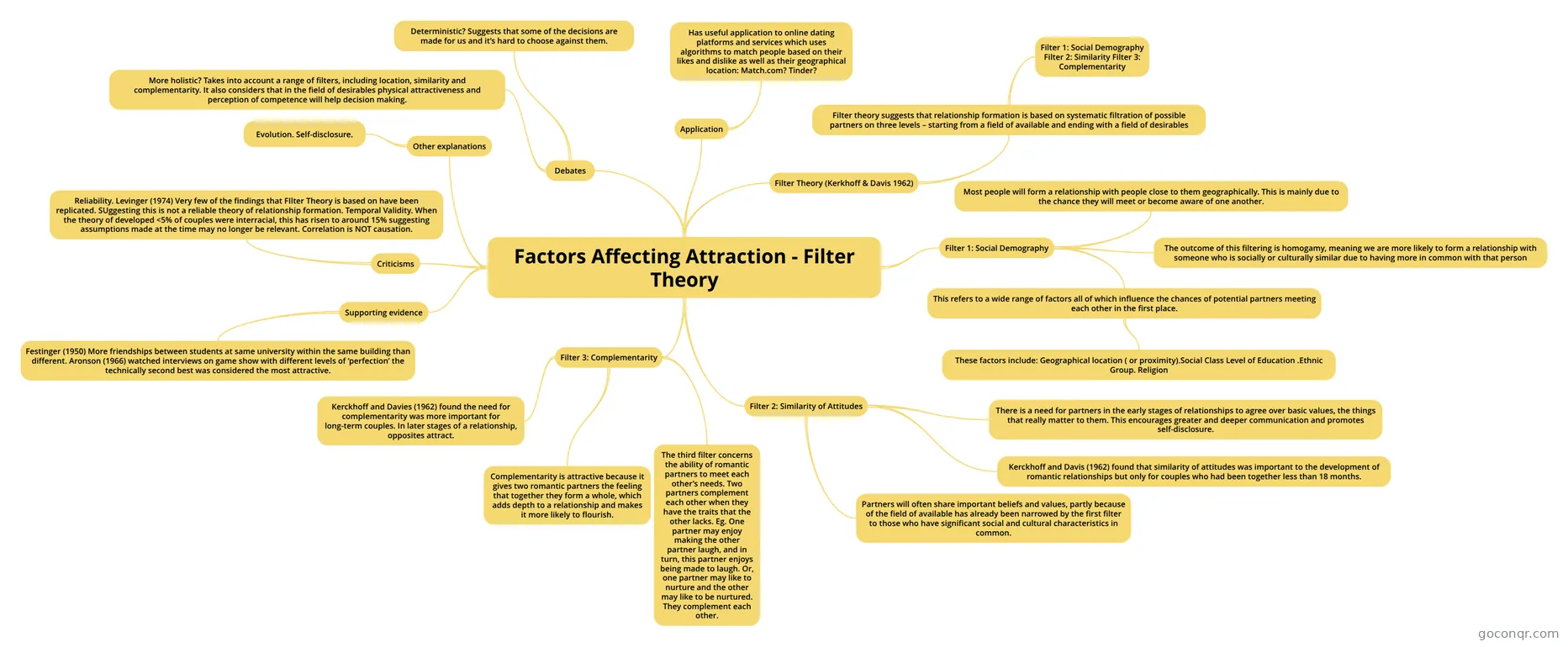
Mind map: Factors affecting attraction - filter theory
Inhalt der Mindmap
Factors Affecting Attraction - Filter Theory
Filter Theory (Kerkhoff & Davis 1962)
- Filter theory suggests that relationship formation is based on systematic filtration of possible partners on three levels – starting from a field of available and ending with a field of desirables
- Filter 1: Social Demography Filter 2: Similarity Filter 3: Complementarity
- Filter theory suggests that relationship formation is based on systematic filtration of possible partners on three levels – starting from a field of available and ending with a field of desirables
Filter 1: Social Demography
- This refers to a wide range of factors all of which influence the chances of potential partners meeting each other in the first place.
- These factors include: Geographical location ( or proximity).Social Class Level of Education .Ethnic Group. Religion
- Most people will form a relationship with people close to them geographically. This is mainly due to the chance they will meet or become aware of one another.
- The outcome of this filtering is homogamy, meaning we are more likely to form a relationship with someone who is socially or culturally similar due to having more in common with that person
- This refers to a wide range of factors all of which influence the chances of potential partners meeting each other in the first place.
Filter 2: Similarity of Attitudes
- There is a need for partners in the early stages of relationships to agree over basic values, the things that really matter to them. This encourages greater and deeper communication and promotes self-disclosure.
- Kerckhoff and Davis (1962) found that similarity of attitudes was important to the development of romantic relationships but only for couples who had been together less than 18 months.
- Partners will often share important beliefs and values, partly because of the field of available has already been narrowed by the first filter to those who have significant social and cultural characteristics in common.
Filter 3: Complementarity
- The third filter concerns the ability of romantic partners to meet each other’s needs. Two partners complement each other when they have the traits that the other lacks. Eg. One partner may enjoy making the other partner laugh, and in turn, this partner enjoys being made to laugh. Or, one partner may like to nurture and the other may like to be nurtured. They complement each other.
- Kerckhoff and Davies (1962) found the need for complementarity was more important for long-term couples. In later stages of a relationship, opposites attract.
- Complementarity is attractive because it gives two romantic partners the feeling that together they form a whole, which adds depth to a relationship and makes it more likely to flourish.
Supporting evidence
- Festinger (1950) More friendships between students at same university within the same building than different. Aronson (1966) watched interviews on game show with different levels of ‘perfection’ the technically second best was considered the most attractive.
Criticisms
- Reliability. Levinger (1974) Very few of the findings that FIlter Theory is based on have been replicated. SUggesting this is not a reliable theory of relationship formation. Temporal Validity. When the theory of developed <5% of couples were interracial, this has risen to around 15% suggesting assumptions made at the time may no longer be relevant. Correlation is NOT causation.
Other explanations
- Evolution. Self-disclosure.
Debates
- More holistic? Takes into account a range of filters, including location, similarity and complementarity. It also considers that in the field of desirables physical attractiveness and perception of competence will help decision making.
- Deterministic? Suggests that some of the decisions are made for us and it’s hard to choose against them.
Application
- Has useful application to online dating platforms and services which uses algorithms to match people based on their likes and dislike as well as their geographical location: Match.com? Tinder?
Informationen
- Beschreibung
- A level Psychology (Relationships) Mindmap am Factors Affecting Attraction - Filter Theory, erstellt von Eve Dowden am 30/12/2018.
- Erstellt von
- Eve Dowden
- Aufrufe
- 0
- Bewertung
Mehr zu Relationship formation and attraction