
Mindmap
Family
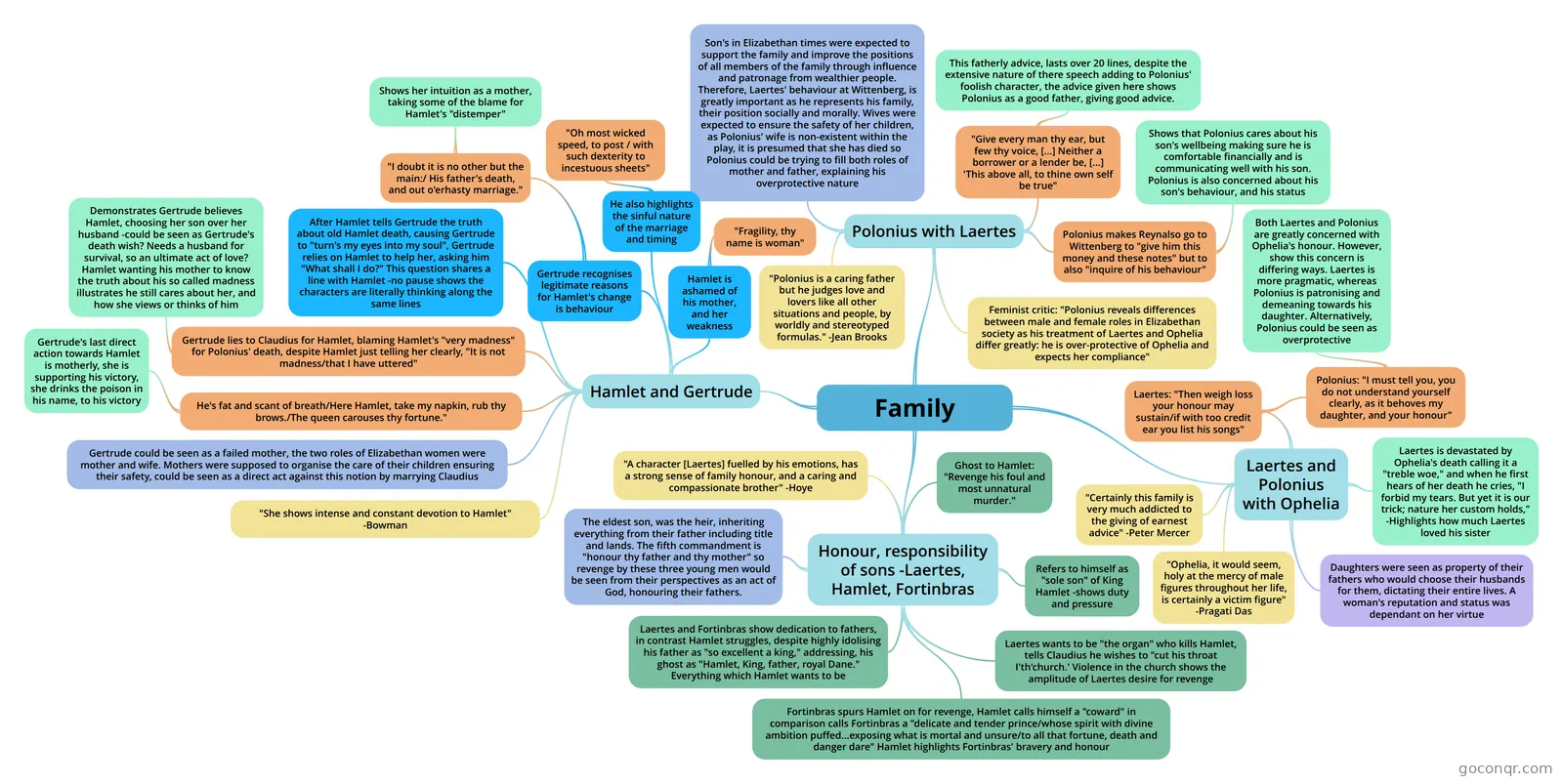
Mind map: Family in Hamlet
Inhalt der Mindmap
Family
Polonius with Laertes
- "Give every man thy ear, but few thy voice, [...] Neither a borrower or a lender be, [...] 'This above all, to thine own self be true"
- This fatherly advice, lasts over 20 lines, despite the extensive nature of there speech adding to Polonius' foolish character, the advice given here shows Polonius as a good father, giving good advice.
- Polonius makes Reynalso go to Wittenberg to "give him this money and these notes" but to also "inquire of his behaviour"
- Shows that Polonius cares about his son's wellbeing making sure he is comfortable financially and is communicating well with his son. Polonius is also concerned about his son's behaviour, and his status
- Son's in Elizabethan times were expected to support the family and improve the positions of all members of the family through influence and patronage from wealthier people. Therefore, Laertes' behaviour at Wittenberg, is greatly important as he represents his family, their position socially and morally. Wives were expected to ensure the safety of her children, as Polonius' wife is non-existent within the play, it is presumed that she has died so Polonius could be trying to fill both roles of mother and father, explaining his overprotective nature
- "Polonius is a caring father but he judges love and lovers like all other situations and people, by worldly and stereotyped formulas." -Jean Brooks
- Feminist critic: "Polonius reveals differences between male and female roles in Elizabethan society as his treatment of Laertes and Ophelia differ greatly: he is over-protective of Ophelia and expects her compliance"
- "Give every man thy ear, but few thy voice, [...] Neither a borrower or a lender be, [...] 'This above all, to thine own self be true"
Laertes and Polonius with Ophelia
- Laertes: "Then weigh loss your honour may sustain/if with too credit ear you list his songs"
- Polonius: "I must tell you, you do not understand yourself clearly, as it behoves my daughter, and your honour"
- Both Laertes and Polonius are greatly concerned with Ophelia's honour. However, show this concern is differing ways. Laertes is more pragmatic, whereas Polonius is patronising and demeaning towards his daughter. Alternatively, Polonius could be seen as overprotective
- Polonius: "I must tell you, you do not understand yourself clearly, as it behoves my daughter, and your honour"
- Laertes is devastated by Ophelia's death calling it a "treble woe," and when he first hears of her death he cries, "I forbid my tears. But yet it is our trick; nature her custom holds," -Highlights how much Laertes loved his sister
- Daughters were seen as property of their fathers who would choose their husbands for them, dictating their entire lives. A woman's reputation and status was dependant on her virtue
- "Certainly this family is very much addicted to the giving of earnest advice" -Peter Mercer
- "Ophelia, it would seem, holy at the mercy of male figures throughout her life, is certainly a victim figure" -Pragati Das
- Laertes: "Then weigh loss your honour may sustain/if with too credit ear you list his songs"
Honour, responsibility of sons -Laertes, Hamlet, Fortinbras
- Ghost to Hamlet: "Revenge his foul and most unnatural murder."
- Refers to himself as "sole son" of King Hamlet -shows duty and pressure
- Laertes wants to be "the organ" who kills Hamlet, tells Claudius he wishes to "cut his throat I'th'church.' Violence in the church shows the amplitude of Laertes desire for revenge
- Fortinbras spurs Hamlet on for revenge, Hamlet calls himself a "coward" in comparison calls Fortinbras a "delicate and tender prince/whose spirit with divine ambition puffed...exposing what is mortal and unsure/to all that fortune, death and danger dare" Hamlet highlights Fortinbras' bravery and honour
- Laertes and Fortinbras show dedication to fathers, in contrast Hamlet struggles, despite highly idolising his father as "so excellent a king," addressing, his ghost as "Hamlet, King, father, royal Dane." Everything which Hamlet wants to be
- The eldest son, was the heir, inheriting everything from their father including title and lands. The fifth commandment is "honour thy father and thy mother" so revenge by these three young men would be seen from their perspectives as an act of God, honouring their fathers.
- "A character [Laertes] fuelled by his emotions, has a strong sense of family honour, and a caring and compassionate brother" -Hoye
Hamlet and Gertrude
- Hamlet is ashamed of his mother, and her weakness
- "Fragility, thy name is woman"
- He also highlights the sinful nature of the marriage and timing
- "Oh most wicked speed, to post / with such dexterity to incestuous sheets"
- Gertrude recognises legitimate reasons for Hamlet's change is behaviour
- "I doubt it is no other but the main:/ His father's death, and out o'erhasty marriage."
- Shows her intuition as a mother, taking some of the blame for Hamlet's "distemper"
- "I doubt it is no other but the main:/ His father's death, and out o'erhasty marriage."
- After Hamlet tells Gertrude the truth about old Hamlet death, causing Gertrude to "turn's my eyes into my soul", Gertrude relies on Hamlet to help her, asking him "What shall I do?" This question shares a line with Hamlet -no pause shows the characters are literally thinking along the same lines
- Gertrude lies to Claudius for Hamlet, blaming Hamlet's "very madness" for Polonius' death, despite Hamlet just telling her clearly, "It is not madness/that I have uttered"
- Demonstrates Gertrude believes Hamlet, choosing her son over her husband -could be seen as Gertrude's death wish? Needs a husband for survival, so an ultimate act of love? Hamlet wanting his mother to know the truth about his so called madness illustrates he still cares about her, and how she views or thinks of him
- He's fat and scant of breath/Here Hamlet, take my napkin, rub thy brows./The queen carouses thy fortune."
- Gertrude's last direct action towards Hamlet is motherly, she is supporting his victory, she drinks the poison in his name, to his victory
- Gertrude could be seen as a failed mother, the two roles of Elizabethan women were mother and wife. Mothers were supposed to organise the care of their children ensuring their safety, could be seen as a direct act against this notion by marrying Claudius
- "She shows intense and constant devotion to Hamlet" -Bowman
- Hamlet is ashamed of his mother, and her weakness
Informationen
- Beschreibung
- English A level (Hamlet (THEMES) ) Mindmap am Family, erstellt von Mel Hughes am 04/03/2019.
- Erstellt von
- Mel Hughes
- Aufrufe
- 0
- Bewertung