
Mindmap
Voting Systems
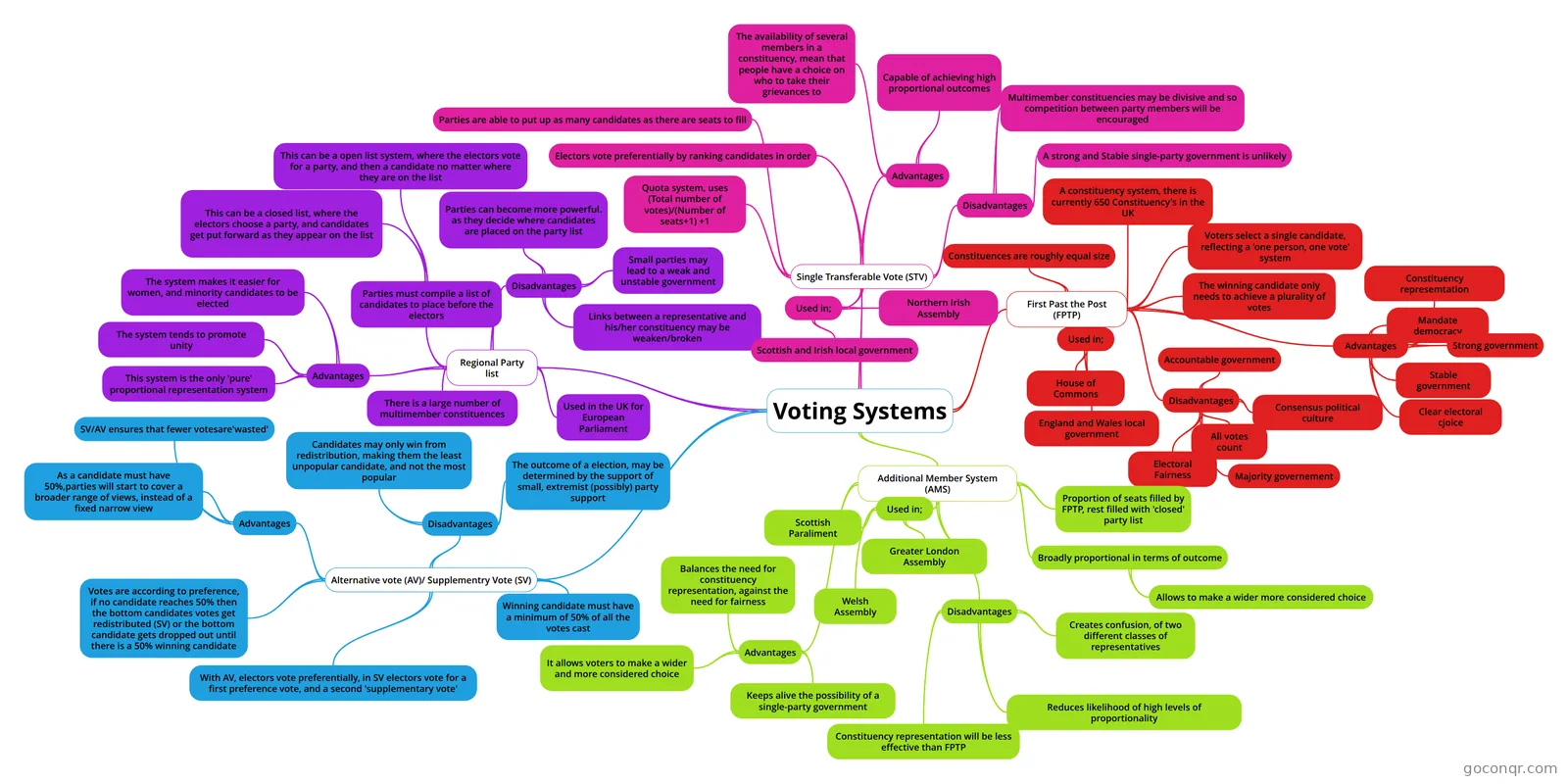
Mind map: UK voting systems
Inhalt der Mindmap
Voting Systems
First Past the Post (FPTP)
- Used in;
- House of Commons
- England and Wales local government
- Constituences are roughly equal size
- A constituency system, there is currently 650 Constituency's in the UK
- Voters select a single candidate, reflecting a 'one person, one vote' system
- The winning candidate only needs to achieve a plurality of votes
- Disadvantages
- Electoral Fairness
- All votes count
- Majority governement
- Accountable government
- Consensus political culture
- Advantages
- Clear electoral cjoice
- Constituency represemtation
- Mandate democracy
- Strong government
- Stable government
- Used in;
Additional Member System (AMS)
- Used in;
- Scottish Paraliment
- Welsh Assembly
- Greater London Assembly
- Proportion of seats filled by FPTP, rest filled with 'closed' party list
- Broadly proportional in terms of outcome
- Allows to make a wider more considered choice
- Advantages
- Balances the need for constituency representation, against the need for fairness
- It allows voters to make a wider and more considered choice
- Keeps alive the possibility of a single-party government
- Disadvantages
- Creates confusion, of two different classes of representatives
- Reduces likelihood of high levels of proportionality
- Constituency representation will be less effective than FPTP
- Used in;
Alternative vote (AV)/ Supplementry Vote (SV)
- Winning candidate must have a minimum of 50% of all the votes cast
- With AV, electors vote preferentially, in SV electors vote for a first preference vote, and a second 'supplementary vote'
- Votes are according to preference, if no candidate reaches 50% then the bottom candidates votes get redistributed (SV) or the bottom candidate gets dropped out until there is a 50% winning candidate
- Advantages
- SV/AV ensures that fewer votesare'wasted'
- As a candidate must have 50%,parties will start to cover a broader range of views, instead of a fixed narrow view
- Disadvantages
- The outcome of a election, may be determined by the support of small, extremist (possibly) party support
- Candidates may only win from redistribution, making them the least unpopular candidate, and not the most popular
Single Transferable Vote (STV)
- Used in;
- Northern Irish Assembly
- Scottish and Irish local government
- Quota system, uses (Total number of votes)/(Number of seats+1) +1
- Parties are able to put up as many candidates as there are seats to fill
- Electors vote preferentially by ranking candidates in order
- Disadvantages
- A strong and Stable single-party government is unlikely
- Multimember constituencies may be divisive and so competition between party members will be encouraged
- Advantages
- Capable of achieving high proportional outcomes
- The availability of several members in a constituency, mean that people have a choice on who to take their grievances to
- Used in;
Regional Party list
- Used in the UK for European Parliament
- There is a large number of multimember constituences
- Disadvantages
- Parties can become more powerful. as they decide where candidates are placed on the party list
- Links between a representative and his/her constituency may be weaken/broken
- Small parties may lead to a weak and unstable government
- Parties must compile a list of candidates to place before the electors
- This can be a closed list, where the electors choose a party, and candidates get put forward as they appear on the list
- This can be a open list system, where the electors vote for a party, and then a candidate no matter where they are on the list
- Advantages
- This system is the only 'pure' proportional representation system
- The system tends to promote unity
- The system makes it easier for women, and minority candidates to be elected
Informationen
- Beschreibung
- Different voting systems in the UK
- Erstellt von
- Phoebe Fletcher
- Aufrufe
- 379
- Tags
- Bewertung