
Mindmap
explanations of attachment
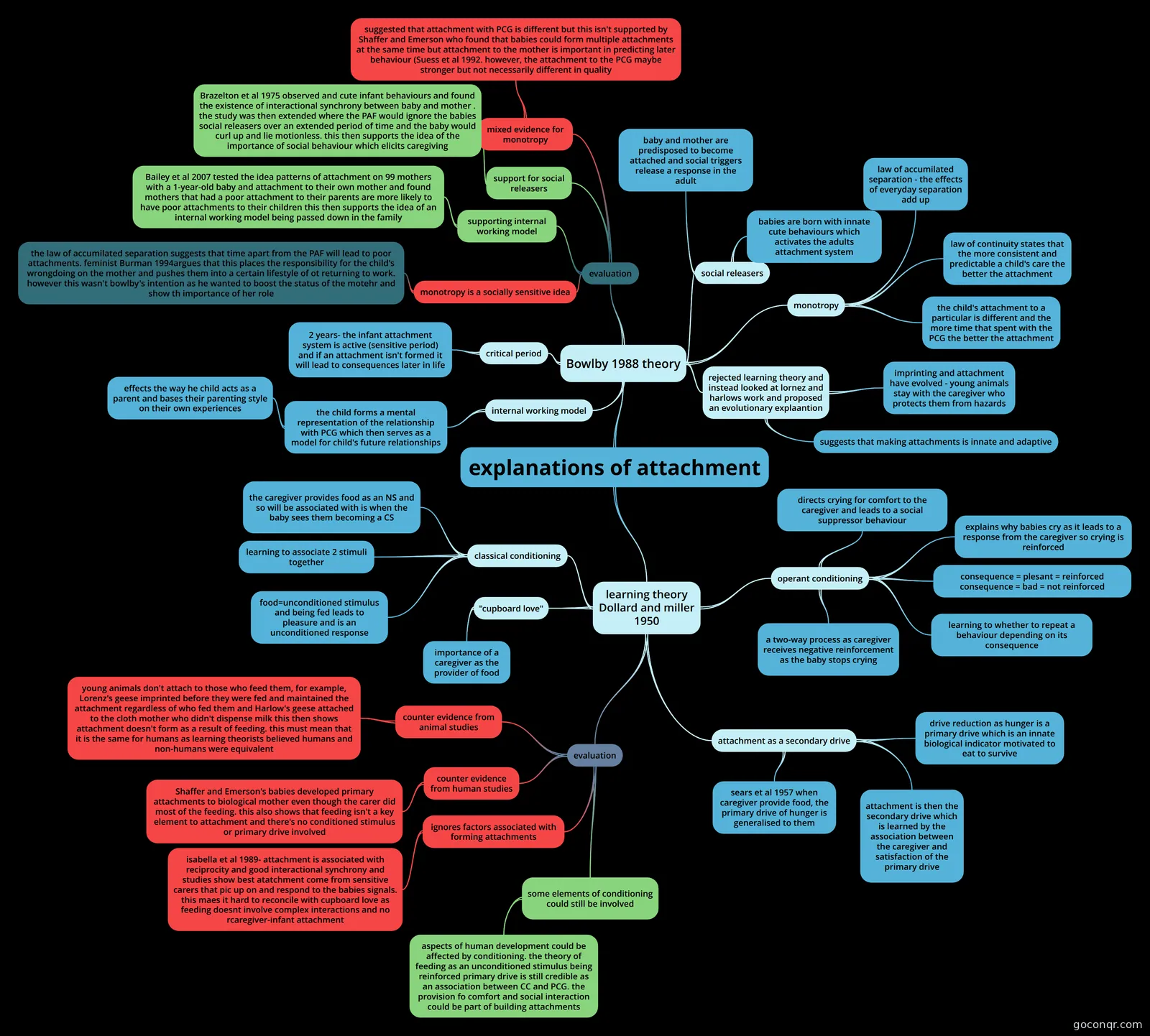
Mind map: Explanations of attachment
Inhalt der Mindmap
explanations of attachment
learning theory Dollard and miller 1950
- "cupboard love"
- importance of a caregiver as the provider of food
- classical conditioning
- learning to associate 2 stimuli together
- food=unconditioned stimulus and being fed leads to pleasure and is an unconditioned response
- the caregiver provides food as an NS and so will be associated with is when the baby sees them becoming a CS
- operant conditioning
- learning to whether to repeat a behaviour depending on its consequence
- consequence = plesant = reinforced consequence = bad = not reinforced
- explains why babies cry as it leads to a response from the caregiver so crying is reinforced
- directs crying for comfort to the caregiver and leads to a social suppressor behaviour
- a two-way process as caregiver receives negative reinforcement as the baby stops crying
- attachment as a secondary drive
- drive reduction as hunger is a primary drive which is an innate biological indicator motivated to eat to survive
- sears et al 1957 when caregiver provide food, the primary drive of hunger is generalised to them
- attachment is then the secondary drive which is learned by the association between the caregiver and satisfaction of the primary drive
- evaluation
- counter evidence from animal studies
- young animals don't attach to those who feed them, for example, Lorenz's geese imprinted before they were fed and maintained the attachment regardless of who fed them and Harlow's geese attached to the cloth mother who didn't dispense milk this then shows attachment doesn't form as a result of feeding. this must mean that it is the same for humans as learning theorists believed humans and non-humans were equivalent
- ignores factors associated with forming attachments
- isabella et al 1989- attachment is associated with reciprocity and good interactional synchrony and studies show best atatchment come from sensitive carers that pic up on and respond to the babies signals. this maes it hard to reconcile with cupboard love as feeding doesnt involve complex interactions and no rcaregiver-infant attachment
- counter evidence from human studies
- Shaffer and Emerson's babies developed primary attachments to biological mother even though the carer did most of the feeding. this also shows that feeding isn't a key element to attachment and there's no conditioned stimulus or primary drive involved
- some elements of conditioning could still be involved
- aspects of human development could be affected by conditioning. the theory of feeding as an unconditioned stimulus being reinforced primary drive is still credible as an association between CC and PCG. the provision fo comfort and social interaction could be part of building attachments
- counter evidence from animal studies
- "cupboard love"
Bowlby 1988 theory
- rejected learning theory and instead looked at lornez and harlows work and proposed an evolutionary explaantion
- suggests that making attachments is innate and adaptive
- imprinting and attachment have evolved - young animals stay with the caregiver who protects them from hazards
- monotropy
- the child's attachment to a particular is different and the more time that spent with the PCG the better the attachment
- law of continuity states that the more consistent and predictable a child's care the better the attachment
- law of accumilated separation - the effects of everyday separation add up
- social releasers
- babies are born with innate cute behaviours which activates the adults attachment system
- baby and mother are predisposed to become attached and social triggers release a response in the adult
- critical period
- 2 years- the infant attachment system is active (sensitive period) and if an attachment isn't formed it will lead to consequences later in life
- internal working model
- the child forms a mental representation of the relationship with PCG which then serves as a model for child's future relationships
- effects the way he child acts as a parent and bases their parenting style on their own experiences
- the child forms a mental representation of the relationship with PCG which then serves as a model for child's future relationships
- evaluation
- mixed evidence for monotropy
- suggested that attachment with PCG is different but this isn't supported by Shaffer and Emerson who found that babies could form multiple attachments at the same time but attachment to the mother is important in predicting later behaviour (Suess et al 1992. however, the attachment to the PCG maybe stronger but not necessarily different in quality
- support for social releasers
- Brazelton et al 1975 observed and cute infant behaviours and found the existence of interactional synchrony between baby and mother . the study was then extended where the PAF would ignore the babies social releasers over an extended period of time and the baby would curl up and lie motionless. this then supports the idea of the importance of social behaviour which elicits caregiving
- supporting internal working model
- Bailey et al 2007 tested the idea patterns of attachment on 99 mothers with a 1-year-old baby and attachment to their own mother and found mothers that had a poor attachment to their parents are more likely to have poor attachments to their children this then supports the idea of an internal working model being passed down in the family
- monotropy is a socially sensitive idea
- the law of accumilated separation suggests that time apart from the PAF will lead to poor attachments. feminist Burman 1994argues that this places the responsibility for the child's wrongdoing on the mother and pushes them into a certain lifestyle of ot returning to work. however this wasn't bowlby's intention as he wanted to boost the status of the motehr and show th importance of her role
- mixed evidence for monotropy
- rejected learning theory and instead looked at lornez and harlows work and proposed an evolutionary explaantion
Informationen
- Beschreibung
- A level Psychology (attachment) Mindmap am explanations of attachment, erstellt von Tommy Sixx am 18/11/2019.
- Erstellt von
- Tommy Sixx
- Aufrufe
- 1
- Bewertung