
Mindmap
Chemistry C1 (Edexcel) Core
Inhalt der Mindmap
Chemistry C1 (Edexcel) Core
Atoms
- Electrons
- Move Around the Nucleus
- Negative Charge -1
- 2 Atoms in the first Shell 8 in the rest E.G oxygen (8 Electrons) 2 on the inner 6 on the next
- Nucleus
- Centre of an Atom
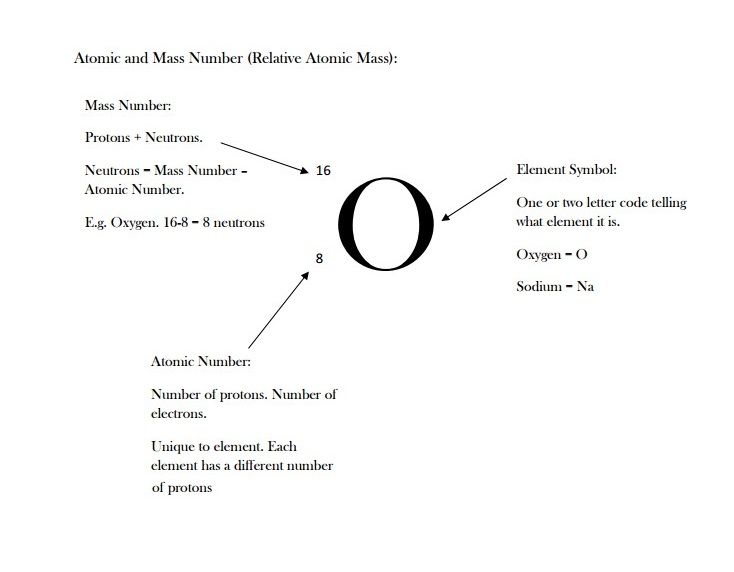
- Contains Protons and Neutrons
- Positive Charge +1 Negative Charge 0
- Almost whole mass of atom is concentrated here
- Protons
- Equal but opposite charges
- Same number of electrons and protons in an atom
- Electrons
Elements
- Only have 1 type of atom.
- Each element has a different number of protons
Mixtures and Compunds
- Mixtures are easily seperated
- Compounds are chemically bonded
- properties of compounds are different to original element
- Naming Compounds 1) when two different elements combine, the compounds name is something-IDE 2) When three or more elements combine, and one of them is oxygen the compounds name is something ATE
Chemical Reactions
- Exothermic Reactions
- Exothermic reactions give out heat to surroundings and are shown by a rise in temperature
- Endothermic Reactions
- Endothermic Reactions take in heat from the surrounding, and are shown by a fall in temperatre
- Exothermic Reactions
Periodic Table
- Elements are put in order of increasing atomic number
- Dimitri Mendeleev made the table of elements 1869
- Gaps in his table predicted properties of undiscovered elements
- Periods
- Rows are called Periods
- Properties of elements change as you go along a period
- Groups
- columns are called groups
- properties of elements have similar properties because they have the same number of electrons in the outer shell
- properties of elements gradually change as you go down a group.
Common Substances and ions
- Water (H2O)
- Carbon Dioxide (CO2)
- Carbon Monoxide (CO)
- Sodium Hydroxide (naoh)
- Ammonie (nh3)
- Methane (ch4)
- Sodium Hydroxide Carbonate (nahco3)
- Methane (ch4)
- Ammonie (nh3)
- Sodium Hydroxide (naoh)
- Carbon Monoxide (CO)
- Carbon Dioxide (CO2)
- Positive Ions +1
- Hydrogen (H)
- Silver (AG)
- all the first group of metals
- Positive Ions +2
- Iron (II) (FE)
- Copper (II) (Cu)
- Zinc (Zn)
- All the second group of metals
- Positive ions +3
- Aluminium (AL)
- Ion (III)
- Negative Ions -2
- Oxide (O)
- Sulphide (S)
- Carbonate (CO3)
- Sulphate (SO4)
- Negative -1
- Hydroxide (OH)
- Nitrate (NO3)
- All of the seventh group of metals
- Water (H2O)
Alkali Metals (Group 1)
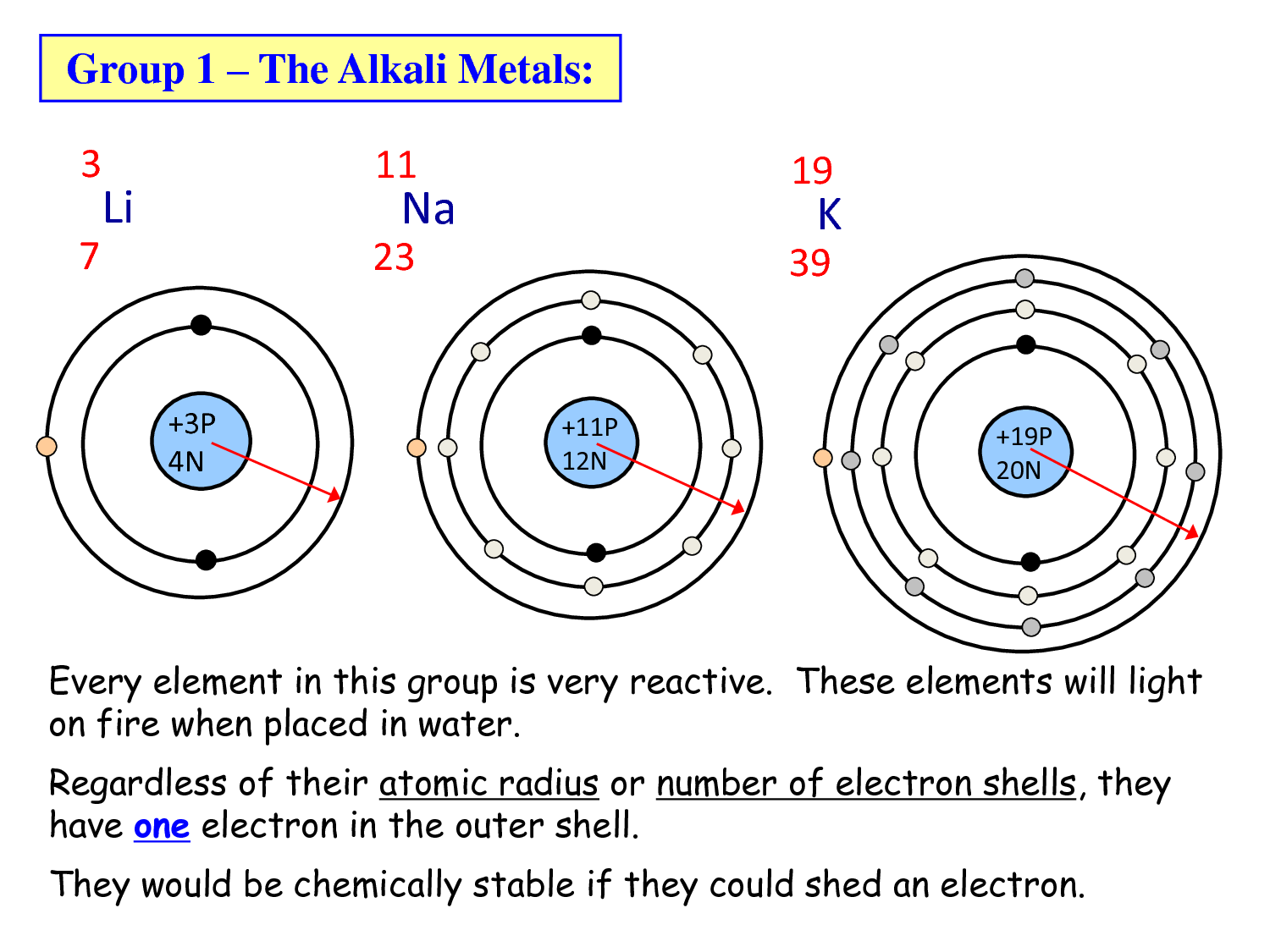
- They have one electron on the outer shell and want to get rid of it so they are very active
- Elements further down the group are more reactive because the extra electron if further from the nucleus.
- Elements in group 1 are more reactive as the atomic number increases.
- Alkali Metal + water -----> Metal Hydroxide + Hydrogen
The Halogens (Group 7)
- Halogens are used in toothpaste and non-stick coasting on frying pans
- On their own they are poisonous
- Chlorine is used to kill bacteria and is used in bleach and swimming pools.
- Iodine is used as an antiseptic
- Aas the atomic number increases the elements get darker and have a higher boiling point
- the higher up group 7 the element is, the more reactive it is.
- Halogens move around in pairs, they are diatomic
- Metals + Halogen = Salt (Metal Halide)
- E.G Aluminium + Chlorine = Aluminium ChlorIDE
- Fluorine (F) , Pale Yellow Gas.
- Chlorine (CL), Pale Green Gas
- Bromine (BR), Dark Red Liquid
- Iodine (I) Purple Black Liquid
- Astatine (AT) Grey-Black Solid
- Iodine (I) Purple Black Liquid
- Bromine (BR), Dark Red Liquid
- Chlorine (CL), Pale Green Gas
Noble Gases (Group O)
- Colourless at room temperature.
- Inert full outer shell so they don't react
- Neon is used in electric discharge tubes (red Light)
- Helium neon and argon are used in lasers
- Helium is used in airships and party balloons
- Argon is used in Filament laps (Light Bulbs)
Precipitates
- Cobalt - Blue (turns grey when left standing.
- Copper - Pale Blue
- Iron (II) Dark green (Turns orange brown when left standing)
- Iron (III) - Orange Brown
- Manganese - Pale Brown
- Nickel - Green
- Zinc- White
Flame Test Colours
- Lithium RED
- Sodium INTENSE YELLOOW
- Potassium LILAC
- Calcium BRICK RED
- Barium PALE GREEN
- Copper GREEN BLUE
Acids and Bases.
- Alkalis are Soluble
- Citric Acid - Food Additive to add sour taste to foods and soft drinks
- Ethanoic Acid - Acid in Vinegar. Used in bottles and photographic film and wood glue. diluted ethanoic acid is used as a descaling agent for kettle.
- Hydrochloric acid - Plastics. used to process steel. Dilute solutions used for cleaning, stomach acid
- Phosphoric Acid - production of petrol, nylon and detergents
- Ammonia Fertilizers - used in manufacturing of nitric acid and sodium carbonate. Dilute Ammonia used for cleaning.
- Sodium Hydroxide - Caustic Soda. Used to make Bleach and other cleaning products E.G drain unblocker. used in soap, paper and textile manufacture
Bilder und Dateien der Mindmap
Informationen
- Beschreibung
- Mindmap am Chemistry C1 (Edexcel) Core, erstellt von Emily Broomfield am 26/03/2015.
- Erstellt von
- Emily Broomfield
- Aufrufe
- 96
- Bewertung