
Mindmap
Social Learning Theory
Inhalt der Mindmap
Social Learning Theory
Albert Bandura
- Observational Learning
- Bandura asserts that most human behavior is learned through observation, imitation, and modeling.
- Bobo Doll Experiment
- Through a series of experiments, he watched children as they observed adults attacking Bobo Dolls. When hit, the dolls fell over and then bounced back up again.
- 4 Principles of Social Learning
- Attention
- We cannot learn if we are not focused on the task. If we see something as being novel or different in some way, we are more likely to make it the focus of their attention.
- Retention
- We learn by internalizing information in our memories. We recall that information later when we are required to respond to a situation that is similar the situation within which we first learned the information.
- Reproduction
- We reproduce previously learned information (behavior, skills, knowledge) when required. However, practice through mental and physical rehearsal often improves our responses.
- Motivation
- We need to be motivated to do anything. Often that motivation originates from our observation of someone else being rewarded or punished for something they have done or said. This usually motivates us later to do, or avoid doing, the same thing.
- Attention
- Reciprocal Determinism
- Bandura believed in “reciprocal determinism”, that is, the world and a person’s behavior cause each other,
- Bandura soon considered personality as an interaction between three components: the environment, behavior, and one’s psychological processes
- Observational Learning
Julian Rotter
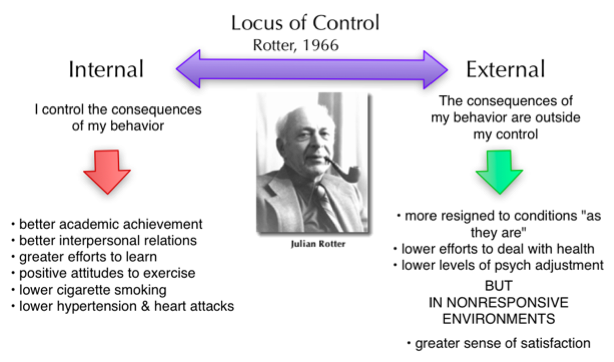
- Locus of Control
- how individuals view their relationship to the environment.
- locus of control refers to our beliefs about the power we have over our lives, and is a cognitive factor that affects personality development.
- Internal Locus of Control
- internal locus of control believes that their rewards in life are guided by their own decisions and efforts.
- External Locus of Control
- A person with an external locus of control sees their life as being controlled by luck, chance, or other people—especially others with more power than them.
- Internal Locus of Control
- Locus of Control
Bilder und Dateien der Mindmap
Informationen
- Beschreibung
- Theories of Bandura and Rotter
- Erstellt von
- SRINJOY GHOSH
- Aufrufe
- 614
- Tags
- Bewertung