
Mindmap
Intelligence
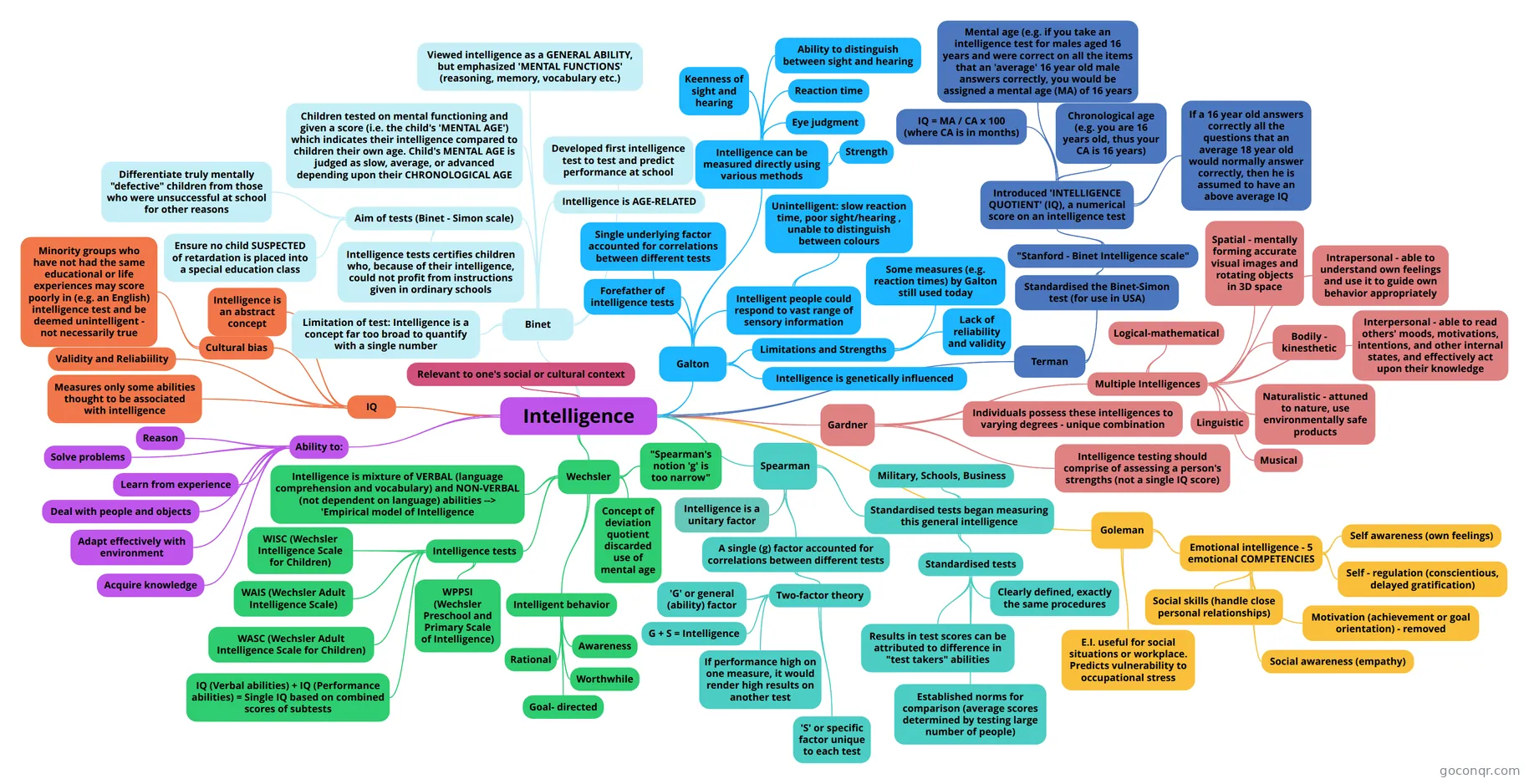
Mind map: Intelligence
Inhalt der Mindmap
Intelligence
Ability to:
- Learn from experience
- Acquire knowledge
- Reason
- Solve problems
- Deal with people and objects
- Adapt effectively with environment
Relevant to one's social or cultural context
Galton
- Forefather of intelligence tests
- Single underlying factor accounted for correlations between different tests
- Intelligence is genetically influenced
- Intelligence can be measured directly using various methods
- Reaction time
- Keenness of sight and hearing
- Ability to distinguish between sight and hearing
- Eye judgment
- Strength
- Intelligent people could respond to vast range of sensory information
- Unintelligent: slow reaction time, poor sight/hearing , unable to distinguish between colours
- Limitations and Strengths
- Lack of reliability and validity
- Some measures (e.g. reaction times) by Galton still used today
Spearman
- Intelligence is a unitary factor
- A single (g) factor accounted for correlations between different tests
- Two-factor theory
- 'G' or general (ability) factor
- 'S' or specific factor unique to each test
- G + S = Intelligence
- If performance high on one measure, it would render high results on another test
- Two-factor theory
- Standardised tests began measuring this general intelligence
- Military, Schools, Business
- Standardised tests
- Established norms for comparison (average scores determined by testing large number of people)
- Clearly defined, exactly the same procedures
- Results in test scores can be attributed to difference in "test takers" abilities
Binet
- Developed first intelligence test to test and predict performance at school
- Viewed intelligence as a GENERAL ABILITY, but emphasized 'MENTAL FUNCTIONS' (reasoning, memory, vocabulary etc.)
- Intelligence is AGE-RELATED
- Children tested on mental functioning and given a score (i.e. the child's 'MENTAL AGE') which indicates their intelligence compared to children their own age. Child's MENTAL AGE is judged as slow, average, or advanced depending upon their CHRONOLOGICAL AGE
- Aim of tests (Binet - Simon scale)
- Differentiate truly mentally "defective" children from those who were unsuccessful at school for other reasons
- Ensure no child SUSPECTED of retardation is placed into a special education class
- Intelligence tests certifies children who, because of their intelligence, could not profit from instructions given in ordinary schools
- Limitation of test: Intelligence is a concept far too broad to quantify with a single number
Terman
- Standardised the Binet-Simon test (for use in USA)
- "Stanford - Binet Intelligence scale"
- Introduced 'INTELLIGENCE QUOTIENT' (IQ), a numerical score on an intelligence test
- Chronological age (e.g. you are 16 years old, thus your CA is 16 years)
- Mental age (e.g. if you take an intelligence test for males aged 16 years and were correct on all the items that an 'average' 16 year old male answers correctly, you would be assigned a mental age (MA) of 16 years
- IQ = MA / CA x 100 (where CA is in months)
- If a 16 year old answers correctly all the questions that an average 18 year old would normally answer correctly, then he is assumed to have an above average IQ
- Introduced 'INTELLIGENCE QUOTIENT' (IQ), a numerical score on an intelligence test
- "Stanford - Binet Intelligence scale"
- Standardised the Binet-Simon test (for use in USA)
Wechsler
- Intelligence is mixture of VERBAL (language comprehension and vocabulary) and NON-VERBAL (not dependent on language) abilities --> 'Empirical model of Intelligence
- Intelligence tests
- WAIS (Wechsler Adult Intelligence Scale)
- WASC (Wechsler Adult Intelligence Scale for Children)
- WPPSI (Wechsler Preschool and Primary Scale of Intelligence)
- WISC (Wechsler Intelligence Scale for Children)
- IQ (Verbal abilities) + IQ (Performance abilities) = Single IQ based on combined scores of subtests
- "Spearman's notion 'g' is too narrow"
- Intelligent behavior
- Awareness
- Goal- directed
- Rational
- Worthwhile
- Concept of deviation quotient discarded use of mental age
Gardner
- Multiple Intelligences
- Linguistic
- Musical
- Logical-mathematical
- Spatial - mentally forming accurate visual images and rotating objects in 3D space
- Bodily - kinesthetic
- Intrapersonal - able to understand own feelings and use it to guide own behavior appropriately
- Interpersonal - able to read others' moods, motivations, intentions, and other internal states, and effectively act upon their knowledge
- Naturalistic - attuned to nature, use environmentally safe products
- Individuals possess these intelligences to varying degrees - unique combination
- Intelligence testing should comprise of assessing a person's strengths (not a single IQ score)
- Multiple Intelligences
Goleman
- Emotional intelligence - 5 emotional COMPETENCIES
- Self awareness (own feelings)
- Self - regulation (conscientious, delayed gratification)
- Motivation (achievement or goal orientation) - removed
- Social awareness (empathy)
- Social skills (handle close personal relationships)
- E.I. useful for social situations or workplace. Predicts vulnerability to occupational stress
- Emotional intelligence - 5 emotional COMPETENCIES
IQ
- Intelligence is an abstract concept
- Cultural bias
- Minority groups who have not had the same educational or life experiences may score poorly in (e.g. an English) intelligence test and be deemed unintelligent - not necessarily true
- Validity and Reliabiility
- Measures only some abilities thought to be associated with intelligence
Informationen
- Beschreibung
- Mindmap am Intelligence, erstellt von Shu Jia Ch'ng am 17/10/2015.
- Erstellt von
- Shu Jia Ch'ng
- Aufrufe
- 0
- Bewertung