
Mindmap
GCSE PE - 6
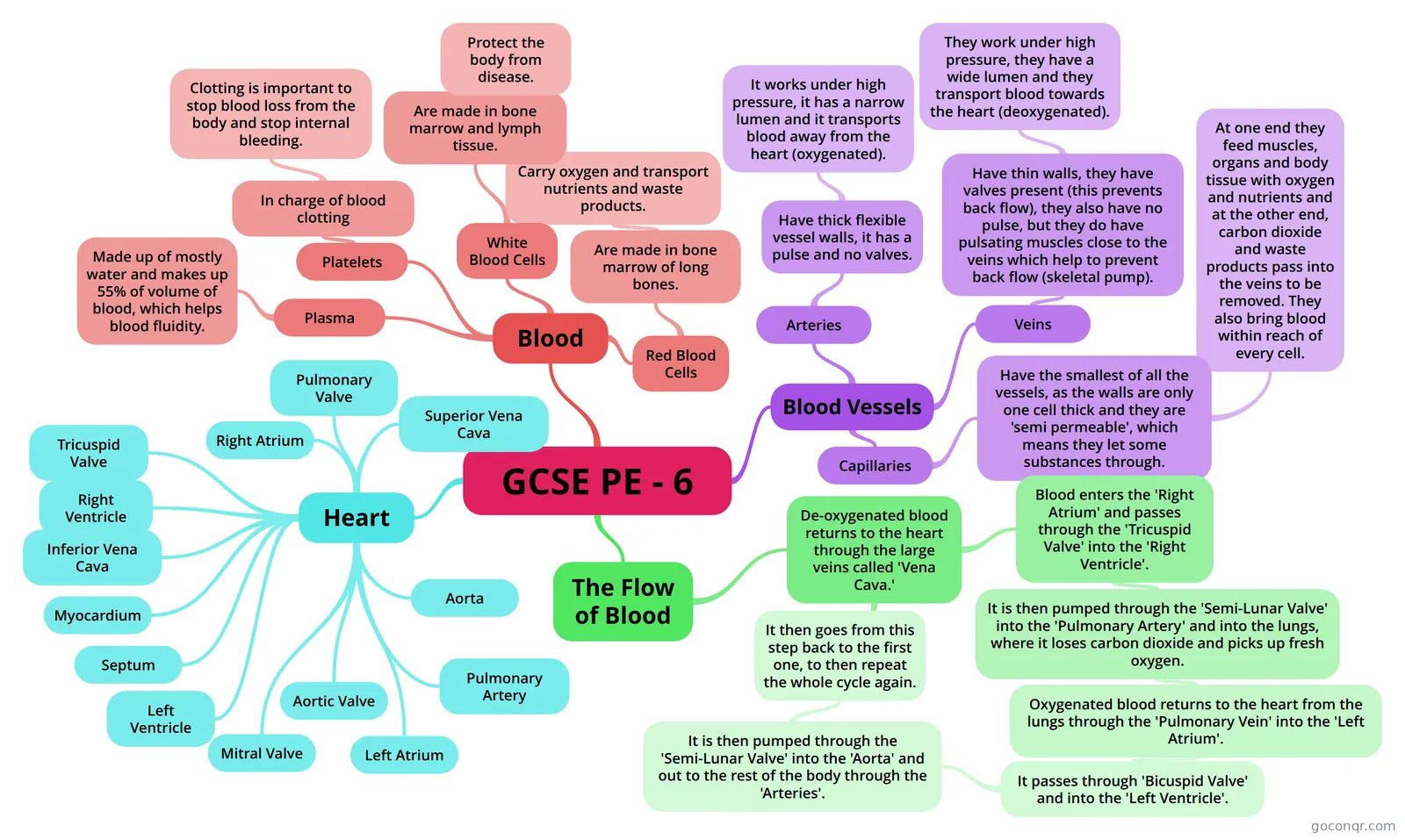
Mind map: GCSE PE blood flow
Inhalt der Mindmap
GCSE PE - 6
Blood
- Red Blood Cells
- Are made in bone marrow of long bones.
- Carry oxygen and transport nutrients and waste products.
- Are made in bone marrow of long bones.
- White Blood Cells
- Are made in bone marrow and lymph tissue.
- Protect the body from disease.
- Are made in bone marrow and lymph tissue.
- Platelets
- In charge of blood clotting
- Clotting is important to stop blood loss from the body and stop internal bleeding.
- In charge of blood clotting
- Plasma
- Made up of mostly water and makes up 55% of volume of blood, which helps blood fluidity.
- Red Blood Cells
Heart
- Inferior Vena Cava
- Superior Vena Cava
- Pulmonary Valve
- Right Atrium
- Tricuspid Valve
- Right Ventricle
- Myocardium
- Septum
- Left Ventricle
- Mitral Valve
- Aortic Valve
- Left Atrium
- Pulmonary Artery
- Aorta
Blood Vessels
- Arteries
- Have thick flexible vessel walls, it has a pulse and no valves.
- It works under high pressure, it has a narrow lumen and it transports blood away from the heart (oxygenated).
- Have thick flexible vessel walls, it has a pulse and no valves.
- Veins
- Have thin walls, they have valves present (this prevents back flow), they also have no pulse, but they do have pulsating muscles close to the veins which help to prevent back flow (skeletal pump).
- They work under high pressure, they have a wide lumen and they transport blood towards the heart (deoxygenated).
- Have thin walls, they have valves present (this prevents back flow), they also have no pulse, but they do have pulsating muscles close to the veins which help to prevent back flow (skeletal pump).
- Capillaries
- Have the smallest of all the vessels, as the walls are only one cell thick and they are 'semi permeable', which means they let some substances through.
- At one end they feed muscles, organs and body tissue with oxygen and nutrients and at the other end, carbon dioxide and waste products pass into the veins to be removed. They also bring blood within reach of every cell.
- Have the smallest of all the vessels, as the walls are only one cell thick and they are 'semi permeable', which means they let some substances through.
- Arteries
The Flow of Blood
- De-oxygenated blood returns to the heart through the large veins called 'Vena Cava.'
- Blood enters the 'Right Atrium' and passes through the 'Tricuspid Valve' into the 'Right Ventricle'.
- It is then pumped through the 'Semi-Lunar Valve' into the 'Pulmonary Artery' and into the lungs, where it loses carbon dioxide and picks up fresh oxygen.
- Oxygenated blood returns to the heart from the lungs through the 'Pulmonary Vein' into the 'Left Atrium'.
- It passes through 'Bicuspid Valve' and into the 'Left Ventricle'.
- It is then pumped through the 'Semi-Lunar Valve' into the 'Aorta' and out to the rest of the body through the 'Arteries'.
- It then goes from this step back to the first one, to then repeat the whole cycle again.
- It is then pumped through the 'Semi-Lunar Valve' into the 'Aorta' and out to the rest of the body through the 'Arteries'.
- It passes through 'Bicuspid Valve' and into the 'Left Ventricle'.
- Oxygenated blood returns to the heart from the lungs through the 'Pulmonary Vein' into the 'Left Atrium'.
- It is then pumped through the 'Semi-Lunar Valve' into the 'Pulmonary Artery' and into the lungs, where it loses carbon dioxide and picks up fresh oxygen.
- Blood enters the 'Right Atrium' and passes through the 'Tricuspid Valve' into the 'Right Ventricle'.
- De-oxygenated blood returns to the heart through the large veins called 'Vena Cava.'
Informationen
- Beschreibung
- GCSE GCSE PE Mindmap am GCSE PE - 6, erstellt von lydia_ward am 23/11/2013.
- Erstellt von
- lydia_ward
- Aufrufe
- 564
- Tags
- Bewertung