
Mindmap
MEMORY
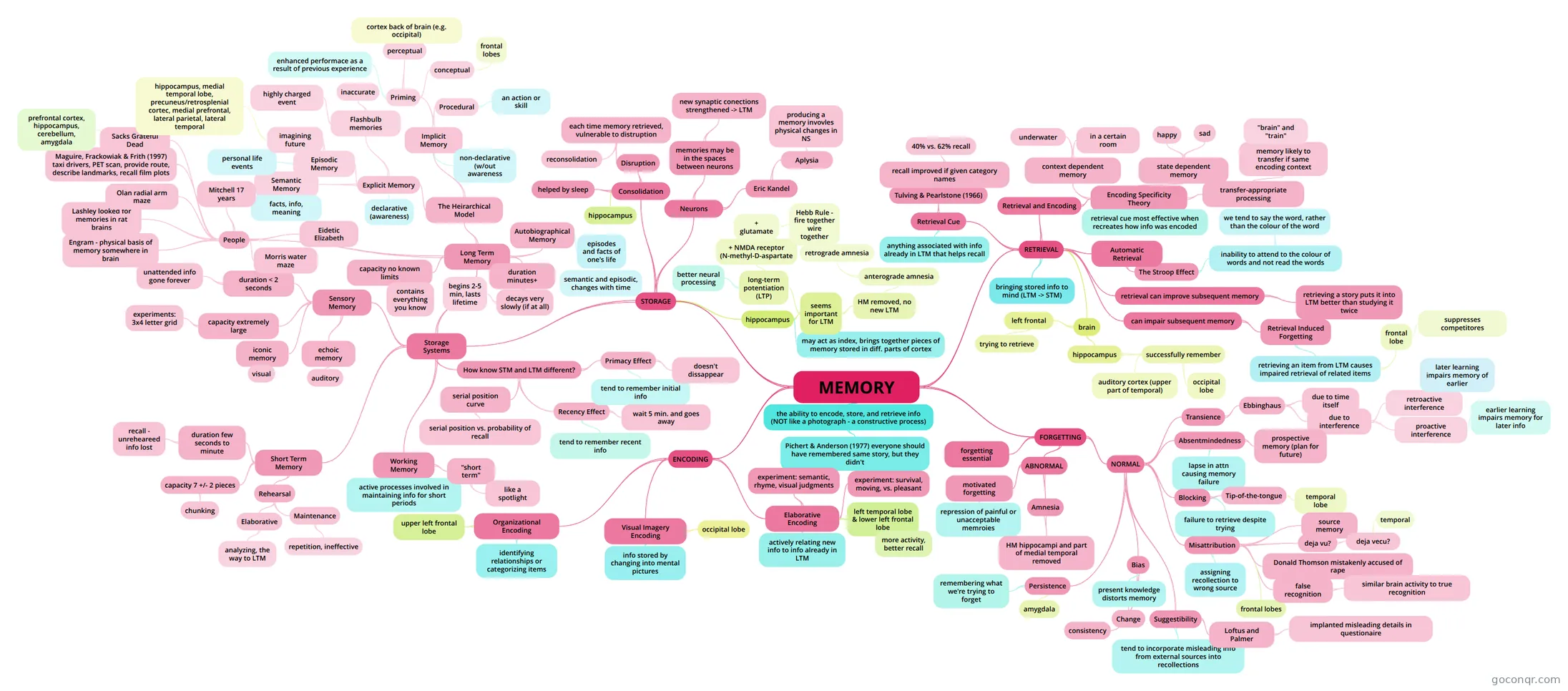
Mind map: memory
Inhalt der Mindmap
MEMORY
the ability to encode, store, and retrieve info (NOT like a photograph - a constructive process)
- Pichert & Anderson (1977) everyone should have remembered same story, but they didn't
ENCODING
- Elaborative Encoding
- actively relating new info to info already in LTM
- left temporal lobe & lower left frontal lobe
- more activity, better recall
- experiment: semantic, rhyme, visual judgments
- experiment: survival, moving, vs. pleasant
- Visual Imagery Encoding
- info stored by changing into mental pictures
- occipital lobe
- Organizational Encoding
- identifying relationships or categorizing items
- upper left frontal lobe
- Elaborative Encoding
STORAGE
- Storage Systems
- Sensory Memory
- duration < 2 seconds
- unattended info gone forever
- capacity extremely large
- experiments: 3x4 letter grid
- iconic memory
- visual
- echoic memory
- auditory
- duration < 2 seconds
- Short Term Memory
- duration few seconds to minute
- recall - unreheareed info lost
- capacity 7 +/- 2 pieces
- chunking
- Rehearsal
- Maintenance
- repetition, ineffective
- Elaborative
- analyzing, the way to LTM
- Maintenance
- duration few seconds to minute
- Long Term Memory
- duration minutes+
- decays very slowly (if at all)
- begins 2-5 min, lasts lifetime
- decays very slowly (if at all)
- capacity no known limits
- contains everything you know
- The Heirarchical Model
- Implicit Memory
- non-declarative (w/out awareness
- Priming
- enhanced performace as a result of previous experience
- perceptual
- cortex back of brain (e.g. occipital)
- conceptual
- frontal lobes
- Procedural
- an action or skill
- Explicit Memory
- Semantic Memory
- facts, info, meaning
- Episodic Memory
- personal life events
- imagining future
- hippocampus, medial temporal lobe, precuneus/retrosplenial cortec, medial prefrontal, lateral parietal, lateral temporal
- declarative (awareness)
- Flashbulb memories
- highly charged event
- inaccurate
- Semantic Memory
- Implicit Memory
- Autobiographical Memory
- episodes and facts of one's life
- semantic and episodic, changes with time
- episodes and facts of one's life
- People
- Engram - physical basis of memory somewhere in brain
- Lashley looked for memories in rat brains
- Eidetic Elizabeth
- Maguire, Frackowiak & Frith (1997) taxi drivers, PET scan, provide route, describe landmarks, recall film plots
- prefrontal cortex, hippocampus, cerebellum, amygdala
- Olan radial arm maze
- Morris water maze
- Sacks Grateful Dead
- Mitchell 17 years
- duration minutes+
- Working Memory
- active processes involved in maintaining info for short periods
- "short term"
- like a spotlight
- How know STM and LTM different?
- Primacy Effect
- tend to remember initial info
- doesn't dissappear
- Recency Effect
- tend to remember recent info
- wait 5 min. and goes away
- serial position curve
- serial position vs. probability of recall
- Primacy Effect
- Sensory Memory
- hippocampus
- may act as index, brings together pieces of memory stored in diff. parts of cortex
- seems important for LTM
- HM removed, no new LTM
- anterograde amnesia
- retrograde amnesia
- anterograde amnesia
- long-term potentiation (LTP)
- + NMDA receptor (N-methyl-D-aspartate
- + glutamate
- Hebb Rule - fire together wire together
- Donald Hebb: if a synapse becomes active at same time a post-synaptic neuron fires, chemical changes in the synapse strengthen this connection
- Hebb Rule - fire together wire together
- + glutamate
- better neural processing
- + NMDA receptor (N-methyl-D-aspartate
- HM removed, no new LTM
- Consolidation
- helped by sleep
- Disruption
- each time memory retrieved, vulnerable to distruption
- reconsolidation
- each time memory retrieved, vulnerable to distruption
- hippocampus
- Neurons
- memories may be in the spaces between neurons
- new synaptic conections strengthened -> LTM
- Eric Kandel
- Aplysia
- producing a memory invovles physical changes in NS
- Aplysia
- memories may be in the spaces between neurons
- Storage Systems
RETRIEVAL
- bringing stored info to mind (LTM -> STM)
- Retrieval Cue
- anything associated with info already in LTM that helps recall
- Tulving & Pearlstone (1966)
- recall improved if given category names
- 40% vs. 62% recall
- recall improved if given category names
- Retrieval and Encoding
- Encoding Specificity Theory
- retrieval cue most effective when recreates how info was encoded
- context dependent memory
- underwater
- in a certain room
- state dependent memory
- happy
- sad
- transfer-appropriate processing
- memory likely to transfer if same encoding context
- "brain" and "train"
- memory likely to transfer if same encoding context
- Encoding Specificity Theory
- Automatic Retrieval
- The Stroop Effect
- inability to attend to the colour of words and not read the words
- we tend to say the word, rather than the colour of the word
- inability to attend to the colour of words and not read the words
- The Stroop Effect
- retrieval can improve subsequent memory
- retrieving a story puts it into LTM better than studying it twice
- can impair subsequent memory
- Retrieval Induced Forgetting
- retrieving an item from LTM causes impaired retrieval of related items
- frontal lobe
- suppresses competitores
- frontal lobe
- retrieving an item from LTM causes impaired retrieval of related items
- Retrieval Induced Forgetting
- brain
- left frontal
- trying to retrieve
- hippocampus
- successfully remember
- auditory cortex (upper part of temporal)
- occipital lobe
- successfully remember
- left frontal
FORGETTING
- NORMAL
- Transience
- Ebbinghaus
- due to time itself
- due to interference
- retroactive interference
- later learning impairs memory of earlier
- proactive interference
- earlier learning impairs memory for later info
- retroactive interference
- Ebbinghaus
- Absentmindedness
- lapse in attn causing memory failure
- prospective memory (plan for future)
- Blocking
- Tip-of-the-tongue
- temporal lobe
- failure to retrieve despite trying
- Tip-of-the-tongue
- Misattribution
- assigning recollection to wrong source
- Donald Thomson mistakenly accused of rape
- source memory
- deja vu?
- deja vecu?
- temporal
- deja vecu?
- frontal lobes
- false recognition
- similar brain activity to true recognition
- Suggestibility
- tend to incorporate misleading info from external sources into recollections
- Loftus and Palmer
- implanted misleading details in questionaire
- Bias
- present knowledge distorts memory
- consistency
- Change
- Persistence
- remembering what we're trying to forget
- amygdala
- Transience
- ABNORMAL
- motivated forgetting
- repression of painful or unacceptable memroies
- Amnesia
- HM hippocampi and part of medial temporal removed
- motivated forgetting
- forgetting essential
- NORMAL
Informationen
- Beschreibung
- Mindmap am MEMORY, erstellt von patriciaskagen2167 am 11/12/2013.
- Erstellt von
- patriciaskagen2167
- Aufrufe
- 6
- Bewertung