
Mindmap
RELATIONSHIPS
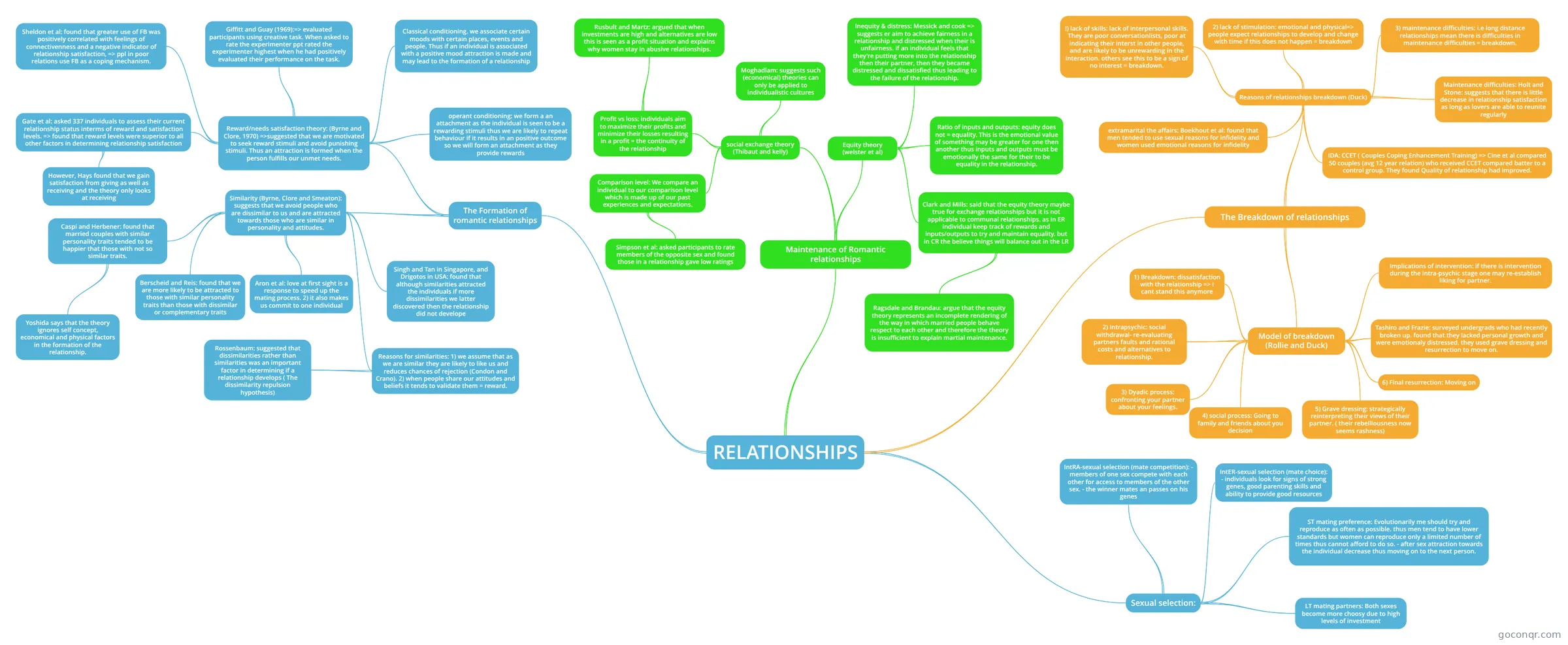
Mind map: Relationships psychology
Inhalt der Mindmap
RELATIONSHIPS
The Formation of romantic relationships
- Reward/needs satisfaction theory: (Byrne and Clore, 1970) =>suggested that we are motivated to seek reward stimuli and avoid punishing stimuli. Thus an attraction is formed when the person fulfills our unmet needs.
- operant conditioning: we form a an attachment as the individual is seen to be a rewarding stimuli thus we are likely to repeat behaviour if it results in an positive outcome so we will form an attachment as they provide rewards
- Classical conditioning. we associate certain moods with certain places, events and people. Thus if an individual is associated with a positive mood attraction is made and may lead to the formation of a relationship
- Giffitt and Guay (1969):=> evaluated participants using creative task. When asked to rate the experimenter ppt rated the experimenter highest when he had positively evaluated their performance on the task.
- Sheldon et al: found that greater use of FB was positively correlated with feelings of connectivenness and a negative indicator of relationship satisfaction, => ppl in poor relations use FB as a coping mechanism.
- Gate et al: asked 337 individuals to assess their current relationship status interms of reward and satisfaction levels. => found that reward levels were superior to all other factors in determining relationship satisfaction
- However, Hays found that we gain satisfaction from giving as well as receiving and the theory only looks at receiving
- Similarity (Byrne, Clore and Smeaton): suggests that we avoid people who are dissimilar to us and are attracted towards those who are similar in personality and attitudes.
- Berscheid and Reis: found that we are more likely to be attracted to those with similar personality traits than those with dissimilar or complementary traits
- Caspi and Herbener: found that married couples with similar personality traits tended to be happier that those with not so similar traits.
- Yoshida says that the theory ignores self concept, economical and physical factors in the formation of the relationship.
- Singh and Tan in Singapore, and Drigotos in USA: found that although similarities attracted the individuals if more dissimilarities we latter discovered then the relationship did not develope
- Reasons for similarities: 1) we assume that as we are similar they are likely to like us and reduces chances of rejection (Condon and Crano). 2) when people share our attitudes and beliefs it tends to validate them = reward.
- Rossenbaum: suggested that dissimilarities rather than similarities was an important factor in determining if a relationship develops ( The dissimilarity repulsion hypothesis)
- Aron et al: love at first sight is a response to speed up the mating process. 2) it also makes us commit to one individual
- Reward/needs satisfaction theory: (Byrne and Clore, 1970) =>suggested that we are motivated to seek reward stimuli and avoid punishing stimuli. Thus an attraction is formed when the person fulfills our unmet needs.
Maintenance of Romantic relationships
- social exchange theory (Thibaut and kelly)
- Profit vs loss: individuals aim to maximize their profits and minimize their losses resulting in a profit = the continuity of the relationship
- Rusbult and Martz: argued that when investments are high and alternatives are low this is seen as a profit situation and explains why women stay in abusive relationships.
- Comparison level: We compare an individual to our comparison level which is made up of our past experiences and expectations.
- Simpson et al: asked participants to rate members of the opposite sex and found those in a relationship gave low ratings
- Moghadlam: suggests such (economical) theories can only be applied to individualistic cultures
- Profit vs loss: individuals aim to maximize their profits and minimize their losses resulting in a profit = the continuity of the relationship
- Equity theory (welster et al)
- Inequity & distress: Messick and cook => suggests er aim to achieve fairness in a relationship and distressed when their is unfairness. if an individual feels that they're putting more into the relationship then their partner, then they became distressed and dissatisfied thus leading to the failure of the relationship.
- Ratio of inputs and outputs: equity does not = equality. This is the emotional value of something may be greater for one then another thus inputs and outputs must be emotionally the same for their to be equality in the relationship.
- Clark and Mills: said that the equity theory maybe true for exchange relationships but it is not applicable to communal relationships. as in ER individual keep track of rewards and inputs/outputs to try and maintain equality. but in CR the believe things will balance out in the LR
- Ragsdale and Brandau: argue that the equity theory represents an incomplete rendering of the way in which married people behave respect to each other and therefore the theory is insufficient to explain martial maintenance.
- social exchange theory (Thibaut and kelly)
The Breakdown of relationships
- Reasons of relationships breakdown (Duck)
- !) lack of skills: lack of interpersonal skills. They are poor conversationlists, poor at indicating their interst in other people, and are likely to be unrewarding in the interaction. others see this to be a sign of no interest = breakdown.
- 2) lack of stimulation: emotional and physical=> people expect relationships to develop and change with time if this does not happen = breakdown
- 3) maintenance difficulties: i.e long distance relationships mean there is difficulties in maintenance difficulties = breakdown.
- extramarital the affairs: Boekhout et al: found that men tended to use sexual reasons for infidelity and women used emotional reasons for infidelity
- Maintenance difficulties: Holt and Stone: suggests that there is little decrease in relationship satisfaction as long as lovers are able to reunite regularly
- IDA: CCET ( Couples Coping Enhancement Training) => Cine et al compared 50 couples (avg 12 year relation) who received CCET compared batter to a control group. They found Quality of relationship had improved.
- Model of breakdown (Rollie and Duck)
- 1) Breakdown: dissatisfaction with the relationship => i cant stand this anymore
- 2) Intrapsychic: social withdrawal- re-evaluating partners faults and rational costs and alternatives to relationship.
- 3) Dyadic process: confronting your partner about your feelings.
- 4) social process: Going to family and friends about you decision
- 5) Grave dressing: strategically reinterpreting their views of their partner. ( their rebelliousness now seems rashness)
- 6) Final resurrection: Moving on
- Tashiro and Frazie: surveyed undergrads who had recently broken up. found that they lacked personal growth and were emotionaly distressed. they used grave dressing and resurrection to move on.
- Implications of intervention: if there is intervention during the intra-psychic stage one may re-establish liking for partner.
- Reasons of relationships breakdown (Duck)
Sexual selection:
- IntRA-sexual selection (mate competition): - members of one sex compete with each other for access to members of the other sex. - the winner mates an passes on his genes
- IntER-sexual selection (mate choice): - individuals look for signs of strong genes, good parenting skills and ability to provide good resources
- ST mating preference: Evolutionarily me should try and reproduce as often as possible. thus men tend to have lower standards but women can reproduce only a limited number of times thus cannot afford to do so. - after sex attraction towards the individual decrease thus moving on to the next person.
- LT mating partners: Both sexes become more choosy due to high levels of investment
Informationen
- Beschreibung
- A-Level Psychology Mindmap am RELATIONSHIPS, erstellt von arshdeep.gill am 28/01/2016.
- Erstellt von
- arshdeep.gill
- Aufrufe
- 2
- Bewertung
Mehr zu Relationship formation and attraction