
Mindmap
Behavioural explanation of depression
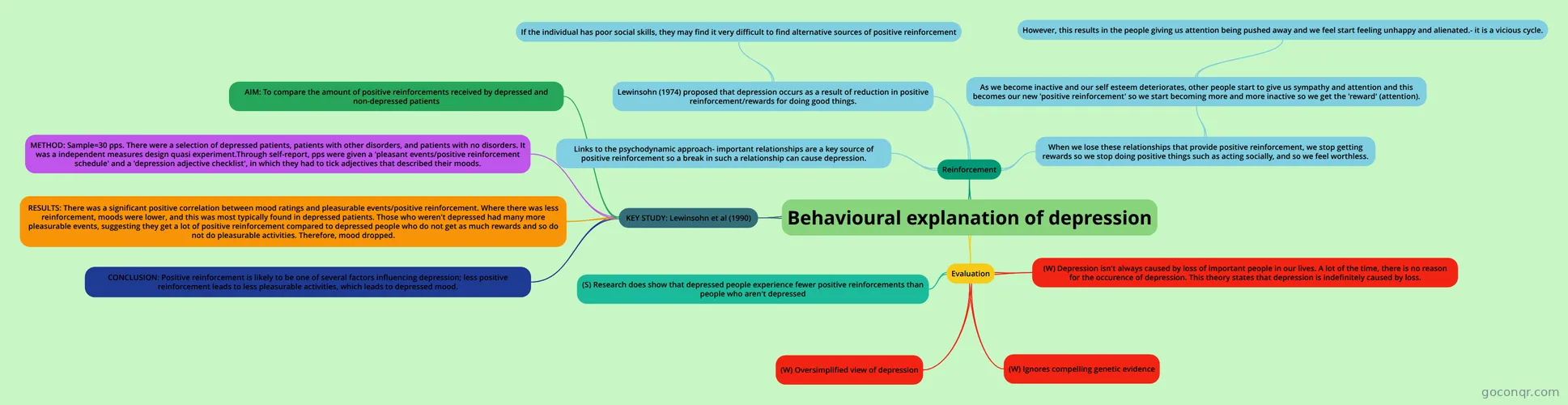
Mind map: Behavioural explanation of depression
Inhalt der Mindmap
Behavioural explanation of depression
Reinforcement
- Lewinsohn (1974) proposed that depression occurs as a result of reduction in positive reinforcement/rewards for doing good things.
- If the individual has poor social skills, they may find it very difficult to find alternative sources of positive reinforcement
- Links to the psychodynamic approach- important relationships are a key source of positive reinforcement so a break in such a relationship can cause depression.
- When we lose these relationships that provide positive reinforcement, we stop getting rewards so we stop doing positive things such as acting socially, and so we feel worthless.
- As we become inactive and our self esteem deteriorates, other people start to give us sympathy and attention and this becomes our new 'positive reinforcement' so we start becoming more and more inactive so we get the 'reward' (attention).
- However, this results in the people giving us attention being pushed away and we feel start feeling unhappy and alienated.- it is a vicious cycle.
- As we become inactive and our self esteem deteriorates, other people start to give us sympathy and attention and this becomes our new 'positive reinforcement' so we start becoming more and more inactive so we get the 'reward' (attention).
- Lewinsohn (1974) proposed that depression occurs as a result of reduction in positive reinforcement/rewards for doing good things.
Evaluation
- (S) Research does show that depressed people experience fewer positive reinforcements than people who aren't depressed
- (W) Depression isn't always caused by loss of important people in our lives. A lot of the time, there is no reason for the occurence of depression. This theory states that depression is indefinitely caused by loss.
- (W) Oversimplified view of depression
- (W) Ignores compelling genetic evidence
KEY STUDY: Lewinsohn et al (1990)
- AIM: To compare the amount of positive reinforcements received by depressed and non-depressed patients
- METHOD: Sample=30 pps. There were a selection of depressed patients, patients with other disorders, and patients with no disorders. It was a independent measures design quasi experiment.Through self-report, pps were given a 'pleasant events/positive reinforcement schedule' and a 'depression adjective checklist', in which they had to tick adjectives that described their moods.
- RESULTS: There was a significant positive correlation between mood ratings and pleasurable events/positive reinforcement. Where there was less reinforcement, moods were lower, and this was most typically found in depressed patients. Those who weren't depressed had many more pleasurable events, suggesting they get a lot of positive reinforcement compared to depressed people who do not get as much rewards and so do not do pleasurable activities. Therefore, mood dropped.
- CONCLUSION: Positive reinforcement is likely to be one of several factors influencing depression; less positive reinforcement leads to less pleasurable activities, which leads to depressed mood.
Informationen
- Beschreibung
- A mind map showing the behavioural explanation of depression proposed by Lewinsohn.
- Erstellt von
- bro-bro-bro123
- Aufrufe
- 73
- Tags
- Bewertung