
Mindmap
Evolutionary Explanations of Relationships
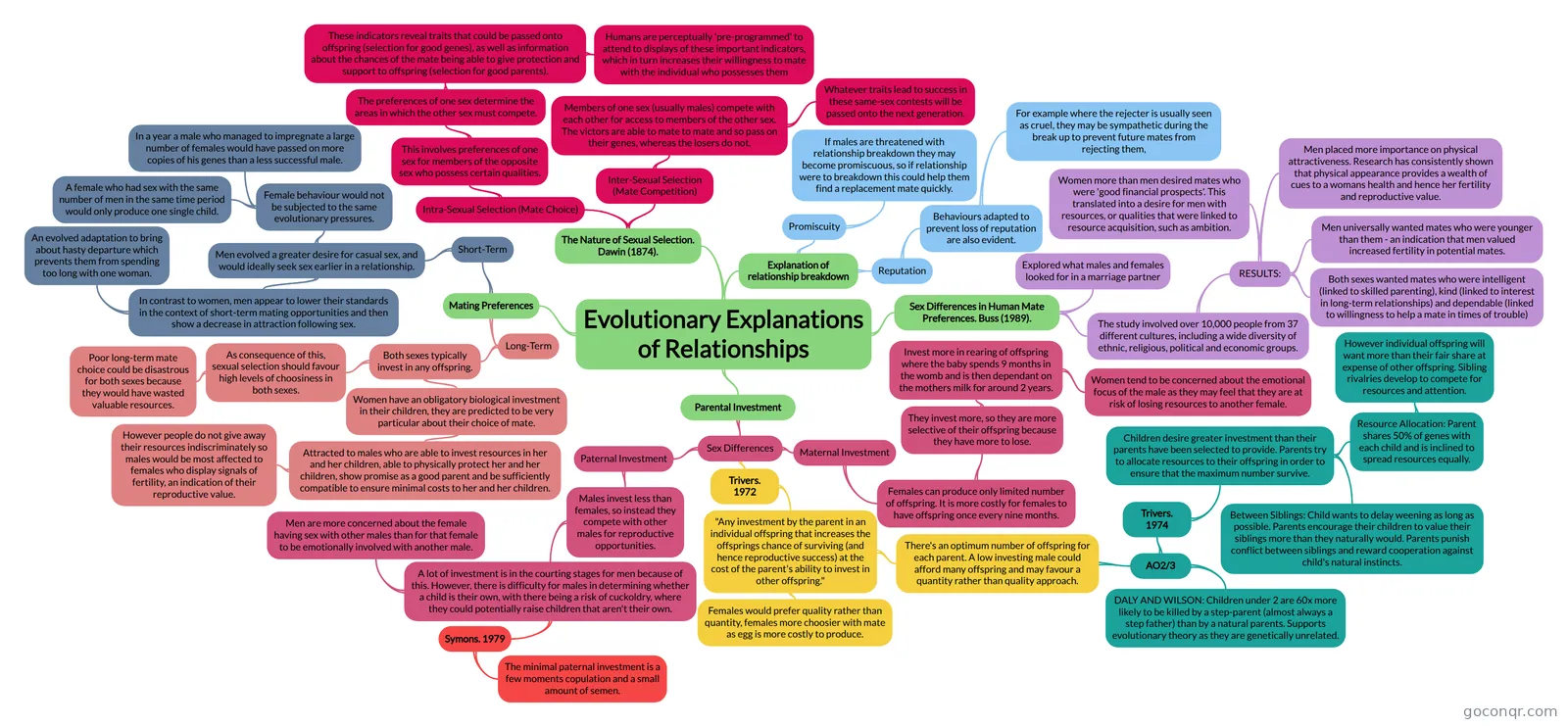
Mind map: Evolutionary explanations of relationships
Inhalt der Mindmap
Evolutionary Explanations of Relationships
The Nature of Sexual Selection. Dawin (1874).
- Inter-Sexual Selection (Mate Competition)
- Members of one sex (usually males) compete with each other for access to members of the other sex. The victors are able to mate to mate and so pass on their genes, whereas the losers do not.
- Whatever traits lead to success in these same-sex contests will be passed onto the next generation.
- Members of one sex (usually males) compete with each other for access to members of the other sex. The victors are able to mate to mate and so pass on their genes, whereas the losers do not.
- Intra-Sexual Selection (Mate Choice)
- This involves preferences of one sex for members of the opposite sex who possess certain qualities.
- The preferences of one sex determine the areas in which the other sex must compete.
- These indicators reveal traits that could be passed onto offspring (selection for good genes), as well as information about the chances of the mate being able to give protection and support to offspring (selection for good parents).
- Humans are perceptually 'pre-programmed' to attend to displays of these important indicators, which in turn increases their willingness to mate with the individual who possesses them
- These indicators reveal traits that could be passed onto offspring (selection for good genes), as well as information about the chances of the mate being able to give protection and support to offspring (selection for good parents).
- The preferences of one sex determine the areas in which the other sex must compete.
- This involves preferences of one sex for members of the opposite sex who possess certain qualities.
- Inter-Sexual Selection (Mate Competition)
Explanation of relationship breakdown
- Promiscuity
- If males are threatened with relationship breakdown they may become promiscuous, so if relationship were to breakdown this could help them find a replacement mate quickly.
- Reputation
- Behaviours adapted to prevent loss of reputation are also evident.
- For example where the rejecter is usually seen as cruel, they may be sympathetic during the break up to prevent future mates from rejecting them,
- Behaviours adapted to prevent loss of reputation are also evident.
- Promiscuity
Sex Differences in Human Mate Preferences. Buss (1989).
- Explored what males and females looked for in a marriage partner
- The study involved over 10,000 people from 37 different cultures, including a wide diversity of ethnic, religious, political and economic groups.
- RESULTS:
- Women more than men desired mates who were 'good financial prospects'. This translated into a desire for men with resources, or qualities that were linked to resource acquisition, such as ambition.
- Men placed more importance on physical attractiveness. Research has consistently shown that physical appearance provides a wealth of cues to a womans health and hence her fertility and reproductive value.
- Men universally wanted mates who were younger than them - an indication that men valued increased fertility in potential mates.
- Both sexes wanted mates who were intelligent (linked to skilled parenting), kind (linked to interest in long-term relationships) and dependable (linked to willingness to help a mate in times of trouble)
- RESULTS:
Mating Preferences
- Short-Term
- Men evolved a greater desire for casual sex, and would ideally seek sex earlier in a relationship.
- Female behaviour would not be subjected to the same evolutionary pressures.
- In a year a male who managed to impregnate a large number of females would have passed on more copies of his genes than a less successful male.
- A female who had sex with the same number of men in the same time period would only produce one single child.
- In contrast to women, men appear to lower their standards in the context of short-term mating opportunities and then show a decrease in attraction following sex.
- An evolved adaptation to bring about hasty departure which prevents them from spending too long with one woman.
- Female behaviour would not be subjected to the same evolutionary pressures.
- Men evolved a greater desire for casual sex, and would ideally seek sex earlier in a relationship.
- Long-Term
- Both sexes typically invest in any offspring.
- As consequence of this, sexual selection should favour high levels of choosiness in both sexes.
- Poor long-term mate choice could be disastrous for both sexes because they would have wasted valuable resources.
- Women have an obligatory biological investment in their children, they are predicted to be very particular about their choice of mate.
- Attracted to males who are able to invest resources in her and her children, able to physically protect her and her children, show promise as a good parent and be sufficiently compatible to ensure minimal costs to her and her children.
- However people do not give away their resources indiscriminately so males would be most affected to females who display signals of fertility, an indication of their reproductive value.
- Attracted to males who are able to invest resources in her and her children, able to physically protect her and her children, show promise as a good parent and be sufficiently compatible to ensure minimal costs to her and her children.
- As consequence of this, sexual selection should favour high levels of choosiness in both sexes.
- Both sexes typically invest in any offspring.
- Short-Term
Parental Investment
- Sex Differences
- Maternal Investment
- Females can produce only limited number of offspring. It is more costly for females to have offspring once every nine months.
- They invest more, so they are more selective of their offspring because they have more to lose.
- Invest more in rearing of offspring where the baby spends 9 months in the womb and is then dependant on the mothers milk for around 2 years.
- Women tend to be concerned about the emotional focus of the male as they may feel that they are at risk of losing resources to another female.
- Invest more in rearing of offspring where the baby spends 9 months in the womb and is then dependant on the mothers milk for around 2 years.
- They invest more, so they are more selective of their offspring because they have more to lose.
- Females can produce only limited number of offspring. It is more costly for females to have offspring once every nine months.
- Paternal Investment
- Males invest less than females, so instead they compete with other males for reproductive opportunities.
- A lot of investment is in the courting stages for men because of this. However, there is difficulty for males in determining whether a child is their own, with there being a risk of cuckoldry, where they could potentially raise children that aren't their own.
- Men are more concerned about the female having sex with other males than for that female to be emotionally involved with another male.
- Symons. 1979
- The minimal paternal investment is a few moments copulation and a small amount of semen.
- A lot of investment is in the courting stages for men because of this. However, there is difficulty for males in determining whether a child is their own, with there being a risk of cuckoldry, where they could potentially raise children that aren't their own.
- Males invest less than females, so instead they compete with other males for reproductive opportunities.
- Trivers. 1972
- "Any investment by the parent in an individual offspring that increases the offsprings chance of surviving (and hence reproductive success) at the cost of the parent's ability to invest in other offspring."
- There's an optimum number of offspring for each parent. A low investing male could afford many offspring and may favour a quantity rather than quality approach.
- AO2/3
- DALY AND WILSON: Children under 2 are 60x more likely to be killed by a step-parent (almost always a step father) than by a natural parents. Supports evolutionary theory as they are genetically unrelated.
- Trivers. 1974
- Children desire greater investment than their parents have been selected to provide. Parents try to allocate resources to their offspring in order to ensure that the maximum number survive.
- Resource Allocation: Parent shares 50% of genes with each child and is inclined to spread resources equally.
- However individual offspring will want more than their fair share at expense of other offspring. Sibling rivalries develop to compete for resources and attention.
- Between Siblings: Child wants to delay weening as long as possible. Parents encourage their children to value their siblings more than they naturally would. Parents punish conflict between siblings and reward cooperation against child's natural instincts.
- Resource Allocation: Parent shares 50% of genes with each child and is inclined to spread resources equally.
- Children desire greater investment than their parents have been selected to provide. Parents try to allocate resources to their offspring in order to ensure that the maximum number survive.
- AO2/3
- Females would prefer quality rather than quantity, females more choosier with mate as egg is more costly to produce.
- There's an optimum number of offspring for each parent. A low investing male could afford many offspring and may favour a quantity rather than quality approach.
- "Any investment by the parent in an individual offspring that increases the offsprings chance of surviving (and hence reproductive success) at the cost of the parent's ability to invest in other offspring."
- Maternal Investment
- Sex Differences
Informationen
- Beschreibung
- A-Level Psychology (Relationships) Mindmap am Evolutionary Explanations of Relationships, erstellt von Rosie Evans am 17/02/2016.
- Erstellt von
- Rosie Evans
- Aufrufe
- 4
- Bewertung
Mehr zu Sexual selection and partner preferences