
Mindmap
Memory
Inhalt der Mindmap
Memory
- Memory: Involves several important processes: 1. Encoding: How memories are formed 2. Storage: How memories are kept over time 3. Retrieval: How memories are recovered and translated into performance Forgetting can occur due to problems in any one the three processes in memory. One problem with the computer analogy, is that we do not save an exact copy of something that happened like a computer does. We remember things through our experiences and it changes over time.
Important Memory Processes
- Encoding
- We have all been introduced to someone and then forgotten their name. That occurs because we have not been able to encode the information because we started talking or listening couldn’t put any attention to encoding their name in memory.
- The Role of Attention
- Attention: focusing awareness on a narrowed range of stimuli or events We have to be selective in our attention and tune out many things around us in order to have a conversation, text someone, or listen to the lecture. Some psychologists believe we have an attention filter and debate whether it screens out information we are not paying attention to either earlier or later in the process. Some theorists believe that this may occur early if we have complex information to pay attention to (high cognitive load) and later if we are just standing around talking (low cognitive load). The cocktail party phenomenon shows that we can talk to one person in a room of other conversations but tune out most everything unless we hear our own name. There is a problem if people try to stay in two conversations at once. One will suffer. Same with driving and talking on a cellphone or texting. It is different that if you are talking to a passenger who can see the traffic and adjust. When multitasking, people are actually just switching attention from one task to the other. Effortful processing or intentionally listening to remember information Automatic Processing: remembering something without intending to (Is bacon used more often among English speakers or pastrami)
- Levels of Processing
- Craik and Lockhart’s Levels of Processing Theory: deeper levels of processing (encoding) result in being able to remember something longer. (p. 287, Fig 7.2) 1. Structural encoding - shallow processing (e.g. word flashed on a screen and you may only recall if it was in capital letters or if it was a short word) 2. Phonemic encoding - intermediate processing (saying word silently or aloud 3. Semantic encoding - deep processing – you learn the meaning so you have to think about it. Best way to remember something
- Enriching Encoding
- 1. Elaboration: linking the to-be-remembered information to some other information at the time of encoding. Elaboration is done with semantic encoding. E.g. When I had to learn about psychological disorders in university, I would relate it to some relative who behaved like it. 2. Visual Imagery: creating mental pictures to represent the information you want to remember Dual coding theory - memory is enhanced by forming semantic (meaning) and visual codes since either can lead to recall. 3. Self-referent encoding involves deciding how or whether information is personally relevant Studies have been done where words have been flashed on a screen and people have been asked to think of how it relates to them. This improves memory for the words because it promotes additional elaboration and better organization of the information.
- Storage
- ¥ Model of Atkinson and Shiffrin (1071) ¥ Storage: Maintaining information in memory Ð Information-processing theories subdivides memory into 3 different stores ¥ Sensory, Short-term, Long-term
- Sensory Memory
- . Sensory memory: Capacity to preserve sensory information in its original form for ¼ of a second e.g. after image or sparkler Ð Partial report (Sperling) - Classic experiment on visual sensory store - Tone cues participants which row to report o Tone comes after the array is gone - Much larger percent recalled, regardless of which row
- Short-Term Memory
- Short-term memory (STM): Limited-capacity store that can maintain unrehearsed information for up to 20 seconds. Short-Term Memory Capacity • George Miller (1956) Number of items that can be recalled from short-term memory, in order, on half of the tested memory trials is about 7 plus or minus 2 items • Recent research by Cowan that prevents subjects from chunking and rehearsing information shows it is likely 4 plus or minus 1 Chunking: Storing information into meaningful or familiar units Example: Chess experts can recall meaningful arrangements of pieces on a board (but not random arrangements) Rehearsal: repeating words over and over or thinking about the information. Maintenance rehearsal – just done to keep it in memory (e.g. phone number) Elaborative rehearsal – think more about it so you are more likely to remember it later. Alan Baddeley describes the STM is as working memory a limited capacity storage that temporarily maintains and stores information by providing an interface between perception (sensory memory), long term memory, and action. The STM or working memory allows us to retrieve information from our LTM (e.g. meaning of words we hear) and use it to understand and work with new information The STM not limited to phonemic encoding but includes visual also. Working memory capacity (WMC) - one’s ability to hold and manipulate information in conscious attention, is influenced by heredity but also by stress. Baddeley’s Phonological loop, Visuospatial sketchpad, central executive control system, and episodic buffer is NOT ON EXAM
- Long-Term Memory
- Long Term Memory: Unlimited capacity store that can hold information for days, weeks or years. Can be permanent (your name). Wilder Penfield’s electronic stimulated brains of people having surgery but what they “recalled” was not necessarily an actual experience Flashbulb memories: vivid and detailed recollections of momentous events. Recent research shows they may not be permanent and accurate. Rather like other memories, they become less detailed and accurate with time. They are special because people are influenced by emotion and are more attached to these memories. How is Knowledge Represented and Organized in Memory? ¥ Cluster – remembering similar items in groups ¥ Conceptual Hierarchies: multilevel classification system See Fig 7.10 p. 295 ¥ Schemas: An organized cluster of knowledge about a particular object or event which we understand from previous experience ¥ Semantic Networks ¥ Nodes represent concepts and are joined to related concepts ¥ Connectionist Networks and PDP Models (See Films on Demand – PDP segment) ¥ Cognitive processes depend on patterns of activation something like neural networks
- Retrieval: Getting Information Out of Memory
- Tip of the Tongue Phenomenon - temporary inability to remember something you know, accompanied by a feeling that it is just out of reach. Memories can often be jogged with retrieval cues. One type of retrieval cue is called context cues. Reinstating the context e.g. crimestopers Hypnosis, however often increases the subject’s tendency to report incorrect information. Encoding Specificity Principle: various pieces of information stored at the same time or in the same type of situation, mood, or place
- Reconstructing Memories and Misinformation Effect
- Remembering is not like replaying a DVD or an exact copy of what we saw in the past. Sir Fredric Bartlett (1932) had his subjects read a story twice and then after 15 minutes write it out. Left out the boring details and added things that were not in the story, likely what fit their schemas Research by and others on the misinformation effect shows that people do not always recall events correctly when they are providing eyewitness testimony. Elizabeth Loftus’ studies of memory reconstruction the misinformation effect involve three stages. 1) Subjects view an event, 2) subjects are exposed to information about the event, some of which is misleading, 3) subjects are later tested on what they remember about the original event. In one study by Loftus and Palmer (1974) the subjects were shown a car accident on a video. Some subjects were asked, “How fast were the cars going when they ‘hit’ each other.” Other “...when they ‘smashed’ into each other.” A week they were asked if they saw any broken glass (there was none in the video). The subjects who heard “smashed” were more likely to say they did. This may be due to one’s schema of “smash”, because the new information replaces the old e.g. saving on a computer or it may be that the new misinformation interferes with the retrieval of the original memory and it may be all three.
- Source, Reality, & Destination Monitering
- Source Monitoring and Reality Monitoring Marcia Johnson has researched source monitoring which refers to making decisions about the origins of memories. (E.g. Where did I hear that?) This is not necessarily encoded at the time we heard the information. Can make source monitoring errors. Source monitoring errors may account for people believing they saw the broken glass when they did not. They have seen broken glass in other accidents but don’t know the source of the memory Destination monitoring- to whom did you tell something. Marcia Johnson notes that reality monitoring is a subtype of source monitoring. Is memory from external or internal sources. “Did I take my pill or did I just intend to take it.” We are more likely to believe something really happened if 1) If the memory is rich in sensory information (e.g. you can feel your hands touching the wet clothes or 2) if you have contextual information (e.g. you looked at the clock when you took your pill).
- Forgetting
- The first person to conduct scientific studies of forgetting was Hermann Ebbinghaus in 1885. He studied only one subject and that was himself. He wanted to make sure that his memory would not be affected by anything he had learned previously so he invented numerous nonsense syllables, BAF, GAC. He memorized 420 lists of these syllables and tested his memory after various time periods. This is called a forgetting curve and it graphs retention (remembering) and forgetting over time. He found that after the first few hours he could remember considerably less nonsense syllables that he could right afterward. So he concluded that most forgetting occurs right after learning something. People who have done research since, have noted that if subjects learn meaningful information, the forgetting curve is not nearly so sharp. It also depends on what measure is used to measure forgetting.
- Measures of Forgetting/Retension
- To measure forgetting, a researcher is also measuring retention or remembering. Retention is the proportion of material retained (remembered). The retention interval is the length of time between when the subject is given the materials to remember and the time forgetting is measured. The three principal methods of measuring forgetting and retention are 1) recall, 2) recognition, and 3) relearning. 1) recall requires subjects to reproduce information on their own without any cues. E.g. Who is the mayor of Lac La Biche or the premier of Alberta? 2) recognition requires the subject to select previously learned information from a number of options. E.g. multiple choice questions. Usually recognition tests yield higher scores than recall tests on the same material. However, there is no guarantee that a recognition test will be easier depending on the number, similarity,and plausibility of the options. 3) Relearning requires a subject to memorize information a second time to determine how much time or effort is saved by having learned it before. For example, the subject is given a list of words to remember and the either time it takes or the number of practice trials is recorded. A week later the subject is given the same list to remember and timed. If the subject took 20 minutes to memorize the list the first time and 5 minutes the second time, the subject would have a savings score of 75% (15/20 = 3/4 or 75%). This is considered to mean the subject retained 75% of the information and forgot 25% of it.
- Why We Forget
- The problem with forgetting, as we have said before can be with the encoding, storage, or retrieval or with some combination of these.
- Ineffective Coding
- Ineffective Coding: Is the loon on a one-dollar coin facing right or left? A lot of forgetting is not really forgetting. People may think they forget something but really it has never been remembered. It has never been encoded. This is called pseudo forgetting and it usually happens due to lack of attention. Sometimes we forget because coding is done ineffectively. Craik and Lockhart’s three levels of processing explains that some ways of encoding are more effective than others. If you are distracted while you are reading your textbook, you may only be saying words to yourself (phonemic coding). You need to code the meaning in order to remember the information.
- Decay
- Decay: This has to do with storage. Decay theory proposes that forgetting occurs because memory traces fade with time. This means we forget because of the time that passes. Evidence shows that time alone can cause a person to forget information from the Sensory Memory and STM. However, researchers have not been able to prove decay causes LTM forgetting. In studies of long term memory, it is not just the passage of time that causes us to forget but rather what happens during that time.
- Interferences
- . Interference: If the subject tries to remember something but then has to remember some other information in the meanwhile the new information can interfere with remembering the original information. Interference theory proposes that people forget information because of competition from other material. Evidence for interference in relation to forgetting has been shown in many studies of the LTM. One influential study was done by McGeoch and McDonald in 1931. They had subjects memorize a list of two-syllable adjectives. Then the subjects were divided into six groups and were given more information to learn that varied from quite similar to the original material to not similar at all. On page 285, you can see the subjects who were given the most similar information had to memorize a list of synonyms afterward (e.g. fast/quickly), second group learned opposites (fast/slow), the third group was just unrelated adjectives, (fast/ green), the fourth group had to learn nonsense syllable, (baja), the fifth group numbers, and the last group did not have to learn anything after they memorized the list. As you can see in the graph the most similar information interfered with remembering the first list most and no information in the meanwhile brought about the best recall. There are two kinds of interference: retroactive and proactive. Retroactive interference occurs when new information interferes with the information one already has learned. E.g. McGeoch and McDonald. Proactive interference occurs when information one has already learned prevents the person from remembering new information.
- Retrieval Failure
- Retrieval Failure: Some of the reasons people forget have to do with a problem in the retrieval process. This is shown when we remember something later that we couldn’t think of earlier. Why is it that sometimes we try hard to remember something and we think of it and other times we can’t remember? One theory is that retrieval failures are more likely to happen when there is a mismatch between the way we encoded the material and the retrieval cue (what we are using to remember the information). According to Tulving and Thomson’s (1973), encoding specificity principle, the value of a retrieval cue depends on how well it corresponds to the memory code. A good retrieval cue matches the encoding. For example, let’s say you coded something phonemically or according to sound -- top part of the brain is “cerebrum” -- remember “cerebral hemisphere” because they sound alike. However, if you code something semantically (according to meaning) you will remember it best if you retrieve it according to meaning. Eg. Reinforcement schedules and you want to remember fixed or variable “intervals” are different from fixed or variable ratios. You might code “interval” by meaning and remember it is about time and waiting for a clock to get to that time. This is encoding and retrieving by meaning. The process of encoding and process stimulated by the measure of retention also needs to match for the best recall. This is called transfer-appropriate processing. So if an exam emphasizes sound or meaning you will do better if you encoded it the same way as you are going to be tested.
- Motivated Forgetting
- . Motivated Forgetting: Motivated forgetting comes from Freud’s ideas and refers to forgetting things you don’t want to think about. Freud called this repression which refers to keeping distressing thoughts and feelings buried in the unconscious. This is hard to study in a lab. However, there has been some studies that have shown that people are less likely to remember anxiety-laden material as easily as emotional neutral information. E.g. if everything went wrong for you one day last week, you might be inclined to forget it and remember what went well. Repressed Memories - People under hypnosis are easily suggestible and may come to believe things are true that are only suggested to them by the hypnotherapist. Many people who have been accused of sexually abusing others have appeared to be genuinely baffled about the accusation. Later some have been proved to be false. A study by Williams (1994) followed up on 129 female children who had been brought to the hospital emergence 17 years previously. Apparently, 38% failed to report the incident which Williams believed was from amnesia (no remembrance of the event). Critics note that there are many reasons why a woman may not report childhood sexual abuse including embarrassment, poor rapport with the interviewer, normal forgetfulness, or conscious preference not to revisit painful experiences. Hypnotic Pseudomemory - In study in text experimenters implanted memories in people under hypnosis and found that they if they were highly susceptible to hypnosis, they were likely to report the implanted memories as true. There is a great debate about recovered memories and both sides seem concerned about their patients. Not all recovered memories occur through hypnosis. We can conclude that some recovered memories are false but some are true and it is hard to tell which is more. However, any memory, recovered or not can be distorted so we should take this into consideration.
- Encoding
The Physiology Of Memory
- Eric Kandel and collegues studied conditioned reflexes in the sea slug. They believe that specific memories depend on increase or decrease in the release of neurotransmitters at certain synapses. James McGaugh - hormones influence memory storage by affecting neuro- transmitter activity. Other animal studies suggest adequate protein synthesis in necessary to form memories and demonstrate that drugs that interfere with protein synthesis impair long-term memories in chicks and rats.
- Neural Circuits
- Specific memories may depend on localized neural circuits in the brain. Richard Thompson’s research has traced the pathway the accounts for a rabbit’s memory of a conditioned eyeblink. If a tiny spot in the cerebellum is destroyed, the rabbit would still blink if a UCS was given (puff of air) but not if a CS was given (something paired with the puff of air). Not all memory paths go to the cerebellum’ they likely go to various parts of the brain. What we learn from Thompson’s research is that it may be possible to map out specific circuits for specific memories. Long-term potentiation (LTP) is a long lasting increase in neural excitability at synapses along a specific neural pathway. So far researchers have produced LTP artificially by electrically stimulating a neural pathway. Many theorists suspect that natural events also increase neural pathway excitability. Memory formation may actually allow new dendrites to grow along these pathways. Rats that learn to run a series of mazes (Greenough, 1985) had new dendritic tree branches believed to store the new information. So anatomy may actually be changed.
- The Anatomy Of Memory
- Organic amnesia - extensive memory loss due to head injury Two types of organic amnesia are: l. Retrograde amnesia - loss of memory for events that occurred before the injury or onset of amnesia. A swimmer has an accident and can no longer remember information for the three years prior to the accident. 2. Anterograde amnesia - loss of memories for events that occur after the onset of amnesia. A man gets into a fight and is severely injured and cannot remember the people he meets after the incident but can remember his wife and kids and anything that happened before the fight. A famous patient known as H.M. has been studied by Brenda Milner and her colleagues since 1953. This man has anterograde amnesia due to surgery for severe epileptic seizures. So he can remember nothing since 1953 except for the last 20-30 seconds. He cannot recognize the doctors who treat him, or where he wants to go in the hospital. He can read the same magazine story over and over again and believe he is reading it for the first time each time. Originally, researchers believed that H.M.’s memory loss was due to the removal of his hippocampus. Now theorists understand that other nearby structures were removed from the same area cause his loss of LTM. The long term memory is believed to be facilitated by a number of different brain structures. It is also known that the hippocampal region is one to the first areas to be damage in Alzheimer’s disease.
- Systems & Types of Memory
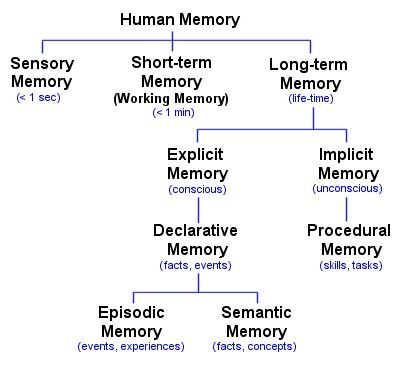
- Implicit Memory – remembering something you did not intend to memorize People with memory loss (amnesiacs) have been shown a list of words they don’t even remember seeing afterwords. However, when asked to fill in the blanks _ss_ss__ (assassin) with the first word that comes to mind, they will choose something from the previous list just as normal people do. Explicit Memory – intentionally remembering something May be handled by different memory systems because explicit memory, but not memory is affected by amnesia, age, alcohol, and interference Declarative memory system handles factual information like definitions of words, math concepts, faces, dates. Likely handled by the medial temporal lobe and parts of the cortex it communicates with. Procedural Memory system – memory for actions, skills and conditioned responses (e.g. typing, riding a bike. May be related to implicit memory e.g. people who play piano can mess up if they start thinking too much about it. This shows that it is not conscious much like implicit memory is. Cerebelum and amygdala may be involved but more difficult to study. Parts of the declarative memory : Semantic – general facts Episodic – personal facts and experiences Another way memory has been divided, is prospective versus retrospective memory Prospective memory refers to recalling something you must do in the future retrospective memory – refers to remembering past events or facts
Improving Memory
- Improving Memory Techniques
- Mneumonic systems – methods to increase the recall of information - uses information already in long term memory. - makes the info more elaborate, actually storing more information but the info makes it easier to recall. -organizes the information - it’s not how much we have to learn but how well it fits with what we already know. Overlearning – continuing to rehearse and learn information you think you already know Serial-position effect - It is easy to learn the things at the beginning and end of lists so change the difficult information to the beginning. Distributed practice - Don’t try to remember everything at one time -- don’t cram Acrostics - First letter of words in a sentence Every Good Boy Does Fine to remember the names of the lines on a musical staff (EGBDF) Acronyms - You make up a word from the first letter of information you need to remember Roy G. Biv - colours in the light spectrum. Narrative Methods - make a story or song - Rhymes - Thirty days hath September
- Method of Loci
- Method of Loci - Invented by the Greeks when people wrote on clay tablets so they could memorize long poems and speeches. They used a mnemonic system where they associated items to be remembered with specific locations. Memorize what the inside of a building looks like. Organize speech by concepts and imagine where each one is (love is a couple embracing by a certain pillar). You could do this with a shopping list - cheese, potatoes, milk and cabbage. Imagine a path in a house or yard.
- Keyword & Peg-Word Methods
- Keyword Method - Used when you have to remember someone’s name or a foreign word. Relate it to a concrete word that can be pictured. Ms. Miller is visiting her grandfather’s mill. Peg-Word Method - on video One is a bun Two is a shoe, etc
- Improving Memory Techniques
Image
Image
Image
Bilder und Dateien der Mindmap
Informationen
- Beschreibung
- Mindmap am Memory, erstellt von Britany Marie Al am 22/03/2016.
- Erstellt von
- Britany Marie Al
- Aufrufe
- 1
- Bewertung