
Mindmap
Behaviourist Approach
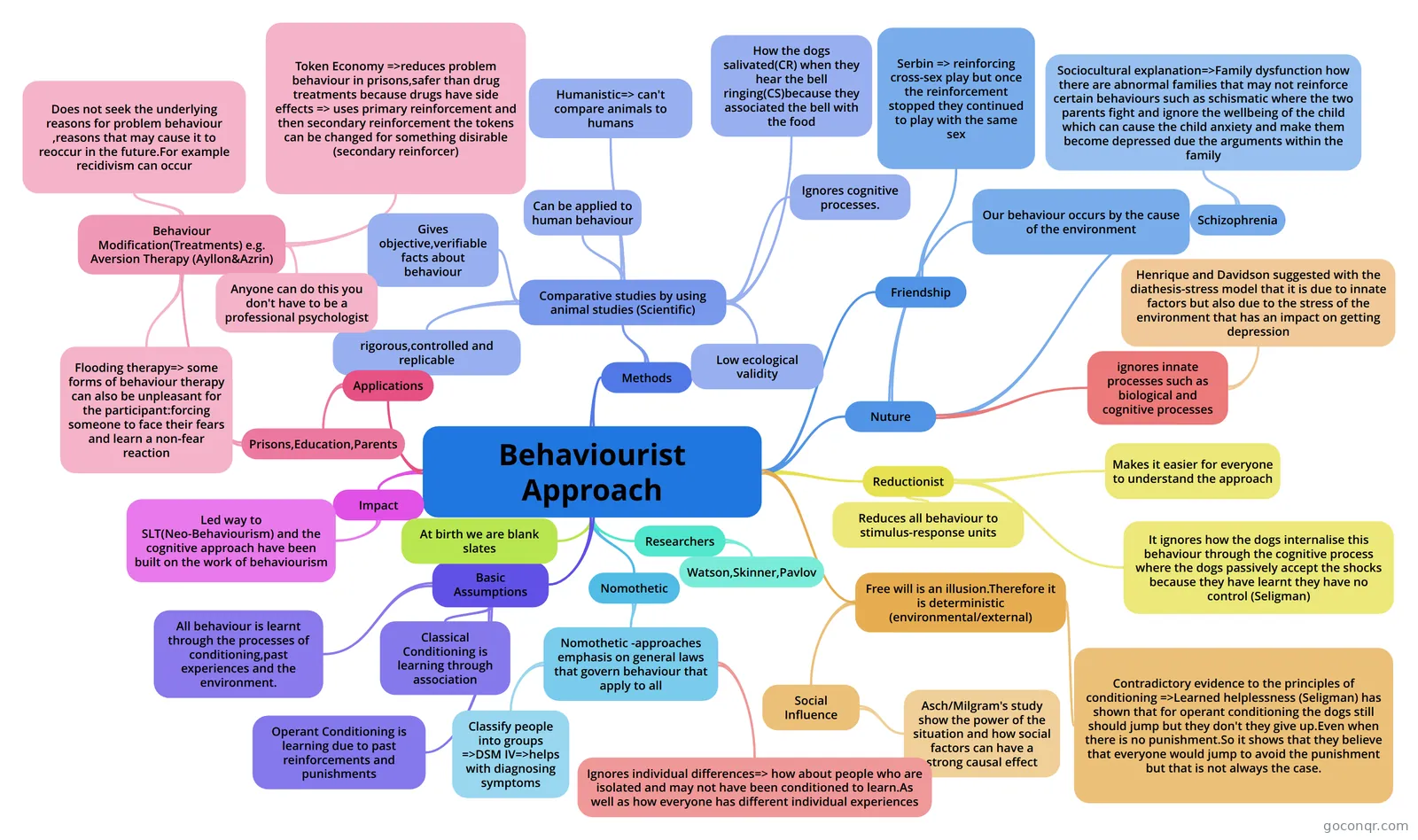
Mind map: Behaviourist approach
Inhalt der Mindmap
Behaviourist Approach
Basic Assumptions
- All behaviour is learnt through the processes of conditioning,past experiences and the environment.
- Classical Conditioning is learning through association
- Operant Conditioning is learning due to past reinforcements and punishments
Methods
- Comparative studies by using animal studies (Scientific)
- Gives objective,verifiable facts about behaviour
- rigorous,controlled and replicable
- Can be applied to human behaviour
- Ignores cognitive processes.
- Low ecological validity
- Humanistic=> can't compare animals to humans
- How the dogs salivated(CR) when they hear the bell ringing(CS)because they associated the bell with the food
- Comparative studies by using animal studies (Scientific)
Researchers
- Watson,Skinner,Pavlov
Applications
- Prisons,Education,Parents
- Behaviour Modification(Treatments) e.g. Aversion Therapy (Ayllon&Azrin)
- Token Economy =>reduces problem behaviour in prisons,safer than drug treatments because drugs have side effects => uses primary reinforcement and then secondary reinforcement the tokens can be changed for something disirable (secondary reinforcer)
- Anyone can do this you don't have to be a professional psychologist
- Flooding therapy=> some forms of behaviour therapy can also be unpleasant for the participant:forcing someone to face their fears and learn a non-fear reaction
- Does not seek the underlying reasons for problem behaviour ,reasons that may cause it to reoccur in the future.For example recidivism can occur
- Behaviour Modification(Treatments) e.g. Aversion Therapy (Ayllon&Azrin)
- Prisons,Education,Parents
Impact
- Led way to SLT(Neo-Behaviourism) and the cognitive approach have been built on the work of behaviourism
Free will is an illusion.Therefore it is deterministic (environmental/external)
- Social Influence
- Asch/Milgram's study show the power of the situation and how social factors can have a strong causal effect
- Contradictory evidence to the principles of conditioning =>Learned helplessness (Seligman) has shown that for operant conditioning the dogs still should jump but they don't they give up.Even when there is no punishment.So it shows that they believe that everyone would jump to avoid the punishment but that is not always the case.
- Social Influence
Nuture
- ignores innate processes such as biological and cognitive processes
- Henrique and Davidson suggested with the diathesis-stress model that it is due to innate factors but also due to the stress of the environment that has an impact on getting depression
- Schizophrenia
- Sociocultural explanation=>Family dysfunction how there are abnormal families that may not reinforce certain behaviours such as schismatic where the two parents fight and ignore the wellbeing of the child which can cause the child anxiety and make them become depressed due the arguments within the family
- Our behaviour occurs by the cause of the environment
- ignores innate processes such as biological and cognitive processes
Nomothetic
- Nomothetic -approaches emphasis on general laws that govern behaviour that apply to all
- Classify people into groups =>DSM IV=>helps with diagnosing symptoms
- Ignores individual differences=> how about people who are isolated and may not have been conditioned to learn.As well as how everyone has different individual experiences
- Nomothetic -approaches emphasis on general laws that govern behaviour that apply to all
Reductionist
- Makes it easier for everyone to understand the approach
- Reduces all behaviour to stimulus-response units
- It ignores how the dogs internalise this behaviour through the cognitive process where the dogs passively accept the shocks because they have learnt they have no control (Seligman)
Friendship
- Serbin => reinforcing cross-sex play but once the reinforcement stopped they continued to play with the same sex
At birth we are blank slates
Informationen
- Beschreibung
- Psychology Mindmap am Behaviourist Approach, erstellt von shanclot am 22/01/2014.
- Erstellt von
- shanclot
- Aufrufe
- 67
- Tags
- Bewertung