
Mindmap
Contraception & Unprotected Sex
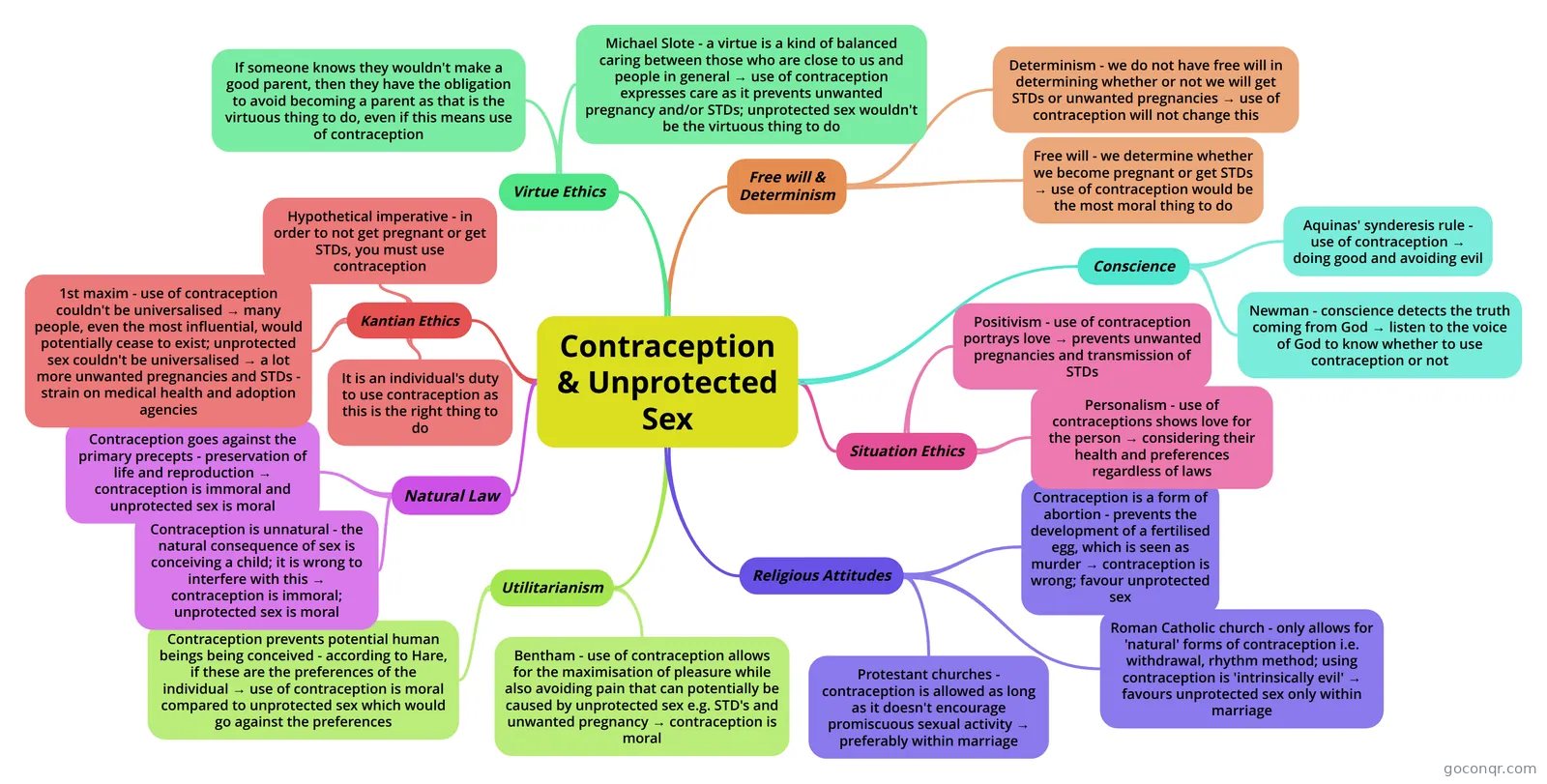
Mind map: Contraception and unprotected sex ethics
Inhalt der Mindmap
Contraception & Unprotected Sex
Virtue Ethics
- If someone knows they wouldn't make a good parent, then they have the obligation to avoid becoming a parent as that is the virtuous thing to do, even if this means use of contraception
- Michael Slote - a virtue is a kind of balanced caring between those who are close to us and people in general → use of contraception expresses care as it prevents unwanted pregnancy and/or STDs; unprotected sex wouldn't be the virtuous thing to do
Free will & Determinism
- Determinism - we do not have free will in determining whether or not we will get STDs or unwanted pregnancies → use of contraception will not change this
- Free will - we determine whether we become pregnant or get STDs → use of contraception would be the most moral thing to do
Natural Law
- Contraception is unnatural - the natural consequence of sex is conceiving a child; it is wrong to interfere with this → contraception is immoral; unprotected sex is moral
- Contraception goes against the primary precepts - preservation of life and reproduction → contraception is immoral and unprotected sex is moral
Conscience
- Aquinas' synderesis rule - use of contraception → doing good and avoiding evil
- Newman - conscience detects the truth coming from God → listen to the voice of God to know whether to use contraception or not
Situation Ethics
- Positivism - use of contraception portrays love → prevents unwanted pregnancies and transmission of STDs
- Personalism - use of contraceptions shows love for the person → considering their health and preferences regardless of laws
Religious Attitudes
- Contraception is a form of abortion - prevents the development of a fertilised egg, which is seen as murder → contraception is wrong; favour unprotected sex
- Protestant churches - contraception is allowed as long as it doesn't encourage promiscuous sexual activity → preferably within marriage
- Roman Catholic church - only allows for 'natural' forms of contraception i.e. withdrawal, rhythm method; using contraception is 'intrinsically evil' → favours unprotected sex only within marriage
Utilitarianism
- Bentham - use of contraception allows for the maximisation of pleasure while also avoiding pain that can potentially be caused by unprotected sex e.g. STD's and unwanted pregnancy → contraception is moral
- Contraception prevents potential human beings being conceived - according to Hare, if these are the preferences of the individual → use of contraception is moral compared to unprotected sex which would go against the preferences
Kantian Ethics
- It is an individual's duty to use contraception as this is the right thing to do
- Hypothetical imperative - in order to not get pregnant or get STDs, you must use contraception
- 1st maxim - use of contraception couldn't be universalised → many people, even the most influential, would potentially cease to exist; unprotected sex couldn't be universalised → a lot more unwanted pregnancies and STDs - strain on medical health and adoption agencies
Informationen
- Beschreibung
- Ethics Mindmap am Contraception & Unprotected Sex, erstellt von pkayy11 am 26/02/2014.
- Erstellt von
- pkayy11
- Aufrufe
- 159
- Tags
- Bewertung