
Mindmap
Inheritance
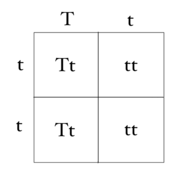
Inhalt der Mindmap
Inheritance
Genetic Terms
- Gene: Section of DNA coding from protein
- Locus: Position of gene on chromosome
- Allele: Alternative form of a gene
- Dominant: Allele that's shown physically if homo/heterozygous
- Recessive: Allele is shown only if homozygous (aa)
- Genotype: The alleles an individual has
- Phenotype: Physical expression of a gene
- Homozygous: When alleles on chromosomes are the same (AA or aa)
- Heterozygous: When alleles on chromosomes are different (Aa)
- F2: Describes 2nd-gen offspring from a cross (Giving 3:1 or 9:3:3:1 ratio)
- F1: Describes 1st-gen offspring from a cross
- Autosomes: Chromosomes not involved in inheritance of gender
- Sex chromosomes: Chromosomes involved in inheritance of gender
- Degenerate: Amino acid has more than 1 code
Monohybrid Inheritance
- Inheritance of 1 gene
- Mendal used peas to show how characteristics are inherited
- Checked if they were tall/dwarf or round/wrinkled
- Perks of this choice
- Easy to grow
- Peas produce statistically meaningful offspring
- Peas Self/Cross fertilise, Flower & fruit in same year
- Controlled by single genes on different chromosomes
- Easy to tell results
- Show Discontinuous variation
- Perks of this choice
- Checked if they were tall/dwarf or round/wrinkled
- Mendal used peas to show how characteristics are inherited
- In a monohybrid cross
- 2 heterozygous individuals produce offspring
- With a phenotypic ratio of 3 Dominant:1 Recessive
- 2 heterozygous individuals produce offspring
- Inheritance of 1 gene
Test Cross/Back cross
- Cross between an individual w/the phenotype of a dominant characteristic, but unknown genotype
- w/an individual that's homozygous recessive for the gene in question
- Back test: The test organism is crossed w/the homozygous recessive parent of the original cross that made it
- w/an individual that's homozygous recessive for the gene in question
- Cross between an individual w/the phenotype of a dominant characteristic, but unknown genotype
When neither allele is dominant
- Co-dominance
- When both alleles in the heterozygote are individually expressed
- E.g Blood grouping in humans (Groups A,B,AB,O) & Speckled chickens
- Co= Allele Work together
- Co-dominant are superscripted to a locus letter
- Co= Allele Work together
- E.g Blood grouping in humans (Groups A,B,AB,O) & Speckled chickens
- When both alleles in the heterozygote are individually expressed
- Incomplete dominance
- The dominant allele is not fully expressed when the recessive allele is present
- Alleles wrote in exponent form (E.G. I^A)
- If phenotypes of offspring are 1:2:1 ratio
- Parents probs heterozygous for the gene that shows incomplete/co-dominance
- When Mendal carried out experiements
- & found 1:2:1 ratios, he developed his 1st law
- Law of Segregation
- The characteristics of an organism
- Are determined by factors (Alleles) which occur in pairs
- Only 1 allele of the pair is present in a gamete
- Are determined by factors (Alleles) which occur in pairs
- Gametes only carry 1 allele for a gene
- The characteristics of an organism
- Law of Segregation
- & found 1:2:1 ratios, he developed his 1st law
- Co-dominance
Independent assortment
- Happens in meiosis (metaphase 1)
- Shows that an allele can combine w/either allele in another pair
- Law of independent assortment: (2nd law of inheritance)
- States that the alleles of 1 gene sort into gametes
- Independently of the alleles of another gene
- I.e alleles are unlinked
- Independently of the alleles of another gene
- States that the alleles of 1 gene sort into gametes
- LOOK Pg.165 & 168 Diagram
- Happens in meiosis (metaphase 1)
Dihybrid Inheritance
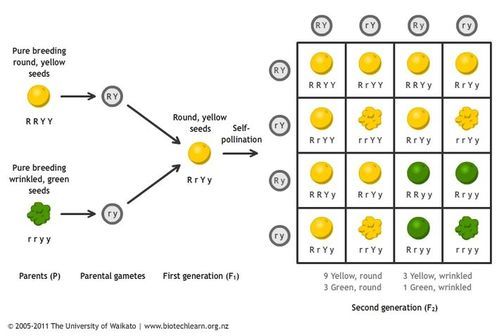
- Simultaneous inheritance of 2 unlinked genes (I.e genes on different chromosomes)
- Mendal tested this w/2 contrasting characteristics
- Y = Yellow , y = Green
- R= Round , r = Wrinkled
- When F2 gen genotypes formed 9:3:3:1 ratio found
- Mendal tested this w/2 contrasting characteristics
- To calculate ratio of cross
- Divide the No. of individuals for a phenotype
- By the No. of homozygous recessive individuals
- Divide the No. of individuals for a phenotype
- Simultaneous inheritance of 2 unlinked genes (I.e genes on different chromosomes)
Linkage
- Description of genes on the same chromosome
- & therefore don't segregate independently @ meiosis
- Linked genes are inherited together
- Because they move together during meiosis & appear in the same gamete
- In meiosis, however crossing over can link to the combination of linked genes
- This is quite rare & can lead to odd ratios (non-mendelian)
- Common explanation for rejecting null hypothesis
- Crossing over value (COV) = No. of recombinants/ No. of progeny x 100
- Common explanation for rejecting null hypothesis
- This is quite rare & can lead to odd ratios (non-mendelian)
- Description of genes on the same chromosome
Chi test
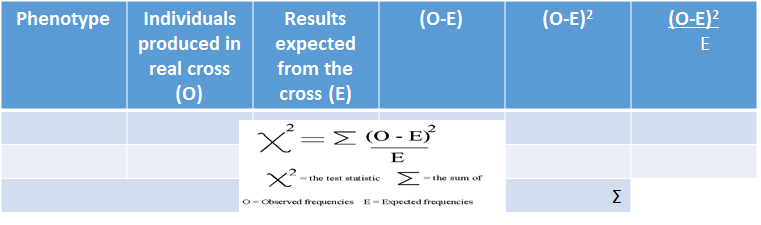
- Checks if the No. of different phenotypes is close enough to the predicted values
- If number ain't close enough, test tells us it has arisen for another reason
- Null Hypothesis
- There is no significant difference between the expected ratio & the ratio of the actual results
- Any difference is down to chance
- Reason for this hypothesis
- Mendelian inheritance is based on there being no difference in:
- No. of different types of gametes
- Probability of each gamete type fusing w/another type of gamete
- Viabilty of the embryos, regardless of genotype
- Genes aren't linked
- Mendelian inheritance is based on there being no difference in:
- There is no significant difference between the expected ratio & the ratio of the actual results
- Method
- Degrees of freedom (df)
- Used to find critical value
- Do (No of phenotypes) -1
- Giving value of df
- Do (No of phenotypes) -1
- Used to find critical value
- Probablity
- Statisticians say if Chi value is under 5%
- Value can be accepted as any deviation is due to chance
- Called critical value (Largest chi value can be to chance)
- Any value above critical value
- Null hypothesis is incorrect as results are affected by another factor
- Any value above critical value
- Called critical value (Largest chi value can be to chance)
- Value can be accepted as any deviation is due to chance
- Statisticians say if Chi value is under 5%
- Conclusion
- 1) Calculated value is more/less than critical value
- 2) This is equivalent to a probability less/greater than 5%
- 3) So null hypothesis is accepted/rejected
- 4) @ 5% level of significance, inheritance is mendelian
- 5a) Any deviation is down to chance (If value is lower than critical)
- 5b) Another factor is involved (If value is bigger than critical)
- 5a) Any deviation is down to chance (If value is lower than critical)
- 4) @ 5% level of significance, inheritance is mendelian
- 3) So null hypothesis is accepted/rejected
- 2) This is equivalent to a probability less/greater than 5%
- 1) Calculated value is more/less than critical value
- Checks if the No. of different phenotypes is close enough to the predicted values
Sex determination
- Plants
- Most angiosperms are hermaphrodites
- Monoecious plants have separate male/female flowers on the same plant
- Dioecious plants have separate male/female individuals
- Animals
- Male/female is controlled by many factors
- Temp:
- Sequential hermaphroditism: (Some fish)
- Start out as 1 sex & change later on in life
- Ploidy level
- Haploid/diploid gametes/cells
- Chromosome structure
- In humans: XX = Female, XY = Male
- In birds/moths: ZZ = Male, ZW = Female
- In humans: XX = Female, XY = Male
- Male/female is controlled by many factors
- Human Sex Determination
- 22/23 chromosomes have identical genes (autosomes)
- 23rd chromosome = Sex = Different sizes = Heterosomes
- 2 regions on X & Y chromosome are homologous & pair at meiosis
- They're called 'pseudoautosomal regions' (PAR1 & PAR2)
- They reflect evolutionary loss of genes from Y chromosome
- Leaving larger X chromosome
- They reflect evolutionary loss of genes from Y chromosome
- They're called 'pseudoautosomal regions' (PAR1 & PAR2)
- 2 regions on X & Y chromosome are homologous & pair at meiosis
- 23rd chromosome = Sex = Different sizes = Heterosomes
- Inheritance of sex
- Female gives 2 X in gametes (Homogametic)
- Male gamete gives X/Y (Heterogametic)
- At fertilisation there is a 50/50 chance of male/female
- Male gamete gives X/Y (Heterogametic)
- Maleness
- Y chromosome contains 'sex-determining region' (SRY gene)
- SRY gene ain't found on X chromosome
- It seems to switch on genes in the autosome that give rise to the expression of male characteristics
- SRY gene ain't found on X chromosome
- Y chromosome contains 'sex-determining region' (SRY gene)
- Female gives 2 X in gametes (Homogametic)
- 22/23 chromosomes have identical genes (autosomes)
- Plants
Sex Linkage
- A gene is carried by a sex chromosome so that a characteristic it encodes is seen predominantly in 1 sex
- All alleles are superscripted to the chromosome they are found on
- Sex-linked conditions
- Haemophilia
- Recessive allele on X chromosome
- Blood doesn't clot
- Recessive allele on X chromosome
- Colour Blindness
- Recessive allele on X chromosome
- Duchennes muscular dystrophy
- Recessive allele on X chromosome
- Muscles progressively degenerates
- Recessive allele on X chromosome
- Haemophilia
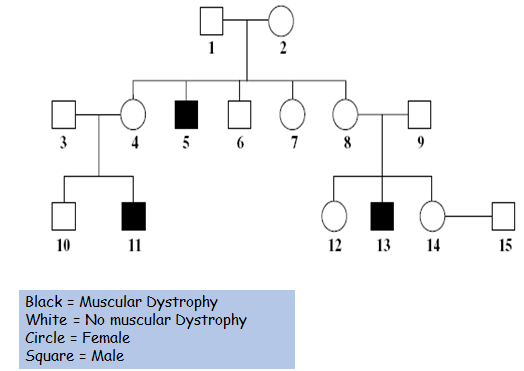
- Pedigree charts/Family Trees
- Can show the inheritance of a medical condition
- Hence used to calculate probability of a child inheriting a condition
- Can show the inheritance of a medical condition
Mutations
- A change in the amount, arrangement or structure in the hereditary material of an organism
- Can be:
- Spontaneous
- Happen without an apparent cause
- Random
- Appear to have equal probability anywhere in the genome of diploid organism
- Spontaneous
- Can be:
- Occur in all cells, mostly harmful
- Some = Good but rare, gives selective advantage
- Can cause variation > Natural Selection > Evolution
- Haploid Organism > Mutation > Expressed
- Diploid Organism > Dominant mutations shown
- Most are recessive & happen in cells w/Dominant alleles thus not expressed
- Mutation in diploid organisms have less impact on evolution
- Most are recessive & happen in cells w/Dominant alleles thus not expressed
- Diploid Organism > Dominant mutations shown
- Source of variation
- Haploid Organism > Mutation > Expressed
- Can cause variation > Natural Selection > Evolution
- Some = Good but rare, gives selective advantage
- Mutation Rate
- Mutations occur in DNA Replication
- Organisms w/short life cycles have more frequent meiosis
- Hence bigger mutation rate
- Organisms w/short life cycles have more frequent meiosis
- Normally low but affected by
- Ionising Radiation <260nm
- Radiation joins adjacent pyrimidine bases in a DNA strand
- Thus DNA polymerase may add wrong nucleotide
- Radiation joins adjacent pyrimidine bases in a DNA strand
- Mutagenic chemicals
- Polycyclic hydrocarbons, Mustard gas
- Slide between bases, preventing DNA polymerase from adding the right nucleotide at replication
- Polycyclic hydrocarbons, Mustard gas
- Ionising Radiation <260nm
- Mutations occur in DNA Replication
- Gene (Point) Mutations
- DNA polymerase makes a mistake, resulting in a gene mutation
- Addition
- A base is added
- Duplication
- Same base is incorporated twice
- Subtraction
- Base is deleted
- Substitution
- A different base is added
- Inversion
- Adjacent bases on the same DNA strand exchange position
- Changes allele > Changes mRNA bases > Polypeptide change > Effecting phenotype
- Depending of nature of mutation
- Could code for same amino acid 'Silent Mutation'
- Amino acid could be replaced for similar chemical
- Could change important place on protein
- Amino acid could be replaced for similar chemical
- Could code for same amino acid 'Silent Mutation'
- Depending of nature of mutation
- E.g Sickle cell Anaemia
- Muatation in beta polypeptide
- Glutamic acid > Valine
- Side chain: Large, hydrophilic > Small, hydrophobic
- Haemoglobin aggregates in low O2 conc
- Joint pain but protected from malaria
- Haemoglobin aggregates in low O2 conc
- Side chain: Large, hydrophilic > Small, hydrophobic
- Glutamic acid > Valine
- Muatation in beta polypeptide
- Insertion/deletion lead to frame shift
- Frame Shift: mRNA reading frame shifts & codes for different amino acids
- Chromosome mutation
- Changes in structure/No. of chromosomes
- Changes in structure
- During crossing over at Chiasmata, Chromosomes don't accurately join together
- Leading to mutation, After gamete fusion no more meiosis will take place
- During crossing over at Chiasmata, Chromosomes don't accurately join together
- No. of chromosomes
- Happen during anaphase 1/2
- Called Non-disjunction
- Faulty spindle in meiosis resulting in 1 daughter cell getting 2 copies of a chromosome
- & other receives none
- Faulty spindle in meiosis resulting in 1 daughter cell getting 2 copies of a chromosome
- Called Non-disjunction
- Happen during anaphase 1/2
- Due to damage > Can repair > But sometimes not correctly
- Changes in structure
- Down syndrome
- 2o oocyte gets either 0/2 copies of 21st chromosome
- 0 copies doesn't make a viable embryo
- So embryo has 3 copies of 21st chromosome
- Called Trisomy 21
- So embryo has 3 copies of 21st chromosome
- 0 copies doesn't make a viable embryo
- Translocation Down's
- Part of chromosome 21 attaches to chromosomes 14
- 2o oocyte gets either 0/2 copies of 21st chromosome
- Changes in structure/No. of chromosomes
- Changes in No. of sets of Chromosomes
- Euploid: Cells w/complete sets of chromosomes
- Aneuploid: too many/too few chromosomes
- Polyploid: Having 2+ sets of chromosomes
- Arises from:
- Non-disjunction
- 2 diploid gametes fuse together (tetraploid 4n)
- Endomitosis: Replication of chromosomes not followed by cytokinesis
- Can happen in tetra/tri-ploid cells
- Infertile Triploid > Fertile Hexaploid
- Can happen in tetra/tri-ploid cells
- More common in flowering plants
- Because
- Reproduce assexually
- Hermaphrodite so don't use chromosomes to determine sex
- Because
- Arises from:
- Polyploid: Having 2+ sets of chromosomes
- Aneuploid: too many/too few chromosomes
- Euploid: Cells w/complete sets of chromosomes
- Carcinogens
- Agent that causes cancer
- Mutagens
- Agents that causes mutations
- Tumour suppressor genes regulate mitosis & prevent rapid cell division
- Mutation can affect a gene's regulatory function > causing it to go through repeated mitosis
- If undetected by immune system it can make a tumour
- That can spread around the body into other tissues
- Forming secondary tumours/metastases (Malignant tumour)
- That can spread around the body into other tissues
- If undetected by immune system it can make a tumour
- Mutation can affect a gene's regulatory function > causing it to go through repeated mitosis
- Oncogenes
- Proto-oncogene codes for a cell division protein
- Mutations can permanently switch on gene
- Making excess protein, causing rapid, repeated mitosis
- Oncogene: When a proto-oncogene mutates such that it causes cancer
- Caused By:
- Mutation causing chromosomes to rearrange
- Extra copy of proto-oncogene
- Caused By:
- Oncogene: When a proto-oncogene mutates such that it causes cancer
- Making excess protein, causing rapid, repeated mitosis
- Mutations can permanently switch on gene
- Proto-oncogene codes for a cell division protein
- A change in the amount, arrangement or structure in the hereditary material of an organism
Control of gene expression
- Epigenetics
- Control of gene expression by modifying Histones/DNA
- But not by affecting the DNA nucleotide structure
- DNA methylation:
- Methyl group can be added to Cytosine
- If regions are highly-methylated, less likely to be transcribed
- Methyl group can be added to Cytosine
- Histone modification
- If DNA is wound strongly around histone
- Becomes harder for enzymes to attach, reducing transcription
- E.g Happens when stem cells differentiate
- If DNA is wound strongly around histone
- Control of gene expression by modifying Histones/DNA
- Consequences of epigenetic change
- Genomic imprinting
- If genes are deactivated in gametes, they are passed onto next gen
- Can inactivate whole chromosomes (X inactivation)
- Genomic imprinting
- Epigenetics
Bilder und Dateien der Mindmap
Informationen
- Beschreibung
- Mindmap am Inheritance, erstellt von Shehzeb B am 23/11/2016.
- Erstellt von
- Shehzeb B
- Aufrufe
- 6
- Bewertung