
Mindmap
Revision Summaries
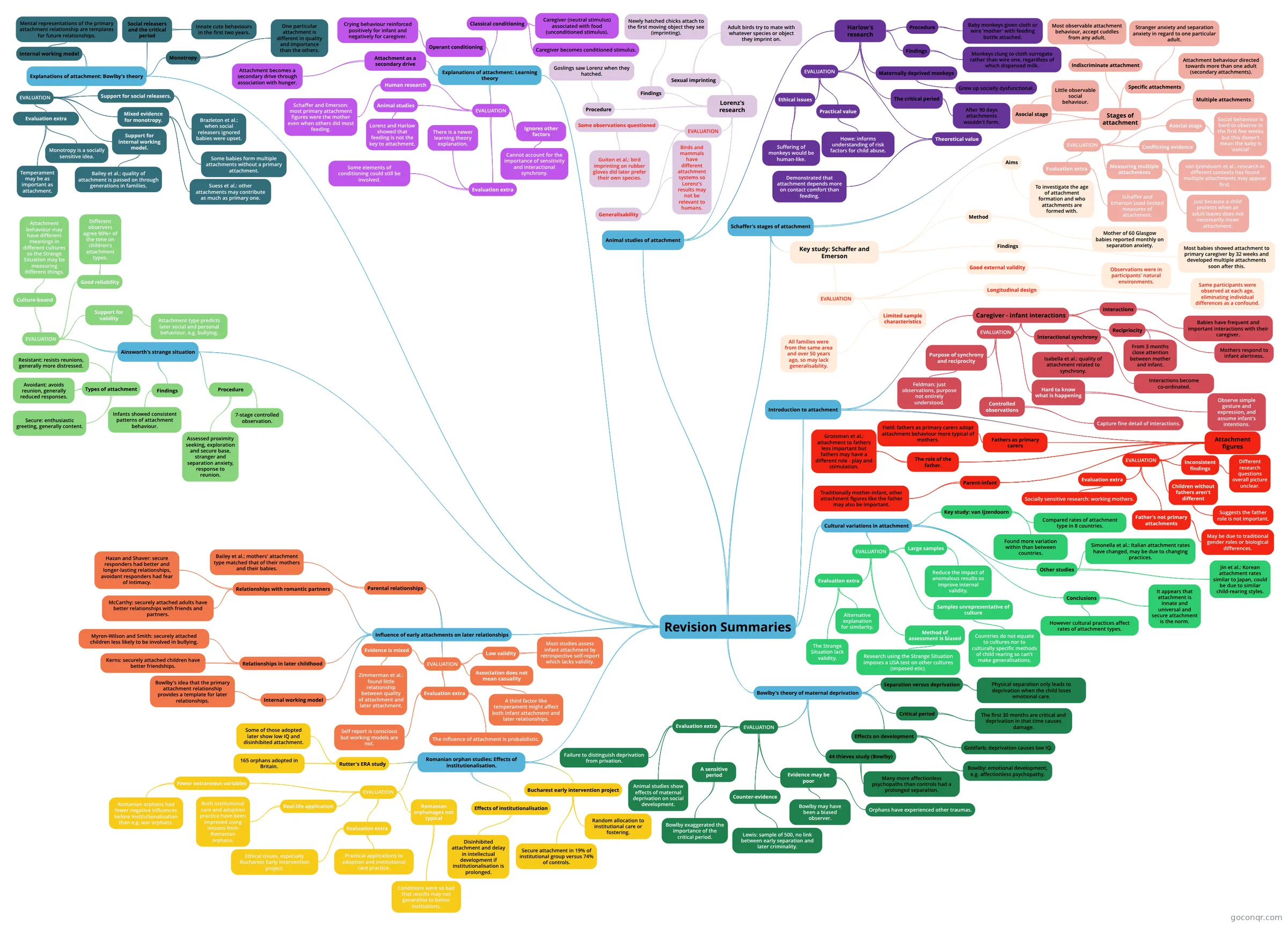
Mind map: Attachment psychology
Inhalt der Mindmap
Revision Summaries
Schaffer's stages of attachment
- Key study: Schaffer and Emerson
- Aims
- To investigate the age of attachment formation and who attachments are formed with.
- Method
- Mother of 60 Glasgow babies reported monthly on separation anxiety.
- Findings
- Most babies showed attachment to primary caregiver by 32 weeks and developed multiple attachments soon after this.
- EVALUATION
- Good external validity
- Observations were in participants' natural environments.
- Longitudinal design
- Same participants were observed at each age, eliminating individual differences as a confound.
- Limited sample characteristics
- All families were from the same area and over 50 years ago, so may lack generalisability.
- Good external validity
- Aims
- Stages of attachment
- Asocial stage
- Little observable social behaviour.
- Indiscriminate attachment
- Most observable attachment behaviour, accept cuddles from any adult.
- Specific attachments
- Stranger anxiety and separation anxiety in regard to one particular adult.
- Multiple attachments
- Attachment behaviour directed towards more than one adult (secondary attachments).
- EVALUATION
- Asocial stage
- Social behaviour is hard to observe in the first few weeks but this doesn't mean the baby is 'asocial'
- Conflicting evidence
- van Ijzendoorn et al.: research in different contexts has found multiple attachments may appear first.
- Measuring multiple attachments
- Just because a child protests when an adult leaves does not necessarily mean attachment.
- Evaluation extra
- Schaffer and Emerson used limited measures of attachment.
- Asocial stage
- Asocial stage
- Key study: Schaffer and Emerson
Introduction to attachment
- Caregiver - infant interactions
- Interactions
- Babies have frequent and important interactions with their caregiver.
- Interactional synchrony
- Interactions become co-ordinated.
- Isabella et al.: quality of attachment related to synchrony.
- EVALUATION
- Hard to know what is happening
- Observe simple gesture and expression, and assume infant's intentions.
- Controlled observations
- Capture fine detail of interactions.
- Purpose of synchrony and reciprocity
- Feldman: just observations, purpose not entirely understood.
- Hard to know what is happening
- Recipriocity
- From 3 months close attention between mother and infant.
- Mothers respond to infant alertness.
- Interactions
- Attachment figures
- Parent-infant
- Traditionally mother-infant, other attachment figures like the father may also be important.
- The role of the father.
- Grossman et al.: attachment to fathers less important but fathers may have a different role - play and stimulation.
- Fathers as primary carers
- Field: fathers as primary carers adopt attachment behaviour more typical of mothers.
- EVALUATION
- Inconsistent findings
- Different research questions overall picture unclear.
- Children without fathers aren't different
- Suggests the father role is not important.
- Father's not primary attachments
- May be due to traditional gender roles or biological differences.
- Evaluation extra
- Socially sensitive research: working mothers.
- Inconsistent findings
- Parent-infant
- Caregiver - infant interactions
Animal studies of attachment
- Lorenz's research
- Procedure
- Goslings saw Lorenz when they hatched.
- Findings
- Newly hatched chicks attach to the first moving object they see (imprinting).
- Sexual imprinting
- Adult birds try to mate with whatever species or object they imprint on.
- EVALUATION
- Generalisability
- Birds and mammals have different attachment systems so Lorenz's results may not be relevant to humans.
- Some observations questioned
- Guiton et al.: bird imprinting on rubber gloves did later prefer their own species.
- Generalisability
- Procedure
- Harlow's research
- Procedure
- Baby monkeys given cloth or wire 'mother' with feeding bottle attached.
- Findings
- Monkeys clung to cloth surrogate rather than wire one, regardless of which dispensed milk.
- Maternally deprived monkeys
- Grew up socially dysfunctional.
- The critical period
- After 90 days attachments wouldn't form.
- EVALUATION
- Theoretical value
- Demonstrated that attachment depends more on contact comfort than feeding.
- Practical value
- Howe: informs understanding of risk factors for child abuse.
- Ethical issues
- Suffering of monkeys would be human-like.
- Theoretical value
- Procedure
- Lorenz's research
Explanations of attachment: Learning theory
- Classical conditioning
- Caregiver becomes conditioned stimulus.
- Caregiver (neutral stimulus) associated with food (unconditioned stimulus).
- Operant conditioning
- Crying behaviour reinforced positively for infant and negatively for caregiver.
- Attachment as a secondary drive
- Attachment becomes a secondary drive through association with hunger.
- EVALUATION
- Animal studies
- Lorenz and Harlow showed that feeding is not the key to attachment.
- Human research
- Schaffer and Emerson: most primary attachment figures were the mother even when others did most feeding.
- Ignores other factors
- Cannot account for the importance of sensitivity and interactional synchrony.
- Evaluation extra
- There is a newer learning theory explanation.
- Some elements of conditioning could still be involved.
- Animal studies
- Classical conditioning
Explanations of attachment: Bowlby's theory
- Monotropy
- One particular attachment is different in quality and importance than the others.
- Social releasers and the critical period
- Innate cute behaviours in the first two years.
- Internal working model
- Mental representations of the primary attachment relationship are templates for future relationships.
- EVALUATION
- Mixed evidence for monotropy.
- Suess et al.: other attachments may contribute as much as primary one.
- Some babies form multiple attachments without a primary attachment.
- Support for social releasers.
- Brazleton et al.: when social releasers ignored babies were upset.
- Support for internal working model.
- Bailey et al.: quality of attachment is passed on through generations in families.
- Evaluation extra
- Monotropy is a socially sensitive idea.
- Temperament may be as important as attachment.
- Mixed evidence for monotropy.
- Monotropy
Ainsworth's strange situation
- Procedure
- Assessed proximity seeking, exploration and secure base, stranger and separation anxiety, response to reunion.
- 7-stage controlled observation.
- Findings
- Infants showed consistent patterns of attachment behaviour.
- Types of attachment
- Secure: enthusiastic greeting, generally content.
- Avoidant: avoids reunion, generally reduced responses.
- Resistant: resists reunions, generally more distressed.
- EVALUATION
- Support for validity
- Attachment type predicts later social and personal behaviour, e.g. bullying.
- Good reliability
- Different observers agree 90%+ of the time on children's attachment types.
- Culture-bound
- Attachment behaviour may have different meanings in different cultures so the Strange Situation may be measuring different things.
- Support for validity
- Procedure
Cultural variations in attachment
- Key study: van Ijzendoorn
- Compared rates of attachment type in 8 countries.
- Found more variation within than between countries.
- Other studies
- Simonella et al.: Italian attachment rates have changed, may be due to changing practices.
- Jin et al.: Korean attachment rates similar to Japan, could be due to similar child-rearing styles.
- Conclusions
- It appears that attachment is innate and universal and secure attachment is the norm.
- However cultural practices affect rates of attachment types.
- EVALUATION
- Large samples
- Reduce the impact of anomalous results so improve internal validity.
- Samples unrepresentative of culture
- Countries do not equate to cultures nor to culturally specific methods of child rearing so can't make generalisations.
- Method of assessment is biased
- Research using the Strange Situation imposes a USA test on other cultures (imposed etic).
- Evaluation extra
- Alternative explanation for similarity.
- The Strange Situation lack validity.
- Large samples
- Key study: van Ijzendoorn
Bowlby's theory of maternal deprivation
- Separation versus deprivation
- Physical separation only leads to deprivation when the child loses emotional care.
- Critical period
- The first 30 months are critical and deprivation in that time causes damage.
- Effects on development
- Goldfarb: deprivation causes low IQ.
- Bowlby: emotional development, e.g. affectionless psychopathy.
- 44 thieves study (Bowlby)
- Many more affectionless psychopaths than controls had a prolonged separation.
- EVALUATION
- Evidence may be poor
- Orphans have experienced other traumas.
- Bowlby may have been a biased observer.
- Counter-evidence
- Lewis: sample of 500, no link between early separation and later criminality.
- A sensitive period
- Bowlby exaggerated the importance of the critical period.
- Evaluation extra
- Animal studies show effects of maternal deprivation on social development.
- Failure to distinguish deprivation from privation.
- Evidence may be poor
- Separation versus deprivation
Romanian orphan studies: Effects of institutionalisation.
- Rutter's ERA study
- 165 orphans adopted in Britain.
- Some of those adopted later show low IQ and disinhibited attachment.
- Bucharest early intervention project
- Random allocation to institutional care or fostering.
- Secure attachment in 19% of institutional group versus 74% of controls.
- Effects of institutionalisation
- Disinhibited attachment and delay in intellectual development if institutionalisation is prolonged.
- EVALUATION
- Real-life application
- Both institutional care and adoption practice have been improved using lessons from Romanian orphans.
- Fewer extraneous variables
- Romanian orphans had fewer negative influences before institutionalisation than e.g. war orphans.
- Romanian orphanages not typical
- Conditions were so bad that results may not generalise to better institutions.
- Evaluation extra
- Ethical issues, especially Bucharest Early Intervention project.
- Practical applications to adoption and institutional care practice.
- Real-life application
- Rutter's ERA study
Influence of early attachments on later relationships
- Internal working model
- Bowlby's idea that the primary attachment relationship provides a template for later relationships.
- Relationships in later childhood
- Kerns: securely attached children have better friendships.
- Myron-Wilson and Smith: securely attached children less likely to be involved in bullying.
- Relationships with romantic partners
- McCarthy: securely attached adults have better relationships with friends and partners.
- Hazan and Shaver: secure responders had better and longer-lasting relationships, avoidant responders had fear of intimacy.
- Parental relationships
- Bailey et al.: mothers' attachment type matched that of their mothers and their babies.
- EVALUATION
- Evidence is mixed
- Zimmerman et al.: found little relationship between quality of attachment and later attachment.
- Low validity
- Most studies assess infant attachment by retrospective self-report which lacks validity.
- Association does not mean casuality
- A third factor like temperament might affect both infant attachment and later relationships.
- Evaluation extra
- The influence of attachment is probabilistic.
- Self report is conscious but working models are not.
- Evidence is mixed
- Internal working model
Informationen
- Beschreibung
- AS level Psychology (Attachment) Mindmap am Revision Summaries, erstellt von Lily Bird am 21/12/2016.
- Erstellt von
- Lily Bird
- Aufrufe
- 0
- Bewertung