
Mindmap
Eating Behaviour
Inhalt der Mindmap
Eating Behaviour
Explanations for food preferences
- Evolutionary approach
- Food preference- a desire for particular foods that are high in energy in order to increase survival and reproduction success.
- Preference for sweetness: A sweet taste is a reliable signal of high-energy food. Fructose is especially sweet and babies will consume large amounts if allowed. This makes a lot of sense in evolutionary terms. Fructose is 'fast-acting' providing energy quickly, and is present in ripe fruit, which would have been favoured for our ancestors.
- Steiner- evidence of negative facial expressions of new-born babies when giving them bitter milk, this occurred before any learning took place- suggests taste receptor is innate.
- Preference for salt: Salts are essential for many cell functions in animals. A preference for salt appears in humans at around 4 months of age. Breast milk is low in salt, so this suggests that babies do not learn the salt preference and it is in fact innate.
- Harris- infants between 16 and 25 weeks who had been breast fed preferred salted rather than unsalted cereals , supports innate idea of preference.
- Preference for fat: High-calorie foods, such as fat, were not readily available to our ancestors. So learning to prefer foods which are high in calories would have carried an advantage since they provide energy important for survival. Fat contains twice as many calories as the equivalent amount of protein or carbohydrate. It also contributes to palatability (making food taste good).
- Torres- concluded that humans have a marked tendency to prefer high-fat foods during periods of stress. This suggests that a preference for fat may have provided energy to fuel the fight or flight response.
- Preference for sweetness: A sweet taste is a reliable signal of high-energy food. Fructose is especially sweet and babies will consume large amounts if allowed. This makes a lot of sense in evolutionary terms. Fructose is 'fast-acting' providing energy quickly, and is present in ripe fruit, which would have been favoured for our ancestors.
- Neophobia- The innate tendency to avoid certain, unfamiliar foods.
- Birch suggested that it appears when children begin to explore their environments and may encounter foods independently from their parents. Therefore, untried foods are potentially harmful, neophobia is adaptive because it means we are less likely to consume substances that could make us ill.
- Walker- 564 mothers of 2-6 year olds completed a questionnaire about their children's eating habits. It was found may of the children were less likely to eat green veg, meat and fruit, but ate normal amounts of other staple foods ( potatoes, cereals, biscuits)
- Taste aversion- When individuals eat a foodstuff and become ill, they avoid this food again in the future.
- Garcia- Gave wolves lamb's meat which had been lightly poisoned, this made the wolves sick. Whenever the wolves approached lambs in the future they would sniff them and quickly be put off and walk away. They had associated the poison with the lambs.
- :( Neophobia is maladaptive- it was beneficial to our ancestors in history but only inhibits our diet nowadays. :( evolutionary explanations ignore cultural differences and individual differences (bitter-tasting chemical PROP)
- Food preference- a desire for particular foods that are high in energy in order to increase survival and reproduction success.
- Learning approach
- Learning processes
- Classical conditioning- 'flavour-flavour' learning. We develop a preference for a new food because of its association with a flavour we already like. This association eventually leads to liking the new food on it's own.
- Operant conditioning- children are often directly reinforced for their eating preferences, mainly by their parents. Thye provide rewards for eating certain foods, in the form of encouragement, praise and punishment. However it is still difficult to establish a preference in children using rewards.
- Social learning theory- explains social influences in terms of modelling and imitation. Children will readily acquire the food preferences of role models, especially if they appear to be rewarded. This is an adaptive function because it ensures that children eat foods which are obviously safe.
- Family influence- Social influences on the learning of food preferences are most obvious within the family. Parent's food preferences have powerful effects on te children, they are considered the 'gate keepers' of their eating.
- Peer influence- Birch arranged for participant children to sit next to three or four other children at school who had different vegetable preferences to them. After four days, the children had changed their preferences and tried food their peers were eating.
- Media influence- As children get older and more independent of their parent's food choices, other models such as on TV who the children can identify with, can impact their eating (usually in an unhealthy way).
- Hare-bruun et al. 8-10 yr old Danish children were studied and it was found that those who watched the most TV also had the most unhealthy food preference. However this was found to be much weaker in the researcher's 6-year follow up.
- Cultural influences- According to Hansen, we learn around the family table when, what and how to eat. Culture determines the food we put on the table, and what children are exposed to.
- Cultural norms- Attitudes towards what contributes as a 'proper meal' changes between cultures. For many older generations it is often 'meat and two veg' or that a sunday meal is a roast dinner for most British households.
- Meat eating- There is a cultural tradition in Britain and France to eat every part of an animal, which is why offal is a common preference. This is not the case in the USA where meat is most commonly in the form of steak.
- Learning processes
- Evolutionary approach
Biological explanation for eating behaviour
- Hypothalamus- Structure in the brain that has a crucial role in integrating the nervous and endocrine systems. Maintains homeostasis. Contains the LH and VMH centres.
- Dual-centre model
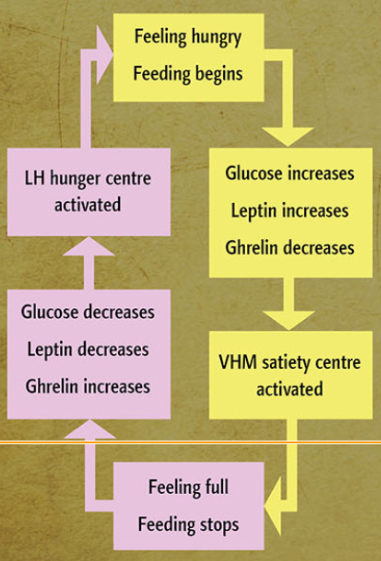
- Lateral hypothalamus (LH)- Described as the 'feeding centre' or 'on switch', the LH contains cells that detect levels of glucose in the liver. The LH is activated when the glucose levels drop below a certain point; this causes the individual to feel hungry.
- A further neural mechanism associated with LH activity is the neurotransmitter neuropeptide y (NPY), It is closely associated with hunger and reduced physical activity.
- Anand and Brobeck- lesioned the LH of rats, and found that they starved themselves to death (aphagia).
- Ventro-medial hypothalamus (VMH)- Described as the 'satiety centre' or 'off switch'. Glucose levels rise in the bloodstream and the liver when an individual eats, this is detected by cells in the VHM, and when it exceeds a certain level the VMH is activated which makes the individual feel full.
- Hetherington and Ranson- Showed that lesioning the VMH in rats caused these animals to become hyperphagic (over eat) and eventually then obese.
- Lateral hypothalamus (LH)- Described as the 'feeding centre' or 'on switch', the LH contains cells that detect levels of glucose in the liver. The LH is activated when the glucose levels drop below a certain point; this causes the individual to feel hungry.
- Dual-centre model
- Hormones
- Ghrelin- hormone secreted by the stomach, it is a hormonal marker of how long since we have last eaten- closely related to how empty our stomach is. Ghrelin levels are detected by receptors in a part of the hypothalamus called the arcuate nucleus. This sends signals to release neuropeptide y.
- Cummings et al- found that Ghrelin levels fell after eating and increased again just before the participants next meal time. There was a correlation between ghrelin levels and hunger levels.
- Leptin- Hormone produced by adipose (fat) cells. Leptin levels in the blood increase along with fat levels, these are detected by the VMH. Leptin is an appetite suppressant, and so contributes to the VMH satiety mechanism. As leptin levels rise, you begin to feel full.
- Licinio et al- investigated three adults from the same Turkish family and found that when they were given leptin supplements their food intake reduced.
- Ghrelin- hormone secreted by the stomach, it is a hormonal marker of how long since we have last eaten- closely related to how empty our stomach is. Ghrelin levels are detected by receptors in a part of the hypothalamus called the arcuate nucleus. This sends signals to release neuropeptide y.
- A better understanding of the neural and hormonal controlling eating behaviour offers therapeutic opportunities. As the interactions between the nervous system and the many hormones involved in eating become clearer, treatments for both anorexia and obesity become more realistic.
- Hypothalamus- Structure in the brain that has a crucial role in integrating the nervous and endocrine systems. Maintains homeostasis. Contains the LH and VMH centres.
Eating disorder: Obesity
- Biological explanation
- Polygenic determination
- Locke et al studied genomes of more than 300,000 people, and identified 97 genes associated with variations in BMI. This demonstrates that the action of genes on obesity is polygenic. This is made even more complex when you consider there are other ways of measuring obesity. Different genes may influence different aspects of obesity.
- Paracchini- carried out a meta-analysis of 25 studies that investigated genes thought to be involved in regulating leptin and leptin receptors. The researchers could find no evidence of a link between these genes and obesity.
- Locke et al studied genomes of more than 300,000 people, and identified 97 genes associated with variations in BMI. This demonstrates that the action of genes on obesity is polygenic. This is made even more complex when you consider there are other ways of measuring obesity. Different genes may influence different aspects of obesity.
- Serotonin
- Dysfunctions in serotonin levels can occur due to stress or disorders such as depression. In these cases, levels of serotonin are abnormally low, creating inaccurate satiety signals that are sent to the hypothalamus, disinhibiting eating behaviour. Low serotonin levels lead to cravings for carbohydrates and sugars, causing weight gain through too many calories.
- Ohia et al- Highlighted the importance in obesity of one serotonin receptor, the 2C receptor. Mice genetically engineered to have no functioning 2C receptors showed to have late-onset obesity.
- Dysfunctions in serotonin levels can occur due to stress or disorders such as depression. In these cases, levels of serotonin are abnormally low, creating inaccurate satiety signals that are sent to the hypothalamus, disinhibiting eating behaviour. Low serotonin levels lead to cravings for carbohydrates and sugars, causing weight gain through too many calories.
- Dopamine
- Dopamine has a crucial role in the brain's reward and motivation system. Normal levels of dopamine stimulate brain areas such as the hypothalamus, providing rewarding feelings of pleasure and well-being. Dopamine is associated with the pleasure we derive from eating and eating cues. However, obesity has been linked with a dysfunctional dopamine system.
- Ritchie and Noble- Conducted a PET scan that found that people who inherited one version of the DRD2 gene had 30-40% fewer D2 receptors compared to those with other versions, meaning they experience less dopamine-activated pleasurable rewards from eating.
- Dopamine has a crucial role in the brain's reward and motivation system. Normal levels of dopamine stimulate brain areas such as the hypothalamus, providing rewarding feelings of pleasure and well-being. Dopamine is associated with the pleasure we derive from eating and eating cues. However, obesity has been linked with a dysfunctional dopamine system.
- Polygenic determination
- Psychological explanation
- Restraint theory
- Herman and Polivy argued that restrained eating is counterproductive and ultimately self-defeating. They noticed the vast majority of people who restrain their eating fail to lose weight.
- Cognitive control: by setting strict limits on food intake and sorting food into 'good' and 'bad' categories, a restrained diet is a highly controlled way of dieting. The individual has to consciously think about their eating all of the time.
- Paradoxical outcome: The result is the restrained eater becomes more preoccupied with food than less. By placing limits of eating, they are no longer eating when hungry and stopping when full, meaning satiety signals are no longer under physiological control, leading to disinhibition.
- Wardle and Beales- Randomly assigned 27 obese individuals to either a diet group, an exercise group or a non-treatment group for 7 weeks. They were tested and noted on their food intake. They found restrained eaters ate significantly more calories than any other groups. They experienced occasional disinhibition where they would binge.
- Paradoxical outcome: The result is the restrained eater becomes more preoccupied with food than less. By placing limits of eating, they are no longer eating when hungry and stopping when full, meaning satiety signals are no longer under physiological control, leading to disinhibition.
- Cognitive control: by setting strict limits on food intake and sorting food into 'good' and 'bad' categories, a restrained diet is a highly controlled way of dieting. The individual has to consciously think about their eating all of the time.
- Herman and Polivy argued that restrained eating is counterproductive and ultimately self-defeating. They noticed the vast majority of people who restrain their eating fail to lose weight.
- Disinhibition
- Restrained eaters are vulnerable to internal and external food cues such as mood, smells or images. These disinhibitors lead to a loss of control over restrained eating, unleashing a session of binge eating, fuelled by a distorted 'all or nothing' mind-set.
- Once a restrained eater has been disinhibited by their internal and external influences, they will not only eat forbidden food, but will continue because in their mind there is no point in stopping.
- Boyce and Kuijer- compared the responses of restrained and unrestrained eaters to media images. Control participants were shown neutral images, and the others were shown images of thinness. After, their food intake was measured by a 'taste-test' where they were allowed to eat as much as they liked. Restrained eaters ate significantly more than unrestrained eaters after being shown the thin images. there was no difference in response to neutral images.
- Once a restrained eater has been disinhibited by their internal and external influences, they will not only eat forbidden food, but will continue because in their mind there is no point in stopping.
- Restrained eaters are vulnerable to internal and external food cues such as mood, smells or images. These disinhibitors lead to a loss of control over restrained eating, unleashing a session of binge eating, fuelled by a distorted 'all or nothing' mind-set.
- Boundary model
- Herman and Polivy said food intake exists on a continuum from hungry to full. If our energy levels dip below a certain point, our biological processes make us feel hungry, and eating until full biologically creates a feeling of discomfort to stop. Between these two points is the zone of biological indifference where biological factors have minimal impact and instead cognitive and social factors influence food intake.
- Restrained eaters have a wider zone of biological indifference so their eating behaviour is more open to cognitive and social control rather than physiological. This makes them vulnerable to disinhibition. They have a self-imposed upper boundary of how much they want to eat, which it far lower than the satiety boundary, leaving them hungry. This boundary is inevitably broken, causing the individual to carry on eating beyond the satiety boundary. The "what the hell effect".
- AGAINST: Savage et al- carried out a longitudinal study of measuring the dietary restraints and disinhibitions of 163 women every two years for a 6 year period. They also measured weight changes. They found that increases in restrained eating were linked to decreases in weight, showing that restrained dieting leads to weight loss.
- Restrained eaters have a wider zone of biological indifference so their eating behaviour is more open to cognitive and social control rather than physiological. This makes them vulnerable to disinhibition. They have a self-imposed upper boundary of how much they want to eat, which it far lower than the satiety boundary, leaving them hungry. This boundary is inevitably broken, causing the individual to carry on eating beyond the satiety boundary. The "what the hell effect".
- Herman and Polivy said food intake exists on a continuum from hungry to full. If our energy levels dip below a certain point, our biological processes make us feel hungry, and eating until full biologically creates a feeling of discomfort to stop. Between these two points is the zone of biological indifference where biological factors have minimal impact and instead cognitive and social factors influence food intake.
- Restraint theory
- Dieting
- The spiral model
- Heatherton and Polivy said low self-esteem is a risk factor for dieting attempts because it makes the individual more likely to make negative comparisons. First time dieters may experience some success at first, but lasting weight loss is rare, so ultimately the weight is regained and the outcome is failure. Instead of rethinking their approach, dieters stick to the plan, only next time trying to push themselves harder. This greater restriction of food intake causes frustration and emotional distress. At the same time, metabolic processes in the body change, such as ghrelin increase, making it physically harder. This results in further failures and repeated attempts, trapping the individual in a downward spiral of unlikely weight loss.
- Lowe and Kleinfield- People who diet to avoid putting on weight rather than to lose it are less likely to experience disinhibited eating; perhaps because their self-esteem is higher. Perhaps the only way to dietary success is to promote self-esteem or by ending attempts to lose weight and accepting oneself as one is.
- Heatherton and Polivy said low self-esteem is a risk factor for dieting attempts because it makes the individual more likely to make negative comparisons. First time dieters may experience some success at first, but lasting weight loss is rare, so ultimately the weight is regained and the outcome is failure. Instead of rethinking their approach, dieters stick to the plan, only next time trying to push themselves harder. This greater restriction of food intake causes frustration and emotional distress. At the same time, metabolic processes in the body change, such as ghrelin increase, making it physically harder. This results in further failures and repeated attempts, trapping the individual in a downward spiral of unlikely weight loss.
- Ironic processes theory
- Trying to suppress various thoughts can actually bring them up to the fore. Dieters who try and deny themselves certain foods, and try and suppress thoughts about them, will become more preoccupied with the forbidden foods rather than less, and want them more. This stems from Wegner's experiment where he asked participants not to think about a white bear, the paradoxical outcome was that they ended up thinking about it more.
- Attempting to distract yourself from thinking about forbidden foods requires mental activity. This leaves you lacking cognitive processing capacity to suppress the thought, which inevitably reappears.
- Adriaanse et al- female student dieters were presented with diet intentions expressed in negative form (when i'm sad, i won't eat chocolate). They found an ironic rebound effect. Just reading the statement reinforced the association between 'being sad' and 'chocolate'. The data showed that those exposed to these statements consumed more unhealthy snacks and calories than a control group during the following week.
- AGAINST: The effects of ironic processes may be relatively small, 'snapshot' lab experiments may exaggerate the effects, whilst real-life attempts to lose weight extend over a longer period of time. This means that other factors are likely to be important as well, such as self-esteem.
- Trying to suppress various thoughts can actually bring them up to the fore. Dieters who try and deny themselves certain foods, and try and suppress thoughts about them, will become more preoccupied with the forbidden foods rather than less, and want them more. This stems from Wegner's experiment where he asked participants not to think about a white bear, the paradoxical outcome was that they ended up thinking about it more.
- The spiral model
- Biological explanation
Eating disorder: Anorexia
- Biological explanations
- Genetic explanation
- Concordance rates indicate the proportion of twin pairs in which both individuals have AN. As MZ twins share 100% of their genes whilst DZ share 50%, a higher concordance rate for MZs is strong genetic evidence of a genetic component to AN.
- Holland- studied 45 pairs of female twins and found a concordance rate of 56% for MZ twins but only 5% for DZ twins. Several years later it was replicated with a 65% concordance for MZ and 32% for DZ.
- Genome-wide association studies (GWAS): They do not make assumptions about which genes might be involved in anorexia, they look at an entire collection of human genes rather than individual genes.
- Boraska et al- conducted a GWAS with 5551 An patients and 21000 matched controls. 72 separate genetic variations were identified, but none of them were significantly related to AN. It was argued that this was due to their study not being sensitive enough and the complexities of the genetic influence.
- Concordance rates indicate the proportion of twin pairs in which both individuals have AN. As MZ twins share 100% of their genes whilst DZ share 50%, a higher concordance rate for MZs is strong genetic evidence of a genetic component to AN.
- Neural explanation
- Serotonin- Findings have been inconsistent but some research shows that decreased/ underactivity of serotonin is linked to suffering with AN. Serotonin is known for controlling our obsessive and anxious behaviours.
- Bailer- found evidence of low levels of serotonin breakdown byproducts in people with AN. These levels return to normal after short-term weight recovery, and beyond normal levels after long-term recovery.
- Attia- studied AN patients who had not returned to their pre-illness weight. These individuals responded less well to drugs that stimulate serotonin activity than AN patients that had returned to their healthy weight.
- Dopamine- Findings have been inconsistent but some research shows that decreased dopamine levels are associated with AN. Dopamine is associated with controlling our emotional responses such as pleasure.
- Kaye- found that the dopamine by-product HVA was in lower levels in recovered AN patients compared to a group of control participants.
- Bailer- administered amphetamine to their participants to increase the release of dopamine. Healthy participants experienced euphoria (pleasure), but the An patients experienced anxiety. As eating increases dopamine release, It may be that An patients restrict their food intake as a means of reducing their anxiety levels
- Serotonin- Findings have been inconsistent but some research shows that decreased/ underactivity of serotonin is linked to suffering with AN. Serotonin is known for controlling our obsessive and anxious behaviours.
- Genetic explanation
- Psychological explanations
- Family systems theory (Minuchin)
- Enmeshment: members of anorexic families are overly involved with each other, boundaries and defined roles are poor, members spend too much time together and impinge upon each other's privacy. There is no sense of identity or independence, the adolescent is likely to assert her independence by refusing to eat.
- Overprotectiveness: Family members are constantly involved in protecting each other from external threats. They nurture obsessively, reinforcing family loyalty but leaving no room for independence.
- Rigidity: Interactions within anorexic families are extremely inflexible. Members deny the need to change, and do not adapt to crisis. The family is unlikely to adapt to give the adolescent independence.
- Conflict avoidance: Members will take whatever steps necessary to prevent conflict or supress it if it occurs. Issues are not resolved and continue to fester until a crisis develops.
- Autonomy and control: Bruch suggested that anorexia is caused by the daughter's struggle to achieve autonomy and control. The mother is particularly domineering and intrusive, and does not accept her daughter's need for independence. The outcome is confusion in the daughter and an overwhelming loss of control, self-starvation is described as being the desperate attempt to control her self-identity and become independedent.
- Brockmeyer- Studied 112 female AN patients and healthy control participants. They found that AN patients showed significantly greater desire to be autonomous.
- Aragona- studied 30 Portuguese patients and found they were no more enmeshed or rigid than a sample of non-eating disordered families. A different method of measuring enmeshment than other studies was used. Different outcomes depending on methodological variations illustrate a wider problem- there is difficulty confirming predictions derived from vaguely defined concepts such as enmeshment and autonomy.
- Behavioural Family systems Therapy (BFST) attempts to disentangle family relationships.
- Social learning theory
- Modelling: AN can develop indirectly through observation of a role model, this could be a mother who obsesses about food and thir weight. Models provide an example of behaviour to follow, what is considered socially acceptable, and glamourizes the behaviour.
- vicarious reinforcement- If the model is praised for losing weight, this reinforces the behaviour and makes the observer more likely to imitate it.
- The media is a rich source of role models. it communicates images of the ideal body shape, in recent times this has become thinner and thinner, presenting it as an aspiration for young women.
- Nasser: compared Egyptain women studying in Cairo to Egyptian women studying in London. 12% of those in London developed AN symptoms whilst 0% of those in Cairo did.
- Becker- Looked at young women in Figi where AN was unheard of before the introduction of TV. By 1998 74% of women completed a survey stating that they were 'too big or fat' and cases of AN started to appear.
- Modelling: AN can develop indirectly through observation of a role model, this could be a mother who obsesses about food and thir weight. Models provide an example of behaviour to follow, what is considered socially acceptable, and glamourizes the behaviour.
- Cognitive theory
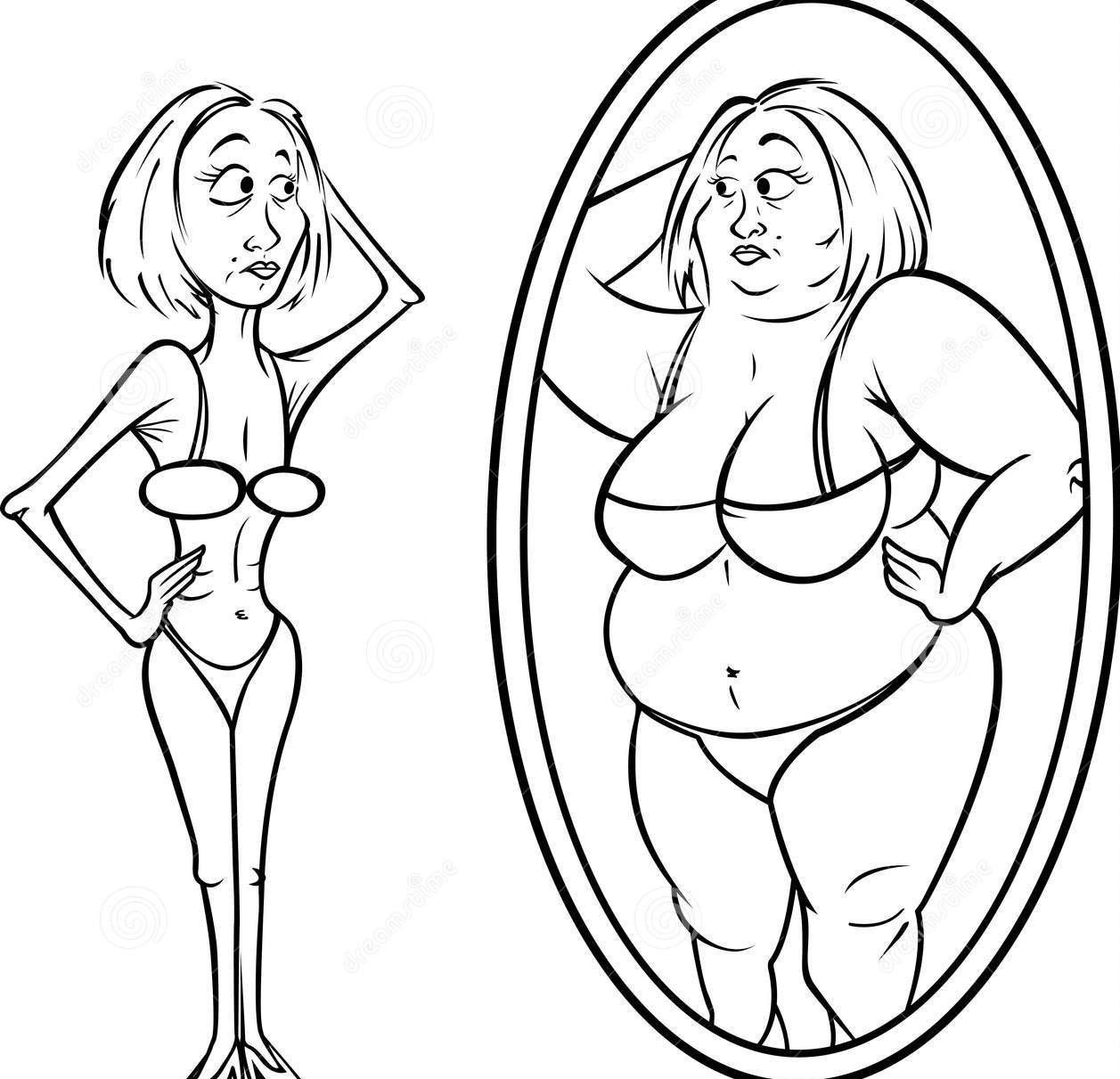
- Cognitive distortions: People with AN have disturbed perceptions and become more and more critical of their own bodies. they misinterpret their emotional states as 'feeing 'fat', even as they get thinner and thinner. They consistently overestimate their body size and weight.
- Irational beliefs: An sufferes express irrational beliefs and attitudes about their disorder that defy rational sense. A key irrational belief is perfectionism, the view hat the individul has to meet demanding standards and harsh goals.
- Cognitive inflexibility: AN sufferers find it difficult to switch fluently from one task to another requiring a different set of cognitive skills. Their weight loss is a solution to a problem that no longer exists, but they are unable to perceive this accurately.
- Cornelissen et al- AN patients and non-AN women had to adjust a computerised image of themselves until it matched their estimated body size. No significant difference was found between the group of women in the accuracy of their estimates. This suggests over-estimation is not pathological.
- Sachdev- used fmri scans on brains of AN patients and a control group when showing them images of their own and other people's bodies. The same brain areas were activated in both groups when they were shown non-self images. However, when the AN patients saw images of themselves, very little activation in parts of the brain was seen, thought to be involved in attention.
- Family systems theory (Minuchin)
- Diathesis-stress: Abraham makes the widely accepted point that AN can only be fully understood by considering the interaction between genetic and non-genetic factors. Genes may cause a vulnerability to AN that only expresses itself when an individual tries to lose weight, which may be for social, cultural or psychological reasons.
- Biological explanations
Bilder und Dateien der Mindmap
Informationen
- Beschreibung
- AS - Level Psychology Mindmap am Eating Behaviour, erstellt von Laura Louise am 17/01/2017.
- Erstellt von
- Laura Louise
- Aufrufe
- 4
- Bewertung