
Mindmap
eating behaviour
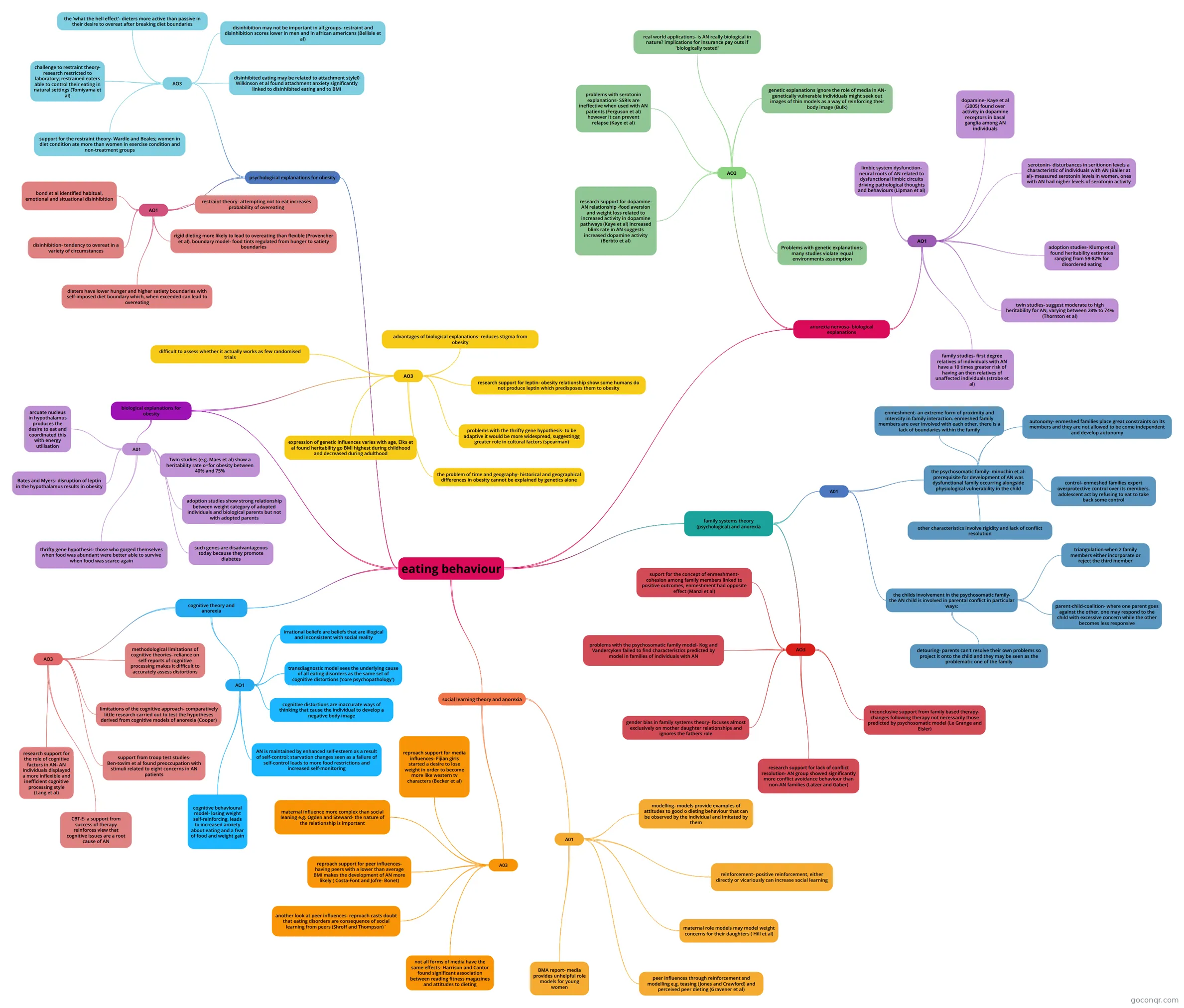
Mind map: eating behaviour
Inhalt der Mindmap
eating behaviour
anorexia nervosa- biological explanations
- AO1
- family studies- first degree relatives of individuals with AN have a 10 times greater risk of having an then relatives of unaffected individuals (strobe et al)
- twin studies- suggest moderate to high heritability for AN, varying between 28% to 74% (Thornton et al)
- adoption studies- Klump et al found heritability estimates ranging from 59-82% for disordered eating
- serotonin- disturbances in seritionon levels a characteristic of individuals with AN (Bailer at al)- measured serotonin levels in women, ones with AN had nigher levels of serotonin activity
- dopamine- Kaye et al (2005) found over activity in dopamine receptors in basal ganglia among AN individuals
- limbic system dysfunction- neural roots of AN related to dysfunctional limbic circuits driving pathological thoughts and behaviours (Lipman et al)
- AO3
- Problems with genetic explanations- many studies violate 'equal environments assumption
- genetic explanations ignore the role of media in AN- genetically vulnerable individuals might seek out images of thin models as a way of reinforcing their body image (Bulk)
- real world applications- is AN really biological in nature? implications for insurance pay outs if 'biologically tested'
- problems with serotonin explanations- SSRIs are ineffective when used with AN patients (Ferguson et al) however it can prevent relapse (Kaye et al)
- research support for dopamine- AN relationship -food aversion and weight loss related to increased activity in dopamine pathways (Kaye et al) increased blink rate in AN suggests increased dopamine activity (Berbto et al)
- AO1
family systems theory (psychological) and anorexia
- A01
- the psychosomatic family- minuchin et al- prerequisite for development of AN was dysfunctional family occurring alongside physiological vulnerability in the child
- enmeshment- an extreme form of proximity and intensity in family interaction. enmeshed family members are over involved with each other. there is a lack of boundaries within the family
- autonomy- enmeshed families place great constraints on its members and they are not allowed to be come independent and develop autonomy
- control- enmeshed families expert overprotective control over its members. adolescent act by refusing to eat to take back some control
- other characteristics involve rigidity and lack of conflict resolution
- the childs involvement in the psychosomatic family- the AN child is involved in parental conflict in particular ways:
- triangulation-when 2 family members either incorporate or reject the third member
- parent-child-coalition- where one parent goes against the other. one may respond to the child with excessive concern while the other becomes less responsive
- detouring- parents can't resolve their own problems so project it onto the child and they may be seen as the problematic one of the family
- the psychosomatic family- minuchin et al- prerequisite for development of AN was dysfunctional family occurring alongside physiological vulnerability in the child
- AO3
- suport for the concept of enmeshment- cohesion among family members linked to positive outcomes, enmeshment had opposite effect (Manzi et al)
- problems with the psychosomatic family model- Kog and Vandercyken failed to find characteristics predicted by model in families of individuals with AN
- inconclusive support from family based therapy- changes following therapy not necessarily those predicted by psychosomatic model (Le Grange and Eisler)
- gender bias in family systems theory- focuses almost exclusively on mother daughter relationships and ignores the fathers role
- research support for lack of conflict resolution- AN group showed significantly more conflict avoidance behaviour than non-AN families (Latzer and Gaber)
- A01
social learning theory and anorexia
- A01
- modelling- models provide examples of attitudes to good o dieting behaviour that can be observed by the individual and imitated by them
- reinforcement- positive reinforcement, either directly or vicariously can increase social learning
- maternal role models may model weight concerns for their daughters ( Hill et al)
- peer influences through reinforcement snd modelling e.g. teasing (Jones and Crawford) and perceived peer dieting (Gravener et al)
- BMA report- media provides unhelpful role models for young women
- A03
- maternal influence more complex than social leaning e.g. Ogden and Steward- the nature of the relationship is important
- reproach support for peer influences- having peers with a lower than average BMI makes the development of AN more likely ( Costa-Font and Jofre- Bonet)
- another look at peer influences- reproach casts doubt that eating disorders are consequence of social learning from peers (Shroff and Thompson)`
- reproach support for media influences- Fijian girls started a desire to lose weight in order to become more like western tv characters (Becker et al)
- not all forms of media have the same effects- Harrison and Cantor found significant association between reading fitness magazines and attitudes to dieting
- A01
cognitive theory and anorexia
- AO1
- cognitive distortions are inaccurate ways of thinking that cause the individual to develop a negative body image
- irrational beliefe are beliefs that are illogical and inconsistent with social reality
- cognitive behavioural model- losing weight self-reinforcing, leads to increased anxiety about eating and a fear of food and weight gain
- transdiagnostic model sees the underlying cause of all eating disorders as the same set of cognitive distortions ('core psychopathology')
- AN is maintained by enhanced self-esteem as a result of self-control; starvation changes seen as a failure of self-control leads to more food restrictions and increased self-monitoring
- AO3
- research support for the role of cognitive factors in AN- AN individuals displayed a more inflexible and inefficient cognitive processing style (Lang et al)
- support from troop test studies- Ben-tovim et al found preoccupation with stimuli related to eight concerns in AN patients
- CBT-E- a support from success of therapy reinforces view that cognitive issues are a root cause of AN
- methodological limitations of cognitive theories- reliance on self-reports of cognitive processing makes it difficult to accurately assess distortions
- limitations of the cognitive approach- comparatively little research carried out to test the hypotheses derived from cognitive models of anorexia (Cooper)
- AO1
biological explanations for obesity
- A01
- Twin studies (e.g. Maes et al) show a heritability rate o=for obesity between 40% and 75%
- adoption studies show strong relationship between weight category of adopted individuals and biological parents but not with adopted parents
- arcuate nucleus in hypothalamus produces the desire to eat and coordinated this with energy utilisation
- Bates and Myers- disruption of leptin in the hypothalamus results in obesity
- thrifty gene hypothesis- those who gorged themselves when food was abundant were better able to survive when food was scarce again
- such genes are disadvantageous today because they promote diabetes
- AO3
- expression of genetic influences varies with age, Elks et al found heritability go BMI highest during childhood and decreased during adulthood
- the problem of time and geography- historical and geographical differences in obesity cannot be explained by genetics alone
- research support for leptin- obesity relationship show some humans do not produce leptin which predisposes them to obesity
- advantages of biological explanations- reduces stigma from obesity
- difficult to assess whether it actually works as few randomised trials
- problems with the thrifty gene hypothesis- to be adaptive it would be more widespread, suggestingg greater role in cultural factors (spearman)
- A01
psychological explanations for obesity
- AO1
- restraint theory- attempting not to eat increases probability of overeating
- rigid dieting more likely to lead to overeating than flexible (Provencher et al). boundary model- food tints regulated from hunger to satiety boundaries
- dieters have lower hunger and higher satiety boundaries with self-imposed diet boundary which, when exceeded can lead to overeating
- disinhibition- tendency to overeat in a variety of circumstances
- bond et al identified habitual, emotional and situational disinhibition
- AO3
- support for the restraint theory- Wardle and Beales; women in diet condition ate more than women in exercise condition and non-treatment groups
- challenge to restraint theory- research restricted to laboratory; restrained eaters able to control their eating in natural settings (Tomiyama et al)
- the 'what the hell effect'- dieters more active than passive in their desire to overeat after breaking diet boundaries
- disinhibition may not be important in all groups- restraint and disinhibition scores lower in men and in african americans (Bellisle et al)
- disinhibited eating may be related to attachment style0 Wilkinson et al found attachment anxiety significantly linked to disinhibited eating and to BMI
- AO1
Informationen
- Beschreibung
- AS - Level Psychology Mindmap am eating behaviour, erstellt von kiera wood am 27/02/2017.
- Erstellt von
- kiera wood
- Aufrufe
- 0
- Bewertung