
Mindmap
Attachment
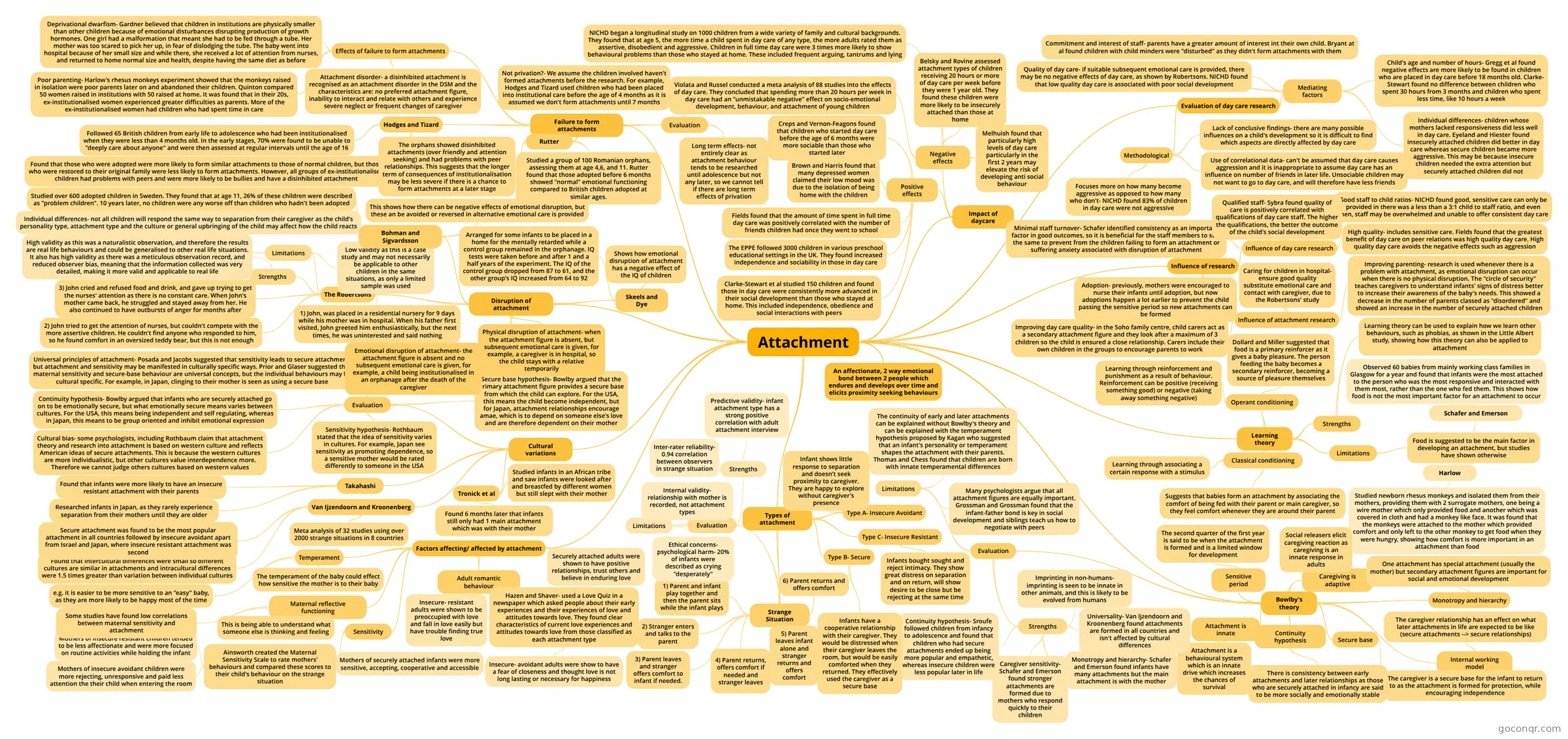
Mind map: attachment
Inhalt der Mindmap
Attachment
An affectionate, 2 way emotional bond between 2 people which endures and develops over time and elicits proximity seeking behaviours
Learning theory
- Classical conditioning
- Learning through associating a certain response with a stimulus
- Suggests that babies form an attachment by associating the comfort of being fed with their parent or main caregiver, so they feel comfort whenever they are around their parent
- Operant conditioning
- Learning through reinforcement and punishment as a result of behaviour. Reinforcement can be positive (receiving something good) or negative (taking away something negative)
- Dollard and Miller suggested that food is a primary reinforcer as it gives a baby pleasure. The person feeding the baby becomes a secondary reinforcer, becoming a source of pleasure themselves
- Strengths
- Learning theory can be used to explain how we learn other behaviours, such as phobias, as shown in the Little Albert study, showing how this theory can also be applied to attachment
- Limitations
- Food is suggested to be the main factor in developing an attachment, but studies have shown otherwise
- Schafer and Emerson
- Observed 60 babies from mainly working class families in Glasgow for a year and found that infants were the most attached to the person who was the most responsive and interacted with them most, rather than the one who fed them. This shows how food is not the most important factor for an attachment to occur
- Harlow
- Studied newborn rhesus monkeys and isolated them from their mothers, providing them with 2 surrogate mothers, one being a wire mother which only provided food and another which was covered in cloth and had a monkey like face. It was found that the monkeys were attached to the mother which provided comfort and only left to the other monkey to get food when they were hungry, showing how comfort is more important in an attachment than food
- Schafer and Emerson
- Food is suggested to be the main factor in developing an attachment, but studies have shown otherwise
- Classical conditioning
Bowlby's theory
- Sensitive period
- The second quarter of the first year is said to be when the attachment is formed and is a limited window for development
- Caregiving is adaptive
- Social releasers elicit caregiving reaction as caregiving is an innate response in adults
- Monotropy and hierarchy
- One attachment has special attachment (usually the mother) but secondary attachment figures are important for social and emotional development
- Internal working model
- The caregiver relationship has an effect on what later attachments in life are expected to be like (secure attachments --> secure relationships)
- Secure base
- The caregiver is a secure base for the infant to return to as the attachment is formed for protection, while encouraging independence
- Continuity hypothesis
- There is consistency between early attachments and later relationships as those who are securely attached in infancy are said to be more socially and emotionally stable
- Attachment is innate
- Attachment is a behavioural system which is an innate drive which increases the chances of survival
- Evaluation
- Limitations
- Many psychologists argue that all attachment figures are equally important. Grossman and Grossman found that the infant-father bond is key in social development and siblings teach us how to negotiate with peers
- The continuity of early and later attachments can be explained without Bowlby's theory and can be explained with the temperament hypothesis proposed by Kagan who suggested that an infant's personality or temperament shapes the attachment with their parents. Thomas and Chess found that children are born with innate temperamental differences
- Strengths
- Imprinting in non-humans- imprinting is seen to be innate in other animals, and this is likely to be evolved from humans
- Universality- Van Ijzendoorn and Kroonenberg found attachments are formed in all countries and isn't affected by cultural differences
- Monotropy and hierarchy- Schafer and Emerson found infants have many attachments but the main attachment is with the mother
- Caregiver sensitivity- Schafer and Emerson found stronger attachments are formed due to mothers who respond quickly to their children
- Continuity hypothesis- Sroufe followed children from infancy to adolescence and found that children who had secure attachments ended up being more popular and empathetic, whereas insecure children were less popular later in life
- Limitations
- Sensitive period
Types of attachment
- Type A- Insecure Avoidant
- Infant shows little response to separation and doesn't seek proximity to caregiver. They are happy to explore without caregiver's presence
- Type B- Secure
- Infants have a cooperative relationship with their caregiver. They would be distressed when their caregiver leaves the room, but would be easily comforted when they returned. They effectively used the caregiver as a secure base
- Type C- Insecure Resistant
- Infants bought sought and reject intimacy. They show great distress on separation and on return, will show desire to be close but be rejecting at the same time
- Strange Situation
- Evaluation
- Strengths
- Predictive validity- infant attachment type has a strong positive correlation with adult attachment interview
- Inter-rater reliability- 0.94 correlation between observers in strange situation
- Limitations
- Ethical concerns- psychological harm- 20% of infants were described as crying "desperately"
- Internal validity- relationship with mother is recorded, not attachment types
- Strengths
- 1) Parent and infant play together and then the parent sits while the infant plays
- 2) Stranger enters and talks to the parent
- 3) Parent leaves and stranger offers comfort to infant if needed.
- 4) Parent returns, offers comfort if needed and stranger leaves
- 5) Parent leaves infant alone and stranger returns and offers comfort
- 6) Parent returns and offers comfort
- Evaluation
- Type A- Insecure Avoidant
Factors affecting/ affected by attachment
- Adult romantic behaviour
- Hazen and Shaver- used a Love Quiz in a newspaper which asked people about their early experiences and their experiences of love and attitudes towards love. They found clear characteristics of current love experiences and attitudes towards love from those classified as each attachment type
- Securely attached adults were shown to have positive relationships, trust others and believe in enduring love
- Insecure- avoidant adults were show to have a fear of closeness and thought love is not long lasting or necessary for happiness
- Insecure- resistant adults were shown to be preoccupied with love and fall in love easily but have trouble finding true love
- Hazen and Shaver- used a Love Quiz in a newspaper which asked people about their early experiences and their experiences of love and attitudes towards love. They found clear characteristics of current love experiences and attitudes towards love from those classified as each attachment type
- Sensitivity
- Ainsworth created the Maternal Sensitivity Scale to rate mothers' behaviours and compared these scores to their child's behaviour on the strange situation
- Mothers of securely attached infants were more sensitive, accepting, cooperative and accessible
- Mothers of insecure avoidant children were more rejecting, unresponsive and paid less attention the their child when entering the room
- Mothers of insecure resistant children tended to be less affectionate and were more focused on routine activities while holding the infant
- Ainsworth created the Maternal Sensitivity Scale to rate mothers' behaviours and compared these scores to their child's behaviour on the strange situation
- Maternal reflective functioning
- This is being able to understand what someone else is thinking and feeling
- Some studies have found low correlations between maternal sensitivity and attachment
- Temperament
- The temperament of the baby could effect how sensitive the mother is to their baby
- e.g. it is easier to be more sensitive to an "easy" baby, as they are more likely to be happy most of the time
- Adult romantic behaviour
Cultural variations
- Tronick et al
- Studied infants in an African tribe and saw infants were looked after and breastfed by different women but still slept with their mother
- Found 6 months later that infants still only had 1 main attachment which was with their mother
- Takahashi
- Researched infants in Japan, as they rarely experience separation from their mothers until they are older
- Found that infants were more likely to have an insecure resistant attachment with their parents
- Van Ijzendoorn and Kroonenberg
- Meta analysis of 32 studies using over 2000 strange situations in 8 countries
- Found that intercultural differences were small so different cultures are similar in attachments and intracultural differences were 1.5 times greater than variation between individual cultures
- Secure attachment was found to be the most popular attachment in all countries followed by insecure avoidant apart from Israel and Japan, where insecure resistant attachment was second
- Evaluation
- Cultural bias- some psychologists, including Rothbaum claim that attachment theory and research into attachment is based on western culture and reflects American ideas of secure attachments. This is because the western cultures are more individualistic, but other cultures value interdependence more. Therefore we cannot judge others cultures based on western values
- Sensitivity hypothesis- Rothbaum stated that the idea of sensitivity varies in cultures. For example, Japan see sensitivity as promoting dependence, so a sensitive mother would be rated differently to someone in the USA
- Continuity hypothesis- Bowlby argued that infants who are securely attached go on to be emotionally secure, but what emotionally secure means varies between cultures. For the USA, this means being independent and self regulating, whereas in Japan, this means to be group oriented and inhibit emotional expression
- Secure base hypothesis- Bowlby argued that the primary attachment figure provides a secure base from which the child can explore. For the USA, this means the child become independent, but for Japan, attachment relationships encourage amae, which is to depend on someone else's love and are therefore dependent on their mother
- Universal principles of attachment- Posada and Jacobs suggested that sensitivity leads to secure attachment, but attachment and sensitivity may be manifested in culturally specific ways. Prior and Glaser suggested that maternal sensitivity and secure-base behaviour are universal concepts, but the individual behaviours may be cultural specific. For example, in Japan, clinging to their mother is seen as using a secure base
- Tronick et al
Disruption of attachment
- The Robertsons
- 1) John, was placed in a residential nursery for 9 days while his mother was in hospital. When his father first visited, John greeted him enthusiastically, but the next times, he was uninterested and said nothing
- 2) John tried to get the attention of nurses, but couldn't compete with the more assertive children. He couldn't find anyone who responded to him, so he found comfort in an oversized teddy bear, but this is not enough
- 3) John cried and refused food and drink, and gave up trying to get the nurses' attention as there is no constant care. When John's mother came back, he struggled and stayed away from her. He also continued to have outbursts of anger for months after
- Strengths
- High validity as this was a naturalistic observation, and therefore the results are real life behaviours and could be generalised to other real life situations. It also has high validity as there was a meticulous observation record, and reduced observer bias, meaning that the information collected was very detailed, making it more valid and applicable to real life
- Limitations
- Low validity as this is a case study and may not necessarily be applicable to other children in the same situations, as only a limited sample was used
- Individual differences- not all children will respond the same way to separation from their caregiver as the child's personality type, attachment type and the culture or general upbringing of the child may affect how the child reacts
- Physical disruption of attachment- when the attachment figure is absent, but subsequent emotional care is given, for example, a caregiver is in hospital, so the child stays with a relative temporarily
- Emotional disruption of attachment- the attachment figure is absent and no subsequent emotional care is given, for example, a child being institutionalised in an orphanage after the death of the caregiver
- Skeels and Dye
- Arranged for some infants to be placed in a home for the mentally retarded while a control group remained in the orphanage. IQ tests were taken before and after 1 and a half years of the experiment. The IQ of the control group dropped from 87 to 61, and the other group's IQ increased from 64 to 92
- Shows how emotional disruption of attachment has a negative effect of the IQ of children
- Bohman and Sigvardsson
- Studied over 600 adopted children in Sweden. They found that at age 11, 26% of these children were described as "problem children". 10 years later, no children were any worse off than children who hadn't been adopted
- This shows how there can be negative effects of emotional disruption, but these an be avoided or reversed in alternative emotional care is provided
- The Robertsons
Failure to form attachments
- Hodges and Tizard
- Followed 65 British children from early life to adolescence who had been institutionalised when they were less than 4 months old. In the early stages, 70% were found to be unable to "deeply care about anyone" and were then assessed at regular intervals until the age of 16
- Found that those who were adopted were more likely to form similar attachments to those of normal children, but those who were restored to their original family were less likely to form attachments. However, all groups of ex-institutionalised children had problems with peers and were more likely to be bullies and have a disinhibited attachment
- Rutter
- Studied a group of 100 Romanian orphans, assessing them at age 4,6, and 11. Rutter found that those adopted before 6 months showed "normal" emotional functioning compared to British children adopted at similar ages.
- The orphans showed disinhibited attachments (over friendly and attention seeking) and had problems with peer relationships. This suggests that the longer term of consequences of institutionalisation may be less severe if there is a chance to form attachments at a later stage
- Effects of failure to form attachments
- Attachment disorder- a disinhibited attachment is recognised as an attachment disorder in the DSM and the characteristics are: no preferred attachment figure, inability to interact and relate with others and experience severe neglect or frequent changes of caregiver
- Poor parenting- Harlow's rhesus monkeys experiment showed that the monkeys raised in isolation were poor parents later on and abandoned their children. Quinton compared 50 women raised in institutions with 50 raised at home. It was found that in their 20s, ex-institutionalised women experienced greater difficulties as parents. More of the ex-institutionalised women had children who had spent time in care
- Deprivational dwarfism- Gardner believed that children in institutions are physically smaller than other children because of emotional disturbances disrupting production of growth hormones. One girl had a malformation that meant she had to be fed through a tube. Her mother was too scared to pick her up, in fear of dislodging the tube. The baby went into hospital because of her small size and while there, she received a lot of attention from nurses, and returned to home normal size and health, despite having the same diet as before
- Evaluation
- Not privation?- We assume the children involved haven't formed attachments before the research. For example, Hodges and Tizard used children who had been placed into institutional care before the age of 4 months as it is assumed we don't form attachments until 7 months
- Long term effects- not entirely clear as attachment behaviour tends to be researched until adolescence but not any later, so we cannot tell if there are long term effects of privation
- Hodges and Tizard
Impact of daycare
- Positive effects
- Brown and Harris found that many depressed women claimed their low mood was due to the isolation of being home with the children
- Clarke-Stewart et al studied 150 children and found those in day care were consistently more advanced in their social development than those who stayed at home. This included independence, obedience and social interactions with peers
- The EPPE followed 3000 children in various preschool educational settings in the UK. They found increased independence and sociability in those in day care
- Fields found that the amount of time spent in full time day care was positively correlated with the number of friends children had once they went to school
- Creps and Vernon-Feagons found that children who started day care before the age of 6 months were more sociable than those who started later
- Negative effects
- Violata and Russel conducted a meta analysis of 88 studies into the effects of day care. They concluded that spending more than 20 hours per week in day care had an "unmistakable negative" effect on socio-emotional development, behaviour, and attachment of young children
- NICHD began a longitudinal study on 1000 children from a wide variety of family and cultural backgrounds. They found that at age 5, the more time a child spent in day care of any type, the more adults rated them as assertive, disobedient and aggressive. Children in full time day care were 3 times more likely to show behavioural problems than those who stayed at home. These included frequent arguing, tantrums and lying
- Melhuish found that particularly high levels of day care particularly in the first 2 years may elevate the risk of developing anti social behaviour
- Belsky and Rovine assessed attachment types of children receiving 20 hours or more of day care per week before they were 1 year old. They found these children were more likely to be insecurely attached than those at home
- Positive effects
Influence of research
- Influence of attachment research
- Improving day care quality- in the Soho family centre, child carers act as a secondary attachment figure and they look after a maximum of 3 children so the child is ensured a close relationship. Carers include their own children in the groups to encourage parents to work
- Adoption- previously, mothers were encouraged to nurse their infants until adoption, but now adoptions happen a lot earlier to prevent the child passing the sensitive period so new attachments can be formed
- Caring for children in hospital- ensure good quality substitute emotional care and contact with caregiver, due to the Robertsons' study
- Improving parenting- research is used whenever there is a problem with attachment, as emotional disruption can occur when there is no physical disruption. The "circle of security" teaches caregivers to understand infants' signs of distress better to increase their awareness of the baby's needs. This showed a decrease in the number of parents classed as "disordered" and showed an increase in the number of securely attached children
- Influence of day care research
- High quality- includes sensitive care. Fields found that the greatest benefit of day care on peer relations was high quality day care. High quality day care avoids the negative effects such as aggression
- Good staff to child ratios- NICHD found good, sensitive care can only be provided in there was a less than a 3:1 child to staff ratio, and even then, staff may be overwhelmed and unable to offer consistent day care
- Minimal staff turnover- Schafer identified consistency as an important factor in good outcomes, so it is beneficial for the staff members to stay the same to prevent from the children failing to form an attachment or suffering anxiety associated with disruption of attachment
- Qualified staff- Sybra found quality of care is positively correlated with qualifications of day care staff. The higher the qualifications, the better the outcome of the child's social development
- Influence of attachment research
Evaluation of day care research
- Methodological
- Focuses more on how many become aggressive as opposed to how many who don't- NICHD found 83% of children in day care were not aggressive
- Use of correlational data- can't be assumed that day care causes aggression and it is inappropriate to assume day care has an influence on number of friends in later life. Unsociable children may not want to go to day care, and will therefore have less friends
- Lack of conclusive findings- there are many possible influences on a child's development so it is difficult to find which aspects are directly affected by day care
- Mediating factors
- Quality of day care- if suitable subsequent emotional care is provided, there may be no negative effects of day care, as shown by Robertsons. NICHD found that low quality day care is associated with poor social development
- Commitment and interest of staff- parents have a greater amount of interest int their own child. Bryant at al found children with child minders were "disturbed" as they didn't form attachments with them
- Individual differences- children whose mothers lacked responsiveness did less well in day care. Eyeland and Hiester found insecurely attached children did better in day care whereas secure children became more aggressive. This may be because insecure children needed the extra attention but securely attached children did not
- Child's age and number of hours- Gregg et al found negative effects are more likely to be found in children who are placed in day care before 18 months old. Clarke- Stewart found no difference between children who spent 30 hours from 3 months and children who spent less time, like 10 hours a week
- Methodological
Informationen
- Beschreibung
- AS Psychology Mindmap am Attachment, erstellt von singn014 am 29/04/2014.
- Erstellt von
- singn014
- Aufrufe
- 47
- Bewertung