
Mindmap
Forming attachments and their development
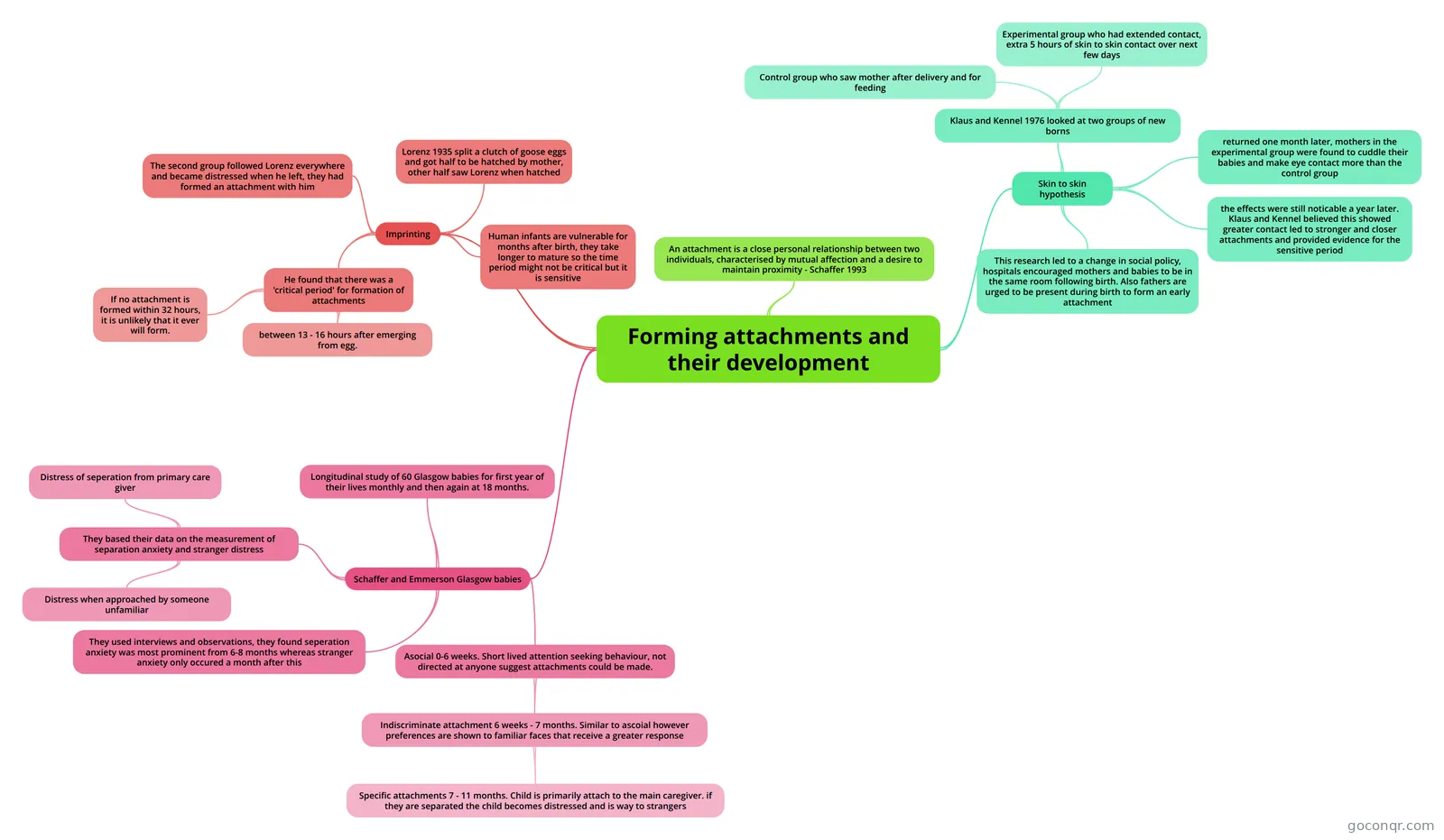
Mind map: Forming attachments and their development
Inhalt der Mindmap
Forming attachments and their development
Imprinting
- Lorenz 1935 split a clutch of goose eggs and got half to be hatched by mother, other half saw Lorenz when hatched
- The second group followed Lorenz everywhere and became distressed when he left, they had formed an attachment with him
- He found that there was a 'critical period' for formation of attachments
- between 13 - 16 hours after emerging from egg.
- If no attachment is formed within 32 hours, it is unlikely that it ever will form.
- Human infants are vulnerable for months after birth, they take longer to mature so the time period might not be critical but it is sensitive
Skin to skin hypothesis
- Klaus and Kennel 1976 looked at two groups of new borns
- Control group who saw mother after delivery and for feeding
- Experimental group who had extended contact, extra 5 hours of skin to skin contact over next few days
- returned one month later, mothers in the experimental group were found to cuddle their babies and make eye contact more than the control group
- the effects were still noticable a year later. Klaus and Kennel believed this showed greater contact led to stronger and closer attachments and provided evidence for the sensitive period
- This research led to a change in social policy, hospitals encouraged mothers and babies to be in the same room following birth. Also fathers are urged to be present during birth to form an early attachment
- Klaus and Kennel 1976 looked at two groups of new borns
An attachment is a close personal relationship between two individuals, characterised by mutual affection and a desire to maintain proximity - Schaffer 1993
Schaffer and Emmerson Glasgow babies
- Longitudinal study of 60 Glasgow babies for first year of their lives monthly and then again at 18 months.
- They based their data on the measurement of separation anxiety and stranger distress
- Distress of seperation from primary care giver
- Distress when approached by someone unfamiliar
- They used interviews and observations, they found seperation anxiety was most prominent from 6-8 months whereas stranger anxiety only occured a month after this
- Asocial 0-6 weeks. Short lived attention seeking behaviour, not directed at anyone suggest attachments could be made.
- Indiscriminate attachment 6 weeks - 7 months. Similar to ascoial however preferences are shown to familiar faces that receive a greater response
- Specific attachments 7 - 11 months. Child is primarily attach to the main caregiver. if they are separated the child becomes distressed and is way to strangers
- Indiscriminate attachment 6 weeks - 7 months. Similar to ascoial however preferences are shown to familiar faces that receive a greater response
Informationen
- Beschreibung
- Psychology (Developmental) Mindmap am Forming attachments and their development, erstellt von HeatherTxo am 03/05/2014.
- Erstellt von
- HeatherTxo
- Aufrufe
- 32
- Bewertung