
Mindmap
Eyewitness testimony
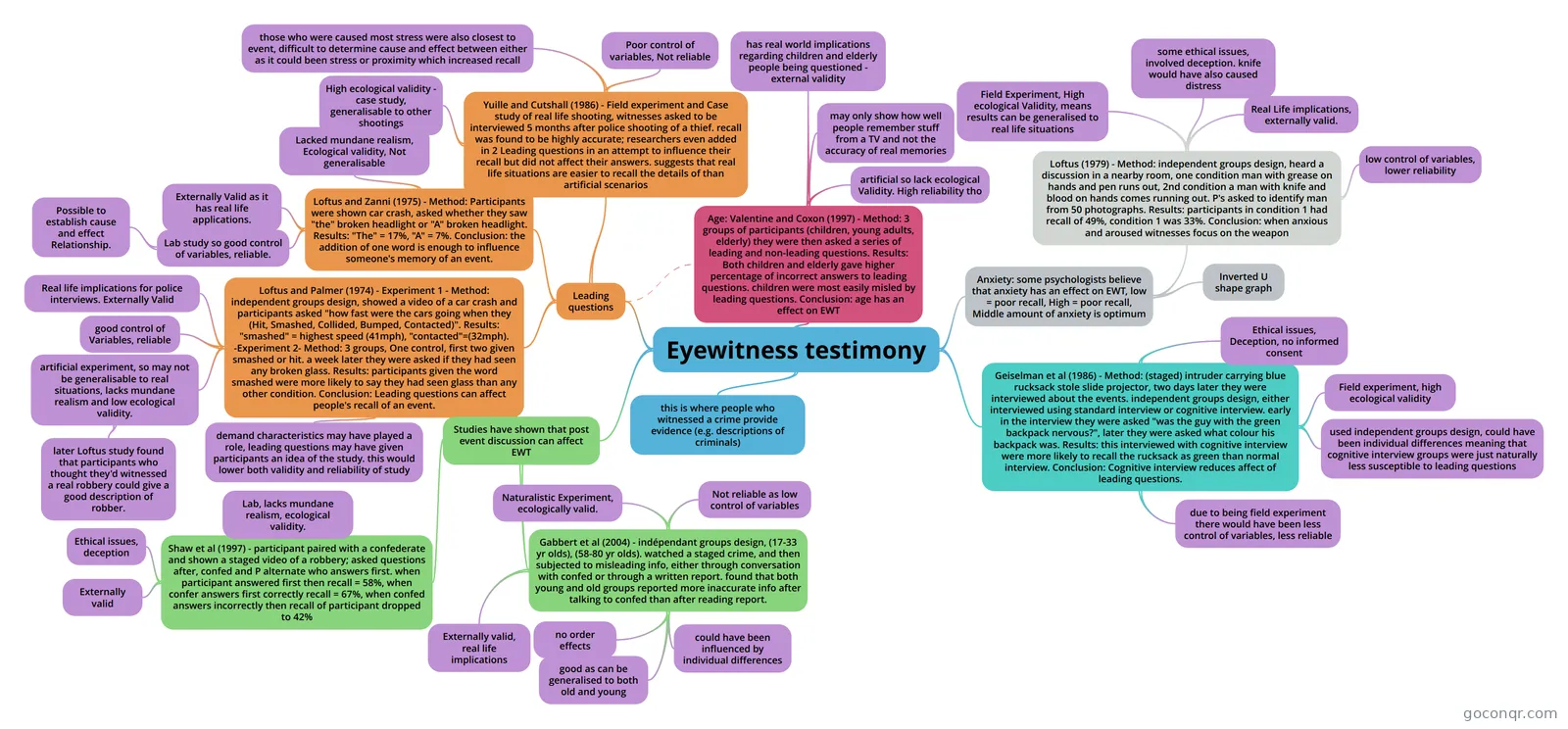
Mind map: Eyewitness testimony
Inhalt der Mindmap
Eyewitness testimony
this is where people who witnessed a crime provide evidence (e.g. descriptions of criminals)
Leading questions
- Loftus and Palmer (1974) - Experiment 1 - Method: independent groups design, showed a video of a car crash and participants asked "how fast were the cars going when they (Hit, Smashed, Collided, Bumped, Contacted)". Results: "smashed" = highest speed (41mph), "contacted"=(32mph). -Experiment 2- Method: 3 groups, One control, first two given smashed or hit. a week later they were asked if they had seen any broken glass. Results: participants given the word smashed were more likely to say they had seen glass than any other condition. Conclusion: Leading questions can affect people's recall of an event.
- Real life implications for police interviews. Externally Valid
- artificial experiment, so may not be generalisable to real situations, lacks mundane realism and low ecological validity.
- later Loftus study found that participants who thought they'd witnessed a real robbery could give a good description of robber.
- good control of Variables, reliable
- demand characteristics may have played a role, leading questions may have given participants an idea of the study. this would lower both validity and reliability of study
- Loftus and Zanni (1975) - Method: Participants were shown car crash, asked whether they saw "the" broken headlight or "A" broken headlight. Results: "The" = 17%, "A" = 7%. Conclusion: the addition of one word is enough to influence someone's memory of an event.
- Externally Valid as it has real life applications.
- Lab study so good control of variables, reliable.
- Possible to establish cause and effect Relationship.
- Lacked mundane realism, Ecological validity, Not generalisable
- Yuille and Cutshall (1986) - Field experiment and Case study of real life shooting, witnesses asked to be interviewed 5 months after police shooting of a thief. recall was found to be highly accurate; researchers even added in 2 Leading questions in an attempt to influence their recall but did not affect their answers. suggests that real life situations are easier to recall the details of than artificial scenarios
- High ecological validity - case study, generalisable to other shootings
- those who were caused most stress were also closest to event, difficult to determine cause and effect between either as it could been stress or proximity which increased recall
- Poor control of variables, Not reliable
- Loftus and Palmer (1974) - Experiment 1 - Method: independent groups design, showed a video of a car crash and participants asked "how fast were the cars going when they (Hit, Smashed, Collided, Bumped, Contacted)". Results: "smashed" = highest speed (41mph), "contacted"=(32mph). -Experiment 2- Method: 3 groups, One control, first two given smashed or hit. a week later they were asked if they had seen any broken glass. Results: participants given the word smashed were more likely to say they had seen glass than any other condition. Conclusion: Leading questions can affect people's recall of an event.
Studies have shown that post event discussion can affect EWT
- Shaw et al (1997) - participant paired with a confederate and shown a staged video of a robbery; asked questions after, confed and P alternate who answers first. when participant answered first then recall = 58%, when confer answers first correctly recall = 67%, when confed answers incorrectly then recall of participant dropped to 42%
- Lab, lacks mundane realism, ecological validity.
- Ethical issues, deception
- Externally valid
- Gabbert et al (2004) - indépendant groups design, (17-33 yr olds), (58-80 yr olds). watched a staged crime, and then subjected to misleading info, either through conversation with confed or through a written report. found that both young and old groups reported more inaccurate info after talking to confed than after reading report.
- Naturalistic Experiment, ecologically valid.
- no order effects
- could have been influenced by individual differences
- Externally valid, real life implications
- Not reliable as low control of variables
- good as can be generalised to both old and young
- Shaw et al (1997) - participant paired with a confederate and shown a staged video of a robbery; asked questions after, confed and P alternate who answers first. when participant answered first then recall = 58%, when confer answers first correctly recall = 67%, when confed answers incorrectly then recall of participant dropped to 42%
Age: Valentine and Coxon (1997) - Method: 3 groups of participants (children, young adults, elderly) they were then asked a series of leading and non-leading questions. Results: Both children and elderly gave higher percentage of incorrect answers to leading questions. children were most easily misled by leading questions. Conclusion: age has an effect on EWT
- has real world implications regarding children and elderly people being questioned - external validity
- artificial so lack ecological Validity. High reliability tho
- may only show how well people remember stuff from a TV and not the accuracy of real memories
Anxiety: some psychologists believe that anxiety has an effect on EWT, low = poor recall, High = poor recall, Middle amount of anxiety is optimum
- Loftus (1979) - Method: independent groups design, heard a discussion in a nearby room, one condition man with grease on hands and pen runs out, 2nd condition a man with knife and blood on hands comes running out. P's asked to identify man from 50 photographs. Results: participants in condition 1 had recall of 49%, condition 1 was 33%. Conclusion: when anxious and aroused witnesses focus on the weapon
- Field Experiment, High ecological Validity, means results can be generalised to real life situations
- Real Life implications, externally valid.
- some ethical issues, involved deception. knife would have also caused distress
- low control of variables, lower reliability
- Inverted U shape graph
- Loftus (1979) - Method: independent groups design, heard a discussion in a nearby room, one condition man with grease on hands and pen runs out, 2nd condition a man with knife and blood on hands comes running out. P's asked to identify man from 50 photographs. Results: participants in condition 1 had recall of 49%, condition 1 was 33%. Conclusion: when anxious and aroused witnesses focus on the weapon
Geiselman et al (1986) - Method: (staged) intruder carrying blue rucksack stole slide projector, two days later they were interviewed about the events. independent groups design, either interviewed using standard interview or cognitive interview. early in the interview they were asked "was the guy with the green backpack nervous?", later they were asked what colour his backpack was. Results: this interviewed with cognitive interview were more likely to recall the rucksack as green than normal interview. Conclusion: Cognitive interview reduces affect of leading questions.
- Field experiment, high ecological validity
- used independent groups design, could have been individual differences meaning that cognitive interview groups were just naturally less susceptible to leading questions
- due to being field experiment there would have been less control of variables, less reliable
- Ethical issues, Deception, no informed consent
Informationen
- Beschreibung
- A level Psychology (Memory) Mindmap am Eyewitness testimony, erstellt von Connor Hargrave am 12/04/2017.
- Erstellt von
- Connor Hargrave
- Aufrufe
- 0
- Bewertung