
Mindmap
Paper 1
Inhalt der Mindmap
Paper 1
Memory
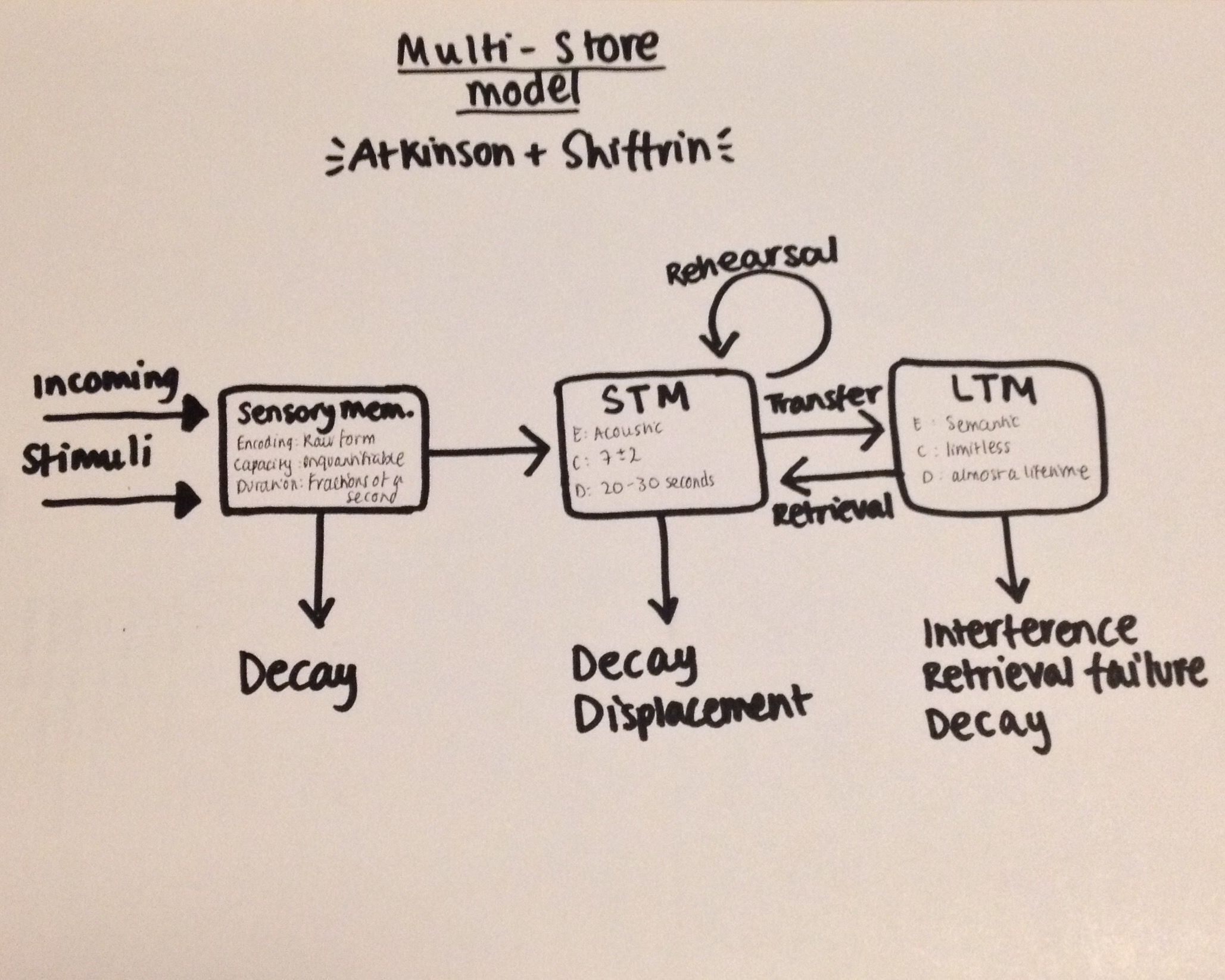
- Sensory
- Duration: fractions of a second
- Capacity: too small to quantify
- Encoding: raw form
- STM
- Duration: 20-30s
- Peterson and Peterson: Consonant Trigrams/Counting backwards.
- Factors affecting
- Maintenance rehearsal
- Deliberate intention to recall
- Amount of information to be retained
- Capacity: 7 +/- 2
- Baddeley: Word Length: remember more short than long words
- Factors affecting
- Rhythmic grouping
- Influence of LTM
- Reading aloud
- Pronunciation time
- Encoding: Acoustic/Visual
- Baddeley: acoustically and semantically similar/dissimilar words (A,S 55%, A,D 75%)
- Factors affecting
- Other ways to encode
- The sound of words
- Duration: 20-30s
- LTM
- Duration: Lifetime
- Bahrick et al: Year book; recall less accurate than matching
- Factors affecting
- How duration is measured
- Thorough learning
- Childhood amnesia
- Capacity: limitless "permastore"
- Encoding: Semantic
- Duration: Lifetime
- Eyewitness Testimony
- Cognitive Interview
- Recall every detail
- Recall events in a different order
- Different perspective
- Recreate the context
- Anxiety
- Loftus: Weapon focus phenomenom
- Age
- Elderly
- Alzheimer's
- Schemas
- Children
- Demand Characteristics "look good"
- Elderly
- Consequences
- More accurate when outcomes are severe
- How the witnesses are tested
- Forced = more inaccurate than volunteered
- Leading questions
- "a barn" / "THE barn"
- Misleading information
- Barn or no barn, group with misled 17% fell for it
- Cognitive Interview
- Improvement
- Loci
- Mneumonics
- Pay attention
- Elaborate rehearsal
- State dependent retrieval - mood and setting
- Peg words
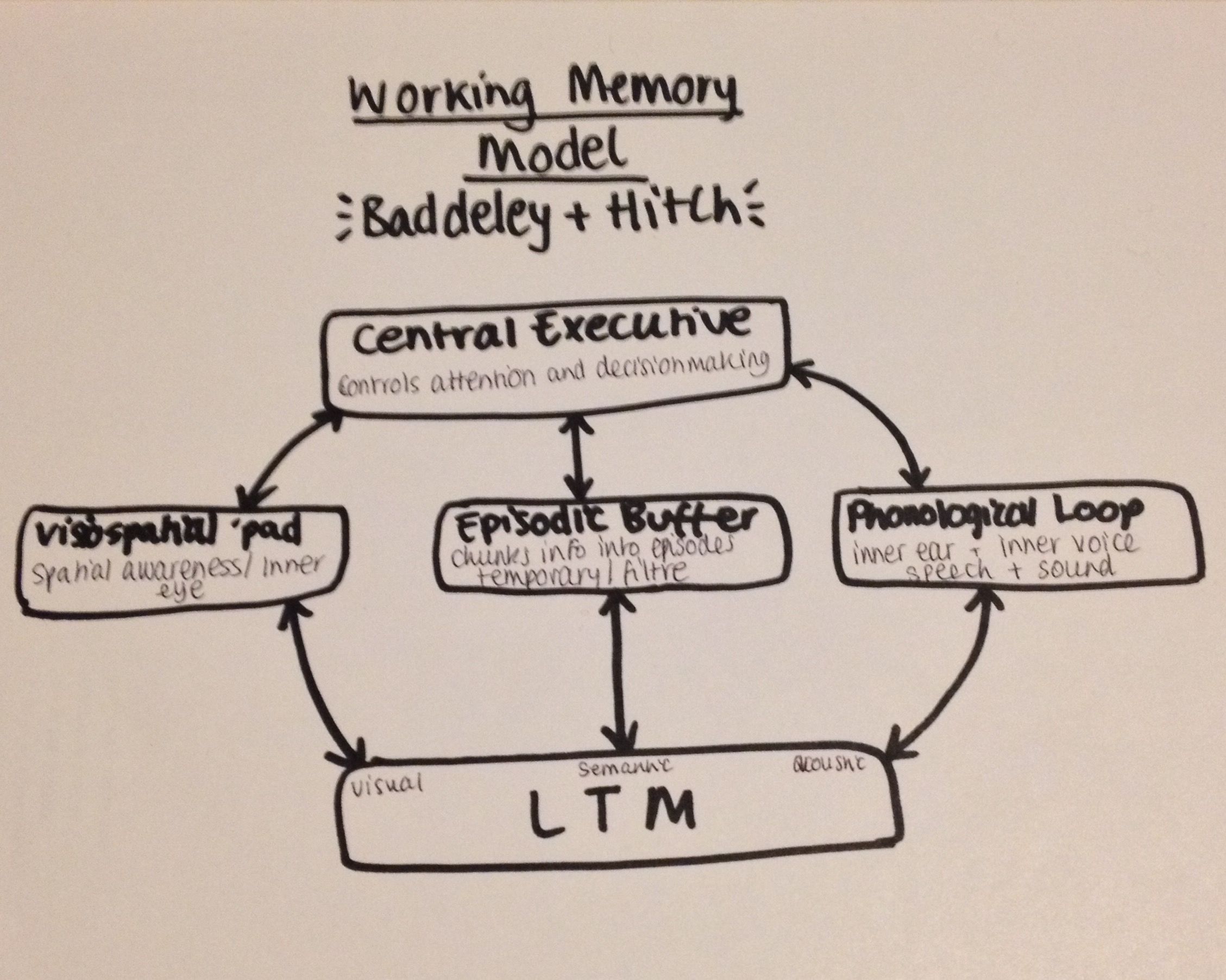
- Models
- WMM
- MSM
- Interface
- Proactive - old interferes with new
- Retroactive - new interferes with old
- Sensory
Attachment
- Learning theory (Behavioural)
- Classical Conditioning
- Unconditioned reinforcer
- Conditioned response
- Association
- Pavlov's dogs
- Unconditioned reinforcer
- Operant conditioning
- Drive state
- Rewards
- Drive state
- Cupboard love
- Harlow and Harlow's monkeys
- Classical Conditioning
- A strong emotional, reciprocal bond between infant and primary caregiver
- 4 Criteria
- Orientates around primary caregiver
- Distress upon separation
- Pleasure upon reunion
- Seek proximity, particularly when stressed
- 4 Criteria
- Evolutionary (Bowlby)
- Innate programming
- Imprinting
- Lorenz' goslings
- Infants' temperament
- Caregiver Sensitivity Hypothesis
- Imprinting
- Critical period
- 2½ years
- Sensitive period, adoption
- 2½ years
- Continuity hypothesis
- Monotropy
- Internal working model
- Innate programming
- Disruptions in Attachment
- Separation: time apart from primary caregiver with the intent of reunition
- Deprivation: prolonged separation
- Privation: no attachment at all
- Reactive Attachment Disorder
- "Crazy Beth" - Child of Rage
- https://www.youtube.com/watch?v=g2-Re_Fl_L4
- "Crazy Beth" - Child of Rage
- Reactive Attachment Disorder
- Day Care
- Strange Situation
- Ainsworth and Method
- Cultural Variation
- Takahashi
- Japanese children, extremely distressed and couldn't complete
- Kroonenberg and Van Ijzendoorn
- Collectivist
- China, lowest
- Individualistic
- UK, highest secure
- 8 countries, 32 studies; meta analysis - 70% Secure, 15% IR, 15% IA
- Collectivist
- Takahashi
- Types
- Secure
- Insecure Avoidant
- Insecure Resistant
- Learning theory (Behavioural)
Social Influence
- Conformity
- Types of Conformity
- the tendency for people to adopt the behaviour and attitudes of members of the majority influence
- Compliance
- -the views of the majority are accepted publicly, while their personal opinion (private view) remains unchanged. -compliance will only last temporarily as long as the group pressure exists.
- Identification
- -when behaviour is changed publicly because we identify with a particular role in that group. However, when we are no longer in this role we will no longer accept the views of the group. -the behaviour is therefore only temporary.
- Internalisation
- -when the behaviour or beliefs of the majority are accepted both publicly and privately as the views become part of his or her own belief system. -it it the most permanent form of conformity meaning that the behaviours or beliefs will stay even if the majority is no longer present.
- Explanations of conformity
- Normative Social Influence
- -driven by a desire to be liked and accepted by a group. -it is most likely to happen in the company of strangers when a person worries about rejection. -e.g. dressing in the same way as friends. -linked to compliance
- Informational Social Influence
- -driven by desire to be right, and do the right thing. -it is most likely to occur in a new situation where people will look to others for how to behave. They believe that the majority re more knowledgeable than they are. -e.g. walking into a restaurant to find a table. -linked to internalisation
- Normative Social Influence
- Asch's Line Experiment
- -A sample of 87 male American undergraduate students was recruited for a lab experiment, using a volunteer sample. -12/18 trials were critical trials. -findings: 36.8% conformed in all trials. 32% of critical trials. 75% conformed at least once- 25% never conformed. Less than 1% conformed when no confederates were present.
- Variables affecting conformity
- Asch further investigated variables/ factors that may increase or decrease levels of conformity. he did this by conducting variations of his original study.
- Group Size
- -suggested that when the size of the majority influence was reduced less people would conform. -variation found: 3 confederates= 31.7% conformity.
- Unanimity (social support)
- -suggested that when the majority influence were not unanimous in their views people would feel less pressure to conform. -variation found: when 1 confederate gave a different answer, conformity dropped to 25%.
- Task Difficulty
- -suggested that when the task difficulty increased more people conform. -variation found: lines made more similar in length= conformity increased.
- Zimbardo's Prison Experiment
- Types of Conformity
- Obedience
- A form of social influence in which an individual follows a direct order. The person issuing the order is usually a figure of authority.
- Resistance to obedience
- the ability to withstand the social pressure to conform to the majority or obey authority.
- Internal LOC
- people believe that what happens to them is due to their own actions.
- External LOC
- people believe that what happens is out of their control and due to things like fate etc.
- Social support
- the pressure to obey can be decreased if the individual has social support is disobeying. It may be that the individual
- Milgram's Electric Shocks Experiment
- 40 male American volunteers all participants gave shocks up to at least 300 volts. 65% of participants continued to 450 volts. 12.5% stopped at 300V. Most participants verbally objected to continuing with the shocks, and became stressed with visible signs of anxiety- but still continued to obey the researcher after verbal prods. Debriefing: 84% reported that they felt glad to have taken part in the study. 74% also felt that they had learned something of personal importance.
- Explanations for obedience
- Situational Variables
- Proximity
- close proximity= less obedience teacher and learner in the same room
- Location
- less prestigious= less obedience run down office
- Uniform
- no uniform= less obedience confederate in ordinary clothes
- Proximity
- Socio-psychological variables
- Agency Theory
- Autonomous State
- behave voluntarily and are aware of the consequences of their actions.
- Agentic State
- see themselves as 'agents' working on behalf of others and therefore are not responsible for their actions
- Agentic Shift
- moving from the autonomous state to the agents shift meaning the individual attributes responsibility for their actions the the person in authority.
- Autonomous State
- Legitimate Authority
- Authority figures
- Destructive authority
- Agency Theory
- Dispositional Variables
- variables relating to the individual such as personality that affects the obedience of individuals.
- Authoritarian Personality
- -A collection of traits developed from strict parenting. -submissive to those of higher status.
- Situational Variables
- Minority Influence
- Situations where one person or a small group of people (a minority) influences the beliefs and behaviour of the majority influence.
- Characteristics
- Consistency
- The minority must all share the same views as it increases interest from other people. This must also happen over time.
- Commitment
- The minority will engage in extreme and risky activities to show dedication towards the cause.
- Flexibility
- The minority needs to be prepared to adjust their views to consider
- Snowball effect
- Consistency
- Moscovici
- asked about shades of blue similarly to ash's line study
- consistent minority had an effect on the majority (8.42%) compared to an inconsistent minority (only 1.25% said green). a third (32%) of all participants judged the slide to be green at least once.
- Social Change
- this occurs when whole societies, rather than just individuals, adopt new attitudes, beliefs and ways of doing things.
- Consistency
- Deeper processing of the issue
- Augmentation principle
- using law to change opinion, e.g. laws on smoking
- Drawing attention to the issue
- Snowball effect
- Social crypto-amnesia
- people have a memory that change has occurred but not sure how it came about
- Role of conformity
- Conformity to the majority can also lead to social change through appealing to normative social influence. This attempts to encourage social change through drawing attention to what others are doing leading to the individual wanting to fit in with the majority.
- Role of obedience
- Zimbardo- obedience can be used to create social change through the process of gradual commitment. Once a small instruction is obeyed, it becomes much more difficult to resist a bigger one. Can bring about negative social change.
- Conformity
Psychopathology
- Definitions of abnormality
- Deviation from social norms
- -when people behave in a way that goes against the expectations of society -break implicit rules leads to deviant behaviour -break explicitly rules leads to criminal behaviour
- Failure to function adequately
- -the inability to complete day to day tasks effectively -Rosenhan & Seligman- if most of all of the 7 criteria are present the person is unable to function adequately= abnormal - e.g. personal distress, observer discomfort.
- Statistical Infrequency
- -when a trait or behaviour is statistically uncommon within the general population. -if it falls statistically outside the normal distribution it is seen as abnormal, e.g. IQ.
- Deviation from ideal mental health
- -when a person fails to meet the criteria for ideal mental health -Jahoda- failure to show all ^ criteria means that a person is abnormal. -e.g. positive attitude, autonomy, self actualisation.
- Deviation from social norms
- OCD
- Characteristics
- Behavioural
- Compulsions
- Avoidance
- Emotional
- Anxiety
- Depression
- Irrational guilt
- Cognitive
- Obsessions
- Catastrophic thinking
- Cognitive strategies
- Behavioural
- Genetic explanation
- Genetic Vulnerability
- Lewis (1936)
- 37% of patients with OCD had parents who also had OCD. 21% of siblings also had OCD.
- Lewis (1936)
- Polygenic
- Not caused by a single gene but several genes are involved.
- Taylor (2013)
- Suggests that there could be up to 230 different genes that may be involved.
- Genetic Vulnerability
- Neural Explanations
- Serotonin
- Low levels of serotonin
- Brain Structures
- Impairment of the left hypocampus gyrus explains the processing of unpleasant emotions
- Serotonin
- Treatment
- SSRIs
- Prevent the reuptake of serotonin into the presynaptic cell to increase levels of serotonin in the synapse.
- Alternatives
- e.g. tricyclics and SNRIs, both work in the same way as SSRIs.
- SSRIs
- Characteristics
- Phobias
- Characteristics
- Behavioural
- Avoidance
- Endurance
- Panic
- Emotional
- Anxiety
- Cognitive
- Irrational beliefs
- Cognitive distortions
- Selective attention
- Behavioural
- Two Process model
- Mower (1960) based the explanation of phobias on behaviourism. Phobias are acquired through classical conditioning. Phobias are maintained through operant conditioning.
- Classical Conditioning
- Watson& Raynor (Little Albert) UCS (Loud Noise) =UCR (Fear) UCS (Loud Noise) + NS (Rat)= CR (Fear)
- Operant Conditioning
- -Phobias maintained through negative reinforcement. -Avoidance of feared stimulus reduces anxiety. -Negatively reinforces the avoidant behaviour meaning next time the person will continue to avoid the stimulus.
- Treatment
- Systematic Desensitisation
- Relaxation techniques Anxiety Hierarchy Exposure
- Flooding
- Exposed to feared situation without gradual build up.
- Systematic Desensitisation
- Characteristics
- Depression
- Characteristics
- Behavioural
- Activity levels
- Disruption to sleeping& eating
- Aggression/ Self harm
- Emotional
- Low mood
- Low self esteem
- Anger
- Cognitive
- Absolutist Thinking
- Catastrophic Thinking
- Negative Schema
- Poor Concentration
- Behavioural
- Beck's Cognitive Theory
- Faulty information processing
- people with depression only focus on the negative aspects of a situation and ignore the positives.
- Negative self schema
- all information about ourselves is interpreted in a negative way
- Negative triad
- negative views about the self, the world and the future
- Faulty information processing
- Ellis' ABC Model
- Activating Event
- Belief
- Consequence
- Treatment
- Beck's Cognitive Therapy
- 1) identify automatic thoughts 2) therapist challenges 3) set homework 4) use evidence
- Ellis' REBT
- 1)identify irrational thoughts 2)challenge irrational thoughts 3)logical, empirical and pragmatic disputing
- Beck's Cognitive Therapy
- Characteristics
- Definitions of abnormality
Bilder und Dateien der Mindmap
Informationen
- Beschreibung
- Incomplete, but a mind map of AQA A AS Psychology (1)
- Erstellt von
- Laura Jones
- Aufrufe
- 14
- Tags
- Verlauf
-
- Erstellt von Ellie Hughes · 4 Feb 2015
- Kopiert von Laura Jones · 6 Mai 2017
- Bewertung