
Mindmap
Attachment
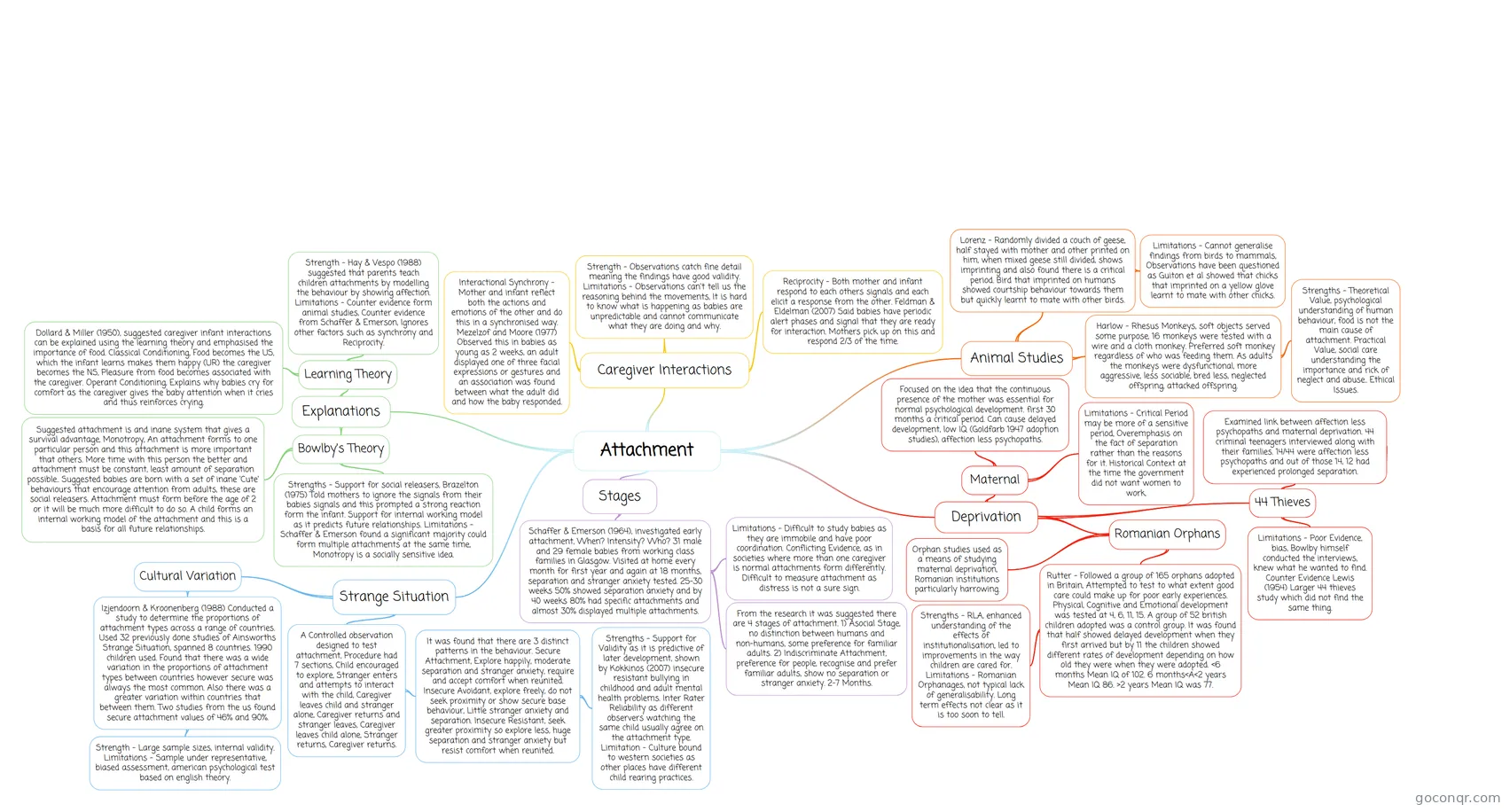
Mind map: Attachment
Inhalt der Mindmap
Attachment
Caregiver Interactions
- Reciprocity - Both mother and infant respond to each others signals and each elicit a response from the other. Feldman & Eldelman (2007) Said babies have periodic alert phases and signal that they are ready for interaction. Mothers pick up on this and respond 2/3 of the time.
- Interactional Synchrony - Mother and infant reflect both the actions and emotions of the other and do this in a synchronised way. Mezelzof and Moore (1977) Observed this in babies as young as 2 weeks, an adult displayed one of three facial expressions or gestures and an association was found between what the adult did and how the baby responded.
- Strength - Observations catch fine detail meaning the findings have good validity. Limitations - Observations can't tell us the reasoning behind the movements, It is hard to know what is happening as babies are unpredictable and cannot communicate what they are doing and why.
Deprivation
- Maternal
- Focused on the idea that the continuous presence of the mother was essential for normal psychological development. first 30 months a critical period. Can cause delayed development, low IQ (Goldfarb 1947 adoption studies), affection less psychopaths.
- Limitations - Critical Period may be more of a sensitive period, Overemphasis on the fact of separation rather than the reasons for it. Historical Context at the time the government did not want women to work.
- Romanian Orphans
- Orphan studies used as a means of studying maternal deprivation, Romanian institutions particularly harrowing.
- Rutter - Followed a group of 165 orphans adopted in Britain, Attempted to test to what extent good care could make up for poor early experiences. Physical, Cognitive and Emotional development was tested at 4, 6, 11, 15. A group of 52 british children adopted was a control group. It was found that half showed delayed development when they first arrived but by 11 the children showed different rates of development depending on how old they were when they were adopted. <6 months Mean IQ of 102. 6 months<A<2 years Mean IQ 86. >2 years Mean IQ was 77.
- Strengths - RLA, enhanced understanding of the effects of institutionalisation, led to improvements in the way children are cared for. Limitations - Romanian Orphanages, not typical lack of generalisability. Long term effects not clear as it is too soon to tell.
- 44 Thieves
- Examined link between affection less psychopaths and maternal deprivation. 44 criminal teenagers interviewed along with their families. 14/44 were affection less psychopaths and out of those 14, 12 had experienced prolonged separation.
- Limitations - Poor Evidence, bias, Bowlby himself conducted the interviews, knew what he wanted to find. Counter Evidence Lewis (1954) Larger 44 thieves study which did not find the same thing.
- Examined link between affection less psychopaths and maternal deprivation. 44 criminal teenagers interviewed along with their families. 14/44 were affection less psychopaths and out of those 14, 12 had experienced prolonged separation.
- Maternal
Stages
- Schaffer & Emerson (1964), investigated early attachment, When? Intensity? Who? 31 male and 29 female babies from working class families in Glasgow. Visited at home every month for first year and again at 18 months, separation and stranger anxiety tested. 25-30 weeks 50% showed separation anxiety and by 40 weeks 80% had specific attachments and almost 30% displayed multiple attachments.
- Limitations - Difficult to study babies as they are immobile and have poor coordination. Conflicting Evidence, as in societies where more than one caregiver is normal attachments form differently. Difficult to measure attachment as distress is not a sure sign.
- From the research it was suggested there are 4 stages of attachment. 1) Asocial Stage, no distinction between humans and non-humans, some preference for familiar adults. 2) Indiscriminate Attachment, preference for people, recognise and prefer familiar adults, show no separation or stranger anxiety. 2-7 Months.
- Schaffer & Emerson (1964), investigated early attachment, When? Intensity? Who? 31 male and 29 female babies from working class families in Glasgow. Visited at home every month for first year and again at 18 months, separation and stranger anxiety tested. 25-30 weeks 50% showed separation anxiety and by 40 weeks 80% had specific attachments and almost 30% displayed multiple attachments.
Explanations
- Learning Theory
- Dollard & Miller (1950), suggested caregiver infant interactions can be explained using the learning theory and emphasised the importance of food. Classical Conditioning, Food becomes the US, which the infant learns makes them happy (UR) the caregiver becomes the NS, Pleasure from food becomes associated with the caregiver. Operant Conditioning, Explains why babies cry for comfort as the caregiver gives the baby attention when it cries and thus reinforces crying.
- Strength - Hay & Vespo (1988) suggested that parents teach children attachments by modelling the behaviour by showing affection. Limitations - Counter evidence form animal studies, Counter evidence from Schaffer & Emerson, Ignores other factors such as synchrony and Reciprocity.
- Bowlby's Theory
- Suggested attachment is and inane system that gives a survival advantage, Monotropy, An attachment forms to one particular person and this attachment is more important that others. More time with this person the better and attachment must be constant, least amount of separation possible.. Suggested babies are born with a set of inane 'Cute' behaviours that encourage attention from adults, these are social releasers. Attachment must form before the age of 2 or it will be much more difficult to do so. A child forms an internal working model of the attachment and this is a basis for all future relationships.
- Strengths - Support for social releasers, Brazelton (1975) Told mothers to ignore the signals from their babies signals and this prompted a strong reaction form the infant. Support for internal working model as it predicts future relationships. Limitations - Schaffer & Emerson found a significant majority could form multiple attachments at the same time, Monotropy is a socially sensitive idea.
- Learning Theory
Strange Situation
- Cultural Variation
- Izjendoorn & Kroonenberg (1988) Conducted a study to determine the proportions of attachment types across a range of countries. Used 32 previously done studies of Ainsworths Strange Situation, spanned 8 countries. 1990 children used. Found that there was a wide variation in the proportions of attachment types between countries however secure was always the most common. Also there was a greater variation within countries that between them. Two studies from the us found secure attachment values of 46% and 90%.
- Strength - Large sample sizes, internal validity. Limitations - Sample under representative, biased assessment, american psychological test based on english theory.
- Izjendoorn & Kroonenberg (1988) Conducted a study to determine the proportions of attachment types across a range of countries. Used 32 previously done studies of Ainsworths Strange Situation, spanned 8 countries. 1990 children used. Found that there was a wide variation in the proportions of attachment types between countries however secure was always the most common. Also there was a greater variation within countries that between them. Two studies from the us found secure attachment values of 46% and 90%.
- A Controlled observation designed to test attachment, Procedure had 7 sections, Child encouraged to explore, Stranger enters and attempts to interact with the child, Caregiver leaves child and stranger alone, Caregiver returns and stranger leaves, Caregiver leaves child alone, Stranger returns, Caregiver returns.
- It was found that there are 3 distinct patterns in the behaviour. Secure Attachment, Explore happily, moderate separation and stranger anxiety, require and accept comfort when reunited. Insecure Avoidant, explore freely, do not seek proximity or show secure base behaviour, Little stranger anxiety and separation. Insecure Resistant, seek greater proximity so explore less, huge separation and stranger anxiety but resist comfort when reunited.
- Strengths - Support for Validity as it is predictive of later development, shown by Kokkinos (2007) insecure resistant bullying in childhood and adult mental health problems. Inter Rater Reliability as different observers watching the same child usually agree on the attachment type. Limitation - Culture bound to western societies as other places have different child rearing practices.
- It was found that there are 3 distinct patterns in the behaviour. Secure Attachment, Explore happily, moderate separation and stranger anxiety, require and accept comfort when reunited. Insecure Avoidant, explore freely, do not seek proximity or show secure base behaviour, Little stranger anxiety and separation. Insecure Resistant, seek greater proximity so explore less, huge separation and stranger anxiety but resist comfort when reunited.
- Cultural Variation
Animal Studies
- Lorenz - Randomly divided a couch of geese, half stayed with mother and other printed on him, when mixed geese still divided, shows imprinting and also found there is a critical period. Bird that imprinted on humans showed courtship behaviour towards them but quickly learnt to mate with other birds.
- Limitations - Cannot generalise findings from birds to mammals, Observations have been questioned as Guiton et al showed that chicks that imprinted on a yellow glove learnt to mate with other chicks.
- Harlow - Rhesus Monkeys, soft objects served some purpose, 16 monkeys were tested with a wire and a cloth monkey. Preferred soft monkey regardless of who was feeding them. As adults the monkeys were dysfunctional, more aggressive, less sociable, bred less, neglected offspring, attacked offspring.
- Strengths - Theoretical Value, psychological understanding of human behaviour, food is not the main cause of attachment. Practical Value, social care understanding the importance and rick of neglect and abuse.. Ethical Issues.
- Lorenz - Randomly divided a couch of geese, half stayed with mother and other printed on him, when mixed geese still divided, shows imprinting and also found there is a critical period. Bird that imprinted on humans showed courtship behaviour towards them but quickly learnt to mate with other birds.
Informationen
- Beschreibung
- A-Level Psychology (Attachments) Mindmap am Attachment, erstellt von Emmie Westley am 09/05/2017.
- Erstellt von
- Emmie Westley
- Aufrufe
- 8
- Verlauf
-
- Erstellt von Emmie Westley · 25 Okt 2016
- Kopiert von Emmie Westley · 25 Okt 2016
- Kopiert von Emmie Westley · 28 Okt 2016
- Kopiert von Emmie Westley · 5 Apr 2017
- Kopiert von Emmie Westley · 8 Mai 2017
- Kopiert von Emmie Westley · 9 Mai 2017
- Bewertung
Mehr zu Attachment and Parenting