
Mindmap
Course of the Third Crusade
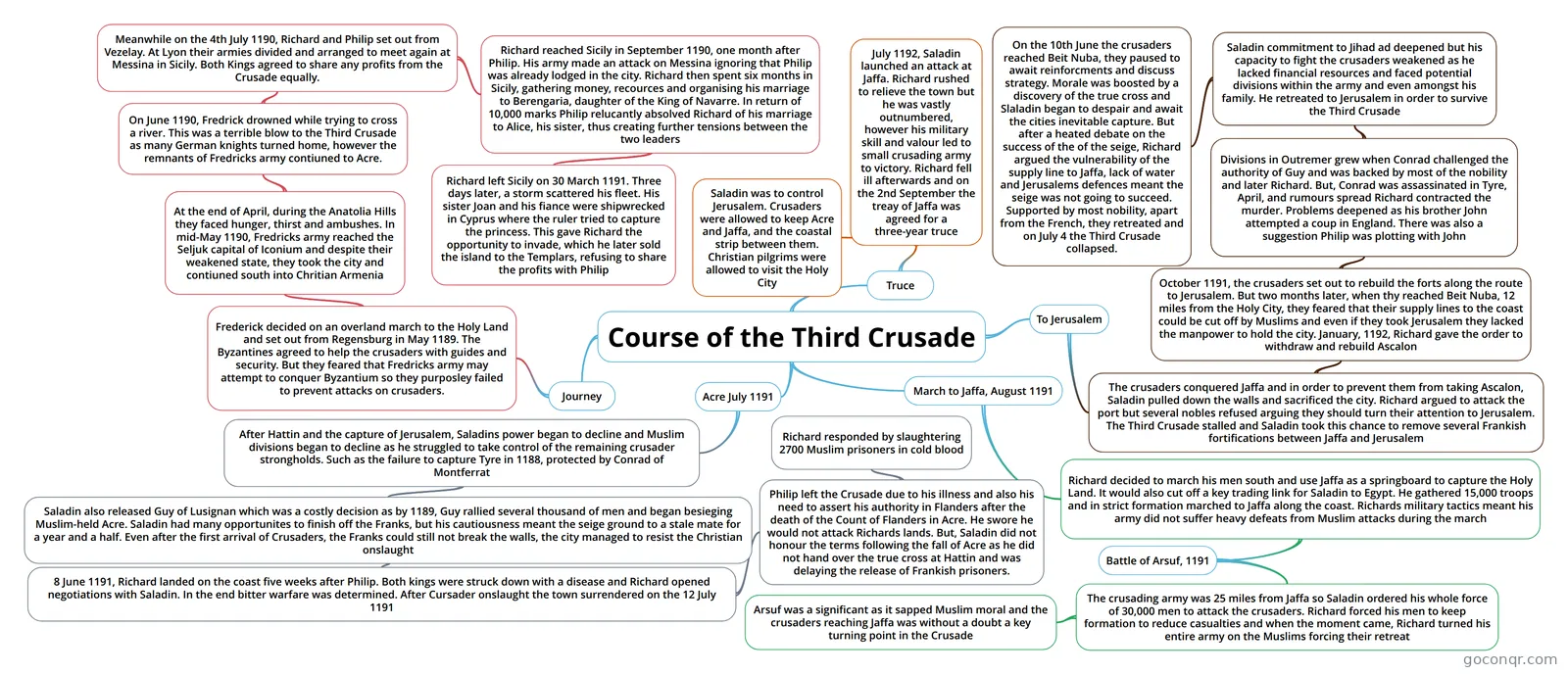
Mind map: Course of the Third Crusade
Inhalt der Mindmap
Course of the Third Crusade
Journey
- Frederick decided on an overland march to the Holy Land and set out from Regensburg in May 1189. The Byzantines agreed to help the crusaders with guides and security. But they feared that Fredricks army may attempt to conquer Byzantium so they purposley failed to prevent attacks on crusaders.
- At the end of April, during the Anatolia Hills they faced hunger, thirst and ambushes. In mid-May 1190, Fredricks army reached the Seljuk capital of Iconium and despite their weakened state, they took the city and contiuned south into Chritian Armenia
- On June 1190, Fredrick drowned while trying to cross a river. This was a terrible blow to the Third Crusade as many German knights turned home, however the remnants of Fredricks army contiuned to Acre.
- Meanwhile on the 4th July 1190, Richard and Philip set out from Vezelay. At Lyon their armies divided and arranged to meet again at Messina in Sicily. Both Kings agreed to share any profits from the Crusade equally.
- Richard reached Sicily in September 1190, one month after Philip. His army made an attack on Messina ignoring that Philip was already lodged in the city. Richard then spent six months in Sicily, gathering money, recources and organising his marriage to Berengaria, daughter of the King of Navarre. In return of 10,000 marks Philip relucantly absolved Richard of his marriage to Alice, his sister, thus creating further tensions between the two leaders
- Richard left Sicily on 30 March 1191. Three days later, a storm scattered his fleet. His sister Joan and his fiance were shipwrecked in Cyprus where the ruler tried to capture the princess. This gave Richard the opportunity to invade, which he later sold the island to the Templars, refusing to share the profits with Philip
- Richard reached Sicily in September 1190, one month after Philip. His army made an attack on Messina ignoring that Philip was already lodged in the city. Richard then spent six months in Sicily, gathering money, recources and organising his marriage to Berengaria, daughter of the King of Navarre. In return of 10,000 marks Philip relucantly absolved Richard of his marriage to Alice, his sister, thus creating further tensions between the two leaders
- Meanwhile on the 4th July 1190, Richard and Philip set out from Vezelay. At Lyon their armies divided and arranged to meet again at Messina in Sicily. Both Kings agreed to share any profits from the Crusade equally.
- On June 1190, Fredrick drowned while trying to cross a river. This was a terrible blow to the Third Crusade as many German knights turned home, however the remnants of Fredricks army contiuned to Acre.
- At the end of April, during the Anatolia Hills they faced hunger, thirst and ambushes. In mid-May 1190, Fredricks army reached the Seljuk capital of Iconium and despite their weakened state, they took the city and contiuned south into Chritian Armenia
- Frederick decided on an overland march to the Holy Land and set out from Regensburg in May 1189. The Byzantines agreed to help the crusaders with guides and security. But they feared that Fredricks army may attempt to conquer Byzantium so they purposley failed to prevent attacks on crusaders.
Acre July 1191
- After Hattin and the capture of Jerusalem, Saladins power began to decline and Muslim divisions began to decline as he struggled to take control of the remaining crusader strongholds. Such as the failure to capture Tyre in 1188, protected by Conrad of Montferrat
- Saladin also released Guy of Lusignan which was a costly decision as by 1189, Guy rallied several thousand of men and began besieging Muslim-held Acre. Saladin had many opportunites to finish off the Franks, but his cautiousness meant the seige ground to a stale mate for a year and a half. Even after the first arrival of Crusaders, the Franks could still not break the walls, the city managed to resist the Christian onslaught
- 8 June 1191, Richard landed on the coast five weeks after Philip. Both kings were struck down with a disease and Richard opened negotiations with Saladin. In the end bitter warfare was determined. After Cursader onslaught the town surrendered on the 12 July 1191
- Philip left the Crusade due to his illness and also his need to assert his authority in Flanders after the death of the Count of Flanders in Acre. He swore he would not attack Richards lands. But, Saladin did not honour the terms following the fall of Acre as he did not hand over the true cross at Hattin and was delaying the release of Frankish prisoners.
- Richard responded by slaughtering 2700 Muslim prisoners in cold blood
- Philip left the Crusade due to his illness and also his need to assert his authority in Flanders after the death of the Count of Flanders in Acre. He swore he would not attack Richards lands. But, Saladin did not honour the terms following the fall of Acre as he did not hand over the true cross at Hattin and was delaying the release of Frankish prisoners.
- 8 June 1191, Richard landed on the coast five weeks after Philip. Both kings were struck down with a disease and Richard opened negotiations with Saladin. In the end bitter warfare was determined. After Cursader onslaught the town surrendered on the 12 July 1191
- Saladin also released Guy of Lusignan which was a costly decision as by 1189, Guy rallied several thousand of men and began besieging Muslim-held Acre. Saladin had many opportunites to finish off the Franks, but his cautiousness meant the seige ground to a stale mate for a year and a half. Even after the first arrival of Crusaders, the Franks could still not break the walls, the city managed to resist the Christian onslaught
- After Hattin and the capture of Jerusalem, Saladins power began to decline and Muslim divisions began to decline as he struggled to take control of the remaining crusader strongholds. Such as the failure to capture Tyre in 1188, protected by Conrad of Montferrat
March to Jaffa, August 1191
- Richard decided to march his men south and use Jaffa as a springboard to capture the Holy Land. It would also cut off a key trading link for Saladin to Egypt. He gathered 15,000 troops and in strict formation marched to Jaffa along the coast. Richards military tactics meant his army did not suffer heavy defeats from Muslim attacks during the march
- Battle of Arsuf, 1191
- The crusading army was 25 miles from Jaffa so Saladin ordered his whole force of 30,000 men to attack the crusaders. Richard forced his men to keep formation to reduce casualties and when the moment came, Richard turned his entire army on the Muslims forcing their retreat
- Arsuf was a significant as it sapped Muslim moral and the crusaders reaching Jaffa was without a doubt a key turning point in the Crusade
- The crusading army was 25 miles from Jaffa so Saladin ordered his whole force of 30,000 men to attack the crusaders. Richard forced his men to keep formation to reduce casualties and when the moment came, Richard turned his entire army on the Muslims forcing their retreat
- Battle of Arsuf, 1191
- Richard decided to march his men south and use Jaffa as a springboard to capture the Holy Land. It would also cut off a key trading link for Saladin to Egypt. He gathered 15,000 troops and in strict formation marched to Jaffa along the coast. Richards military tactics meant his army did not suffer heavy defeats from Muslim attacks during the march
To Jerusalem
- The crusaders conquered Jaffa and in order to prevent them from taking Ascalon, Saladin pulled down the walls and sacrificed the city. Richard argued to attack the port but several nobles refused arguing they should turn their attention to Jerusalem. The Third Crusade stalled and Saladin took this chance to remove several Frankish fortifications between Jaffa and Jerusalem
- October 1191, the crusaders set out to rebuild the forts along the route to Jerusalem. But two months later, when thy reached Beit Nuba, 12 miles from the Holy City, they feared that their supply lines to the coast could be cut off by Muslims and even if they took Jerusalem they lacked the manpower to hold the city. January, 1192, Richard gave the order to withdraw and rebuild Ascalon
- Divisions in Outremer grew when Conrad challenged the authority of Guy and was backed by most of the nobility and later Richard. But, Conrad was assassinated in Tyre, April, and rumours spread Richard contracted the murder. Problems deepened as his brother John attempted a coup in England. There was also a suggestion Philip was plotting with John
- Saladin commitment to Jihad ad deepened but his capacity to fight the crusaders weakened as he lacked financial resources and faced potential divisions within the army and even amongst his family. He retreated to Jerusalem in order to survive the Third Crusade
- On the 10th June the crusaders reached Beit Nuba, they paused to await reinforcments and discuss strategy. Morale was boosted by a discovery of the true cross and Slaladin began to despair and await the cities inevitable capture. But after a heated debate on the success of the of the seige, Richard argued the vulnerability of the supply line to Jaffa, lack of water and Jerusalems defences meant the seige was not going to succeed. Supported by most nobility, apart from the French, they retreated and on July 4 the Third Crusade collapsed.
- Saladin commitment to Jihad ad deepened but his capacity to fight the crusaders weakened as he lacked financial resources and faced potential divisions within the army and even amongst his family. He retreated to Jerusalem in order to survive the Third Crusade
- Divisions in Outremer grew when Conrad challenged the authority of Guy and was backed by most of the nobility and later Richard. But, Conrad was assassinated in Tyre, April, and rumours spread Richard contracted the murder. Problems deepened as his brother John attempted a coup in England. There was also a suggestion Philip was plotting with John
- October 1191, the crusaders set out to rebuild the forts along the route to Jerusalem. But two months later, when thy reached Beit Nuba, 12 miles from the Holy City, they feared that their supply lines to the coast could be cut off by Muslims and even if they took Jerusalem they lacked the manpower to hold the city. January, 1192, Richard gave the order to withdraw and rebuild Ascalon
- The crusaders conquered Jaffa and in order to prevent them from taking Ascalon, Saladin pulled down the walls and sacrificed the city. Richard argued to attack the port but several nobles refused arguing they should turn their attention to Jerusalem. The Third Crusade stalled and Saladin took this chance to remove several Frankish fortifications between Jaffa and Jerusalem
Truce
- July 1192, Saladin launched an attack at Jaffa. Richard rushed to relieve the town but he was vastly outnumbered, however his military skill and valour led to small crusading army to victory. Richard fell ill afterwards and on the 2nd September the treay of Jaffa was agreed for a three-year truce
- Saladin was to control Jerusalem. Crusaders were allowed to keep Acre and Jaffa, and the coastal strip between them. Christian pilgrims were allowed to visit the Holy City
- July 1192, Saladin launched an attack at Jaffa. Richard rushed to relieve the town but he was vastly outnumbered, however his military skill and valour led to small crusading army to victory. Richard fell ill afterwards and on the 2nd September the treay of Jaffa was agreed for a three-year truce
Informationen
- Beschreibung
- AS - Level History Mindmap am Course of the Third Crusade, erstellt von Jake Clarke am 23/05/2017.
- Erstellt von
- Jake Clarke
- Aufrufe
- 2
- Bewertung