
Mindmap
13. Basis of intelligence
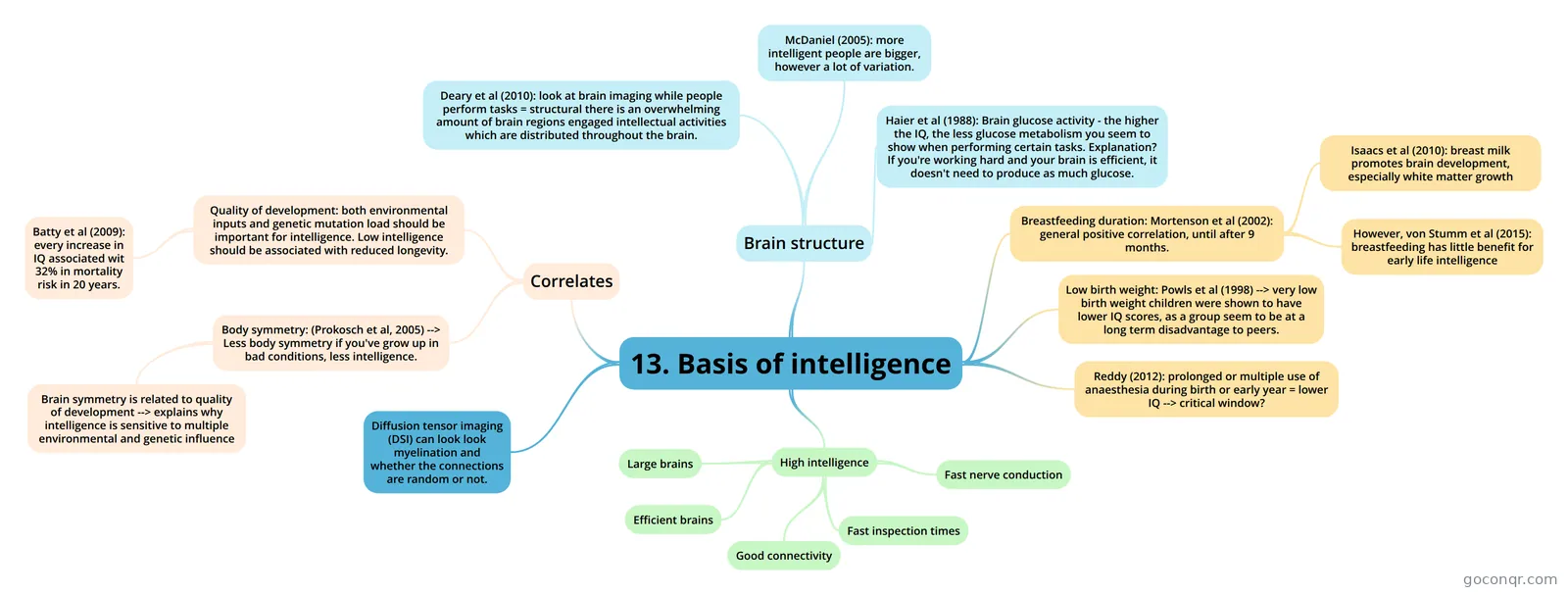
Mind map: Basis of intelligence
Inhalt der Mindmap
13. Basis of intelligence
Brain structure
- Deary et al (2010): look at brain imaging while people perform tasks = structural there is an overwhelming amount of brain regions engaged intellectual activities which are distributed throughout the brain.
- McDaniel (2005): more intelligent people are bigger, however a lot of variation.
- Haier et al (1988): Brain glucose activity - the higher the IQ, the less glucose metabolism you seem to show when performing certain tasks. Explanation? If you're working hard and your brain is efficient, it doesn't need to produce as much glucose.
Diffusion tensor imaging (DSI) can look look myelination and whether the connections are random or not.
High intelligence
- Large brains
- Efficient brains
- Good connectivity
- Fast inspection times
- Fast nerve conduction
Correlates
- Body symmetry: (Prokosch et al, 2005) --> Less body symmetry if you've grow up in bad conditions, less intelligence.
- Brain symmetry is related to quality of development --> explains why intelligence is sensitive to multiple environmental and genetic influence
- Quality of development: both environmental inputs and genetic mutation load should be important for intelligence. Low intelligence should be associated with reduced longevity.
- Batty et al (2009): every increase in IQ associated wit 32% in mortality risk in 20 years.
- Body symmetry: (Prokosch et al, 2005) --> Less body symmetry if you've grow up in bad conditions, less intelligence.
Breastfeeding duration: Mortenson et al (2002): general positive correlation, until after 9 months.
- Isaacs et al (2010): breast milk promotes brain development, especially white matter growth
- However, von Stumm et al (2015): breastfeeding has little benefit for early life intelligence
Low birth weight: Powls et al (1998) --> very low birth weight children were shown to have lower IQ scores, as a group seem to be at a long term disadvantage to peers.
Reddy (2012): prolonged or multiple use of anaesthesia during birth or early year = lower IQ --> critical window?
Informationen
- Beschreibung
- Undergraduate Individual Differences Mindmap am 13. Basis of intelligence, erstellt von Izzy Sharpe am 26/05/2017.
- Erstellt von
- Izzy Sharpe
- Aufrufe
- 0
- Bewertung
Mehr zu Genetic and Environmental Influences on Intelligence